

Paul Schmitz did not set out to build a mobile shower ministry.
He spent years in Christian radio — on air, in programming, management, fundraising and major gifts. That was the career he thought would carry him into retirement.
Then God made a left turn.
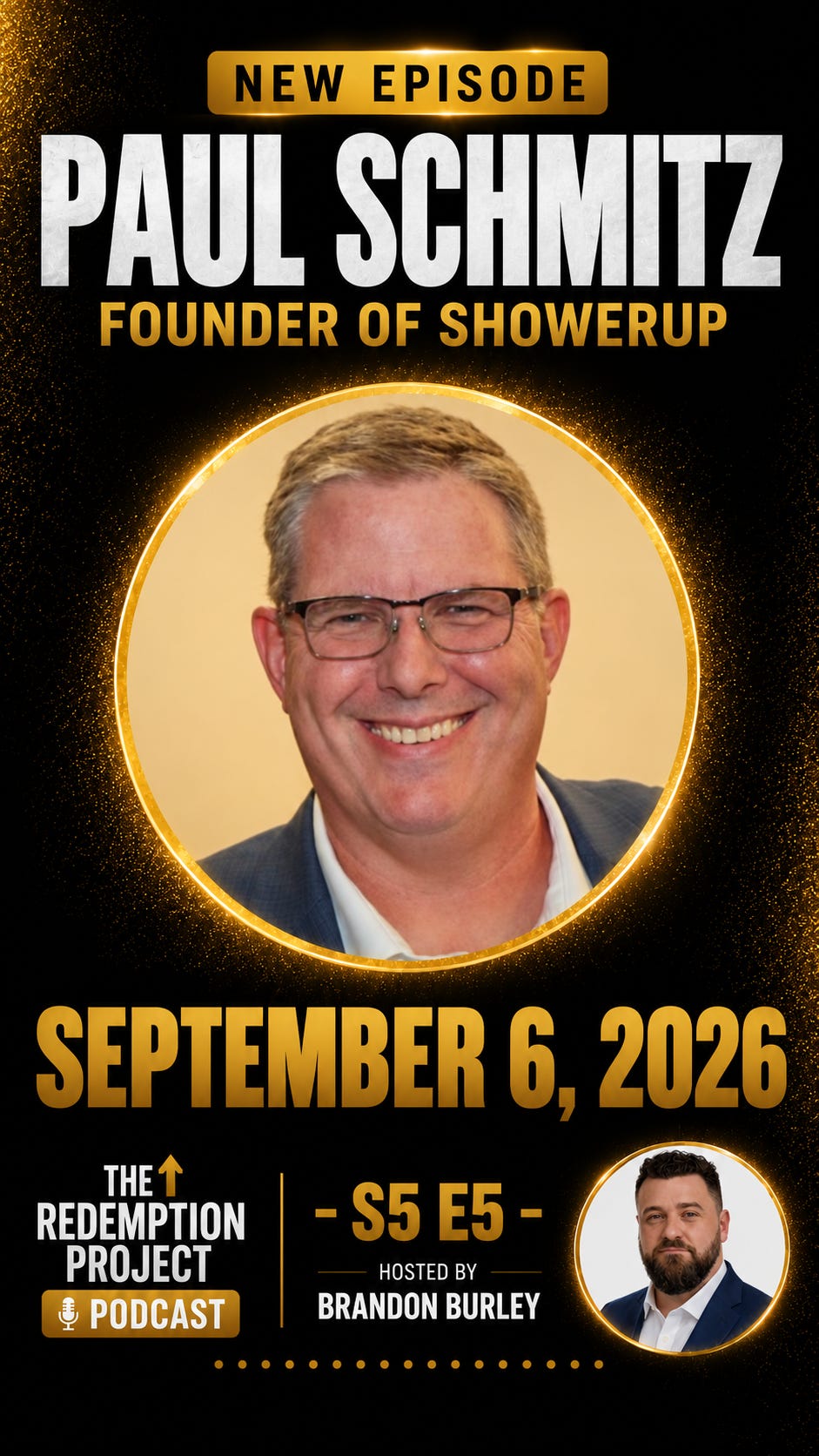
In this Season 5 Good Works episode of The Redemption Project, Brandon Burley talks with Paul Schmitz, founder of ShowerUp, about faith, obedience, homelessness, dignity and the ministry of helping people feel human again.
The story begins before ShowerUp existed.
While living in Kansas, Paul read Crazy Love by Francis Chan. The book pushed him back into Scripture and forced him to think more deeply about God’s love — not only for him, but for the lost, hurting, disenfranchised and marginalized people Scripture repeatedly places near the heart of God.
One night, Paul prayed that if something needed to change, he did not want to do it simply because it seemed like a good idea.
He wanted God to change his heart.
The next day, he told his wife they should go downtown and hand out lunches to people experiencing homelessness.
She was all in.
That simple beginning grew into serving meals to hundreds of people each week. Paul describes moments that felt miraculous, including an Easter chili meal where the food should have run out — but somehow kept being served until everyone in line had eaten.
Later, Christian radio brought Paul and his family to Middle Tennessee.
There, he and his wife began serving with another organization that was already helping the unhoused community. For Paul, the work was never only about food. And later, with ShowerUp, it would never be only about showers or laundry.
It was always about relationship.
That is one of the main themes of this episode.
A meal matters.
A shower matters.
Clean clothes matter.
But the deeper work is letting people know they are seen, known, loved and not invisible.
Then came the moment that changed everything.
Paul was scrolling through social media one morning when he saw a truck with a shower and bathroom in it. He had the passing thought that maybe something like that could serve people experiencing homelessness.
Then he kept scrolling.
But the thought came back.
And then, in a moment Paul describes as unmistakable, he heard the words:
“You’re doing that.”
He said out loud, “No, I’m not.”
Again, the words came:
“You’re doing that.”
Paul said he did not have time.
Then it came a third time.
“You’re doing that.”
Paul connects that moment to the story of Samuel hearing God call him in the night. By the third time, he knew he needed to listen.
So he walked to the other end of the house and told his wife that it was going to sound crazy, but he thought they were supposed to build some kind of mobile shower unit for their friends experiencing homelessness.
She was in from the beginning.
From there, Paul began researching the need. At the time, he says mobile showers for the unhoused were not common. He found only a couple of organizations around the country doing anything like it.
In Nashville, he found roughly 5,000 people experiencing homelessness and fewer than a dozen actual shower heads available to people living on the street.
Not a dozen locations.
A dozen shower heads.
That was the need.
So they began raising money and, in about six weeks, raised around $20,000. Paul bought a box truck and started looking for someone who could help with plumbing, electrical, heating, air conditioning, engineering and design.
He thought of Lee Company, but he did not know anyone there.
A friend connected him with someone. Paul prepared his pitch, walked into the meeting, explained the need, explained the vision and asked for help.
The man looked at him and said:
“We’re in.”
Then came another moment Paul still sees as confirmation.
The man told him that just days before the meeting, a senior vice president at Lee Company had come into his office and said he had a strange dream: the company got a box truck, put showers in it, took it downtown and gave showers to people experiencing homelessness.
Paul had made the appointment before knowing any of that.
For him, that was not coincidence.
That was a clue.
That first box truck became the first ShowerUp unit.
Paul wanted three private shower suites — not stalls. He is intentional about that word. “Stall” sounds like something for cattle. ShowerUp is built around the opposite message.
People are not cattle.
They are guests.
They deserve privacy.
They deserve locking doors.
They deserve hot water.
They deserve space for their belongings.
They deserve a mirror, a sink and a place that feels like theirs, even if only for a few minutes.
Paul explains that the goal was not to move people through a system as quickly as possible.
The goal was to let them know they are loved, cared for and that they matter.
That first unit came together in about three to four months.
Since then, ShowerUp has grown into a ministry serving in multiple cities, including Nashville, Cookeville, Chattanooga, Memphis, Chicago, Wichita, Huntsville, Tampa Bay and St. Pete/Clearwater. Some cities have more than one unit, and ShowerUp has also added mobile laundry.
Paul says ShowerUp has served nearly 100,000 people with clean, private, hot showers.
But the most powerful part of the episode may be what people say afterward.
When Paul asks guests how the shower was, he used to expect answers like “hot,” “good” or “fine.”
Instead, he heard the same answer again and again:
“I feel human again.”
That phrase is the heart of the episode.
People experiencing homelessness often feel invisible, overlooked, shoved aside and unseen. Paul says the work is about helping elevate dignity, ignite hope and demonstrate God’s love.
The ministry does not have to say, “God loves you,” for people to understand it.
The service says it.
The consistency says it.
The relationship says it.
Paul also explains one of the most important lessons of street outreach:
Consistency is currency.
When ShowerUp shows up at the same place, at the same time, week after week, people learn that they can trust them. Consistency becomes reliability. Reliability becomes relationship. Relationship becomes community.
That is why ShowerUp posts schedules online and works alongside other organizations providing meals, clothing, health care, mental health support, pet care, haircuts and other services. ShowerUp does not try to do everything. It works with others so the experience is richer for the guests they serve.
The conversation also moves beyond ShowerUp’s logistics into a broader challenge for listeners.
Paul says people often want to do something but do not know where to start.
His first suggestion is simple:
Acknowledge people.
Smile.
Wave.
Speak a kind word.
Let someone know they are seen.
He is not telling people they must give money. He is not giving a complicated plan. He is saying that one of the first ways to restore dignity is to stop pretending people are invisible.
That is what makes this episode Season 5.
Good work is not always complicated.
Sometimes it is a hot shower.
Sometimes it is clean laundry.
Sometimes it is a haircut.
Sometimes it is a sandwich.
Sometimes it is a smile.
Sometimes it is a person saying, “I see you,” to someone who has spent far too long feeling unseen.
This is a conversation about homelessness, but it is also a conversation about obedience, faith, dignity, compassion and what happens when ordinary people follow the left turn God puts in front of them.
Paul did not plan this.
But he followed it.
And because he did, thousands of people have stepped into a private shower, closed a locking door, stood under hot water and walked out saying:
“I feel human again.”
That is good work.
That is ShowerUp.
And that is why this story matters.
I am a retired detective and criminal justice / government educator based in Tennessee. I founded The Redemption Project, as a place to focus on civics, rebuild non-partisan trust, and provide educational and emotional grace while learning about the news. I also have a column in Knox TN Today. My reporting and commentary have also appeared in other outlets including; Governing, The Arizona Capitol Times, South Florida Sun Sentinel, Police1, among other state and regional outlets.