



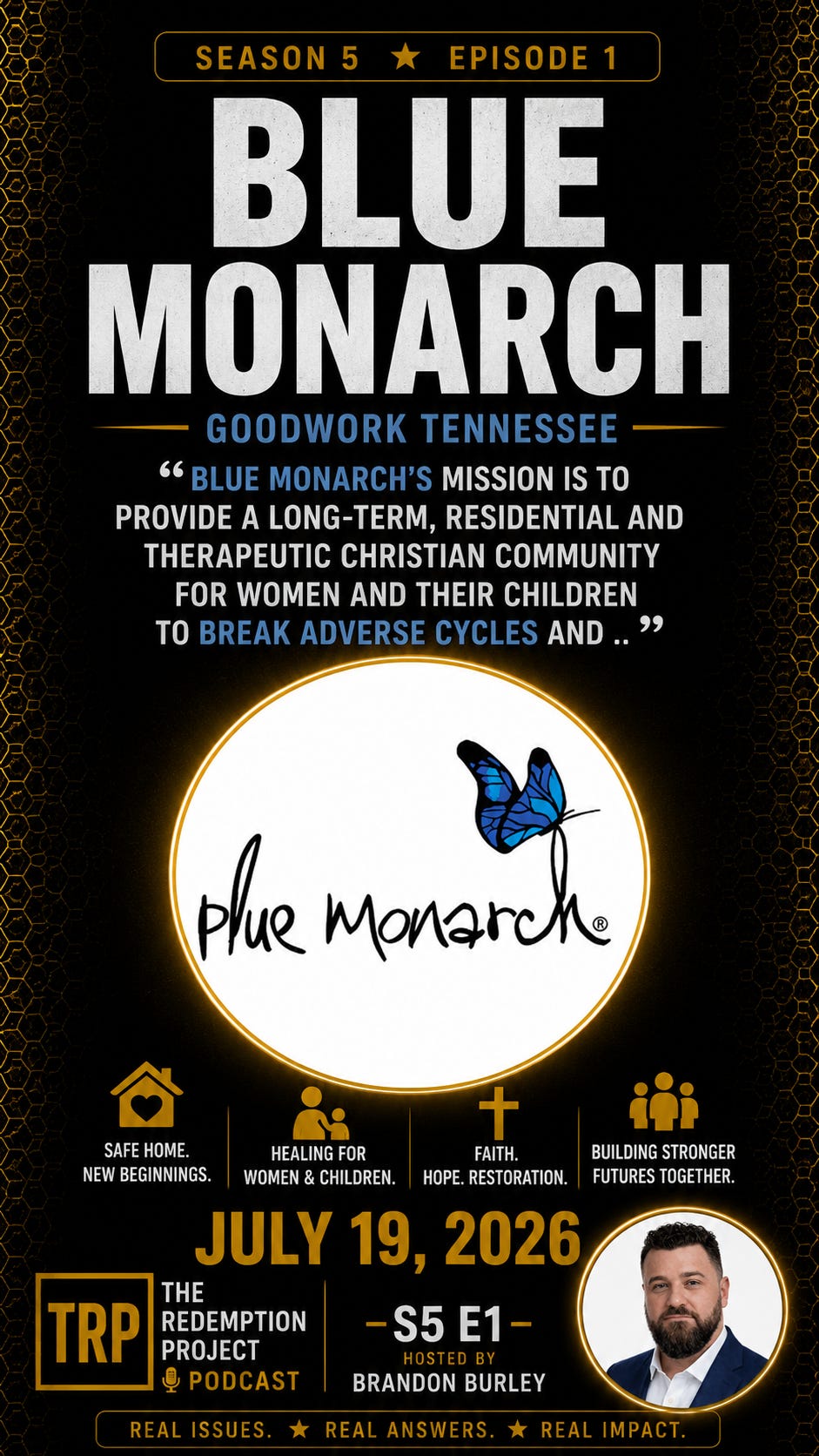
When a mother enters recovery, her children do not simply wait outside the process.
They may have witnessed addiction, instability, incarceration, violence or the removal of a parent from the home. They may also be carrying trauma of their own—sometimes without the words to explain what happened.
Blue Monarch was created around the belief that lasting recovery requires helping the entire family heal.
In the Season 5 premiere of The Redemption Project, Brandon Burley speaks with Shakia, Blue Monarch’s officer of development and community relations—and a graduate of the program herself.
After struggling with opioid addiction for 14 years and cycling through programs that did not provide enough time or support, Shakia reached a breaking point following a near-fatal automobile crash. Her arrival at Blue Monarch began a long recovery process that she says changed not only her life, but the lives of her children.
Blue Monarch is a long-term, faith-based residential program serving mothers and children affected by addiction, abuse and economic hardship. Women may enter with their children or begin the program while working toward restoring custody. The organization places equal emphasis on the mother’s recovery and the child’s healing.
The residential phase lasts approximately 18 to 24 months. During that time, women participate in individualized counseling, group therapy, parenting education, cognitive-behavioral programming, spiritual development and intensive life-skills work. Recovery is treated as their full-time job.
Graduates may then enter WINGS—Women in Newly Grounded Success—a transitional community where families can live in onsite cottages while the mother begins working, pursuing education and building greater independence. A family completing the full continuum may receive nearly three years of structured support.
Brandon and Shakia also discuss Blue Monarch’s relationships with courts, probation officers, the Tennessee Department of Correction and the Department of Children’s Services. Some women arrive after incarceration, while others are referred by judges, caseworkers or community partners.
The organization is now expanding its campus, constructing a multipurpose building and planning additional housing and childcare resources so it can serve more families.
This is not a story about temporarily removing a woman from addiction.
It is about rebuilding the life beneath it—and giving her children the opportunity to grow up without repeating the same cycle.
I am a retired detective and criminal justice / government educator based in Tennessee. I am a commentary write for Tennessee Lookout and a weekly columnist with Knox TN Today. My work examines public policy, public safety systems and civic responsibility. My reporting and commentary have also appeared in Governing, The Arizona Capitol Times, South Florida Sun Sentinel, Police1, among other state and regional outlets.


