

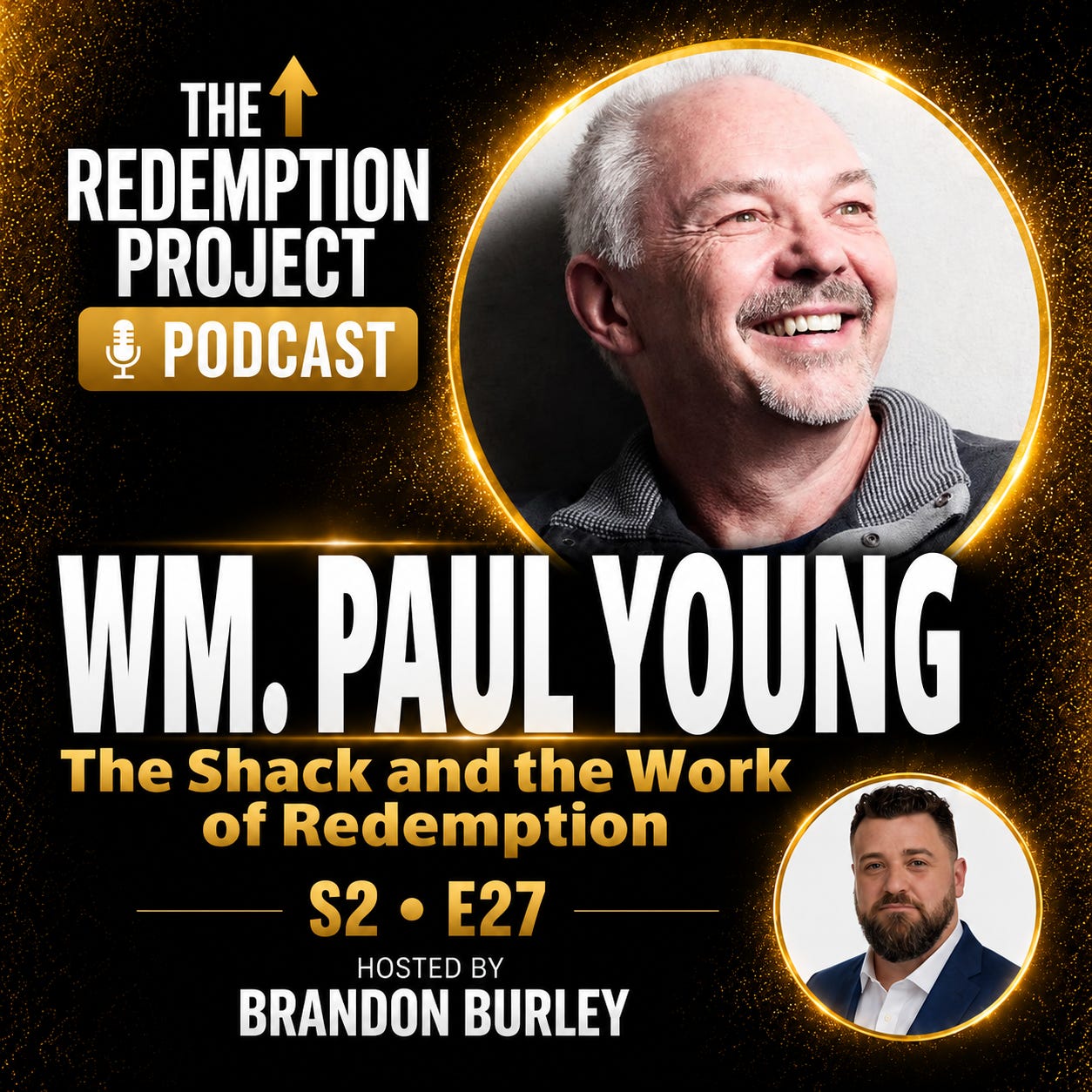
Before The Shack reached strangers, Wm. Paul Young had to face the damage he had caused among the people who knew him best.
In our conversation, he describes a crisis at 38, when his wife, Kim, discovered his affair. He does not present that moment as an instant transformation. He says the work of rebuilding their marriage took 11 years. The book that would change his life came afterward, written as a Christmas gift for his children.
That order matters. The success of a book is not the same thing as the repair of a life.
Paul joined me on The Redemption Project to talk about that repair, the unexpected journey of The Shack, and the questions behind Return to the Shack: A Journey into Redemption. What began with his own history became a conversation about the people we struggle to forgive, the harm we cannot pretend away, and what Christians mean when we talk about redemption.
The person before the author
Young describes growing up as a missionary's child in New Guinea, experiencing abuse, being sent to boarding school, and eventually returning to Canada. He talks about learning to perform for other people: reading their expectations, creating a version of himself that could meet them, and keeping the damaged parts out of view.
In his telling, creativity and intelligence did not automatically make him healthy. They could also help him hide.
Those experiences provide context for his life. They do not make the harm he later caused disappear. Young speaks about his affair, his wife's response, and the long process of facing what he had carried into their marriage. There is no claim here that saying the right words repaired everything. He describes years of work.
He also describes a faith shaped by the distance between the Jesus he trusted and the picture of God the Father he had inherited. Working through that tension became part of his personal rebuilding and, eventually, part of his writing.
A gift that traveled beyond the family
Young says he was working three jobs when he wrote The Shack. One of those jobs was janitorial work. He remembers making 12 copies at Office Depot, giving the book to his children, and handing the extras to friends.
The friends passed it along. Then messages began arriving from people he did not know.
What unsettled him was not simply that strangers liked the story. They were telling him where it had met them in grief, loss, and questions about God. He recalls reaching out to an author he knew because he did not know how to answer those messages.
We talk about the publishing decisions that followed, the book's unexpected reach, and the film adaptation. Young keeps returning to the same distinction: being part of something meaningful is not the same as building an identity around its success.
From The Redemption Project shop · Our own products
Redemption is a conversation worth carrying into everyday life. Explore our faith-inspired apparel, including the Jesus Saves 24/7 Retro Tee.
See the Jesus Saves 24/7 Retro Tee →
Made to order. Shipping calculated at checkout.
When redemption has a face
The conversation turns toward Young's friendships with men on death row at Riverbend Maximum Security Institution in Nashville.
He describes a relationship that began when someone asked him to sign a copy of The Shack for a prisoner. Young wanted to deliver it himself. Over time, those visits became friendships and helped shape the questions he brings to Return to the Shack.
As he describes the sequel, the question is no longer only what a grieving father experiences in an encounter with God. It is what happens when that father must face the person who caused the harm, and when the rest of the family must live with everything that has happened.
That is where words such as justice, mercy, forgiveness, and accountability become harder to keep at a distance. Recognizing someone's humanity does not require pretending the harm was small. Nor does speaking about redemption settle every question about consequences.
For me, that tension reaches back to the beginning of The Redemption Project: listening to people who had been incarcerated and asking about their faith, their decisions, and the lives they were trying to rebuild.
A conversation that leaves the disagreement in
Paul and I do not approach every theological question from the same place. We discuss human nature, sin, salvation, and what it means to be made in the image of God. He challenges ideas I hold as a Calvinist. I explain why those convictions do not remove my commitment to telling redemption stories.
The disagreement remains in the episode. This is a conversation, not a statement that either of us has adopted everything the other believes.
What also remains is the willingness to keep talking. Young asks whether I believe anyone is irredeemable. My answer is no. From there, we discuss why we answer that question as we do and what our answers mean for how we treat people.
We close with prayer, not because all the differences have disappeared, but because a difficult conversation can still end with care for the person across from us.
Listen to the full conversation with Wm. Paul Young. The questions are worth more than a quick answer.
Content note: This conversation includes discussion of childhood sexual abuse, infidelity, incarceration, grief, and strong language.
Recorded: September 1, 2026.
I am a retired detective and criminal justice / government educator based in Tennessee. I founded The Redemption Project, as a place to focus on civics, rebuild non-partisan trust, and provide educational and emotional grace while learning about the news. I also have a column in Knox TN Today. My reporting and commentary have also appeared in other outlets including; Governing, The Arizona Capitol Times, South Florida Sun Sentinel, Police1, among other state and regional outlets.


