

Checkout charity raises hundreds of millions of dollars. The more revealing story is what customers, retailers, nonprofits and intermediaries each get from the transaction — and what happens to the money after the screen disappears.
By Brandon Burley
The Redemption Project Newsroom | Analysis / Systems Explained
The screen appears before the receipt.
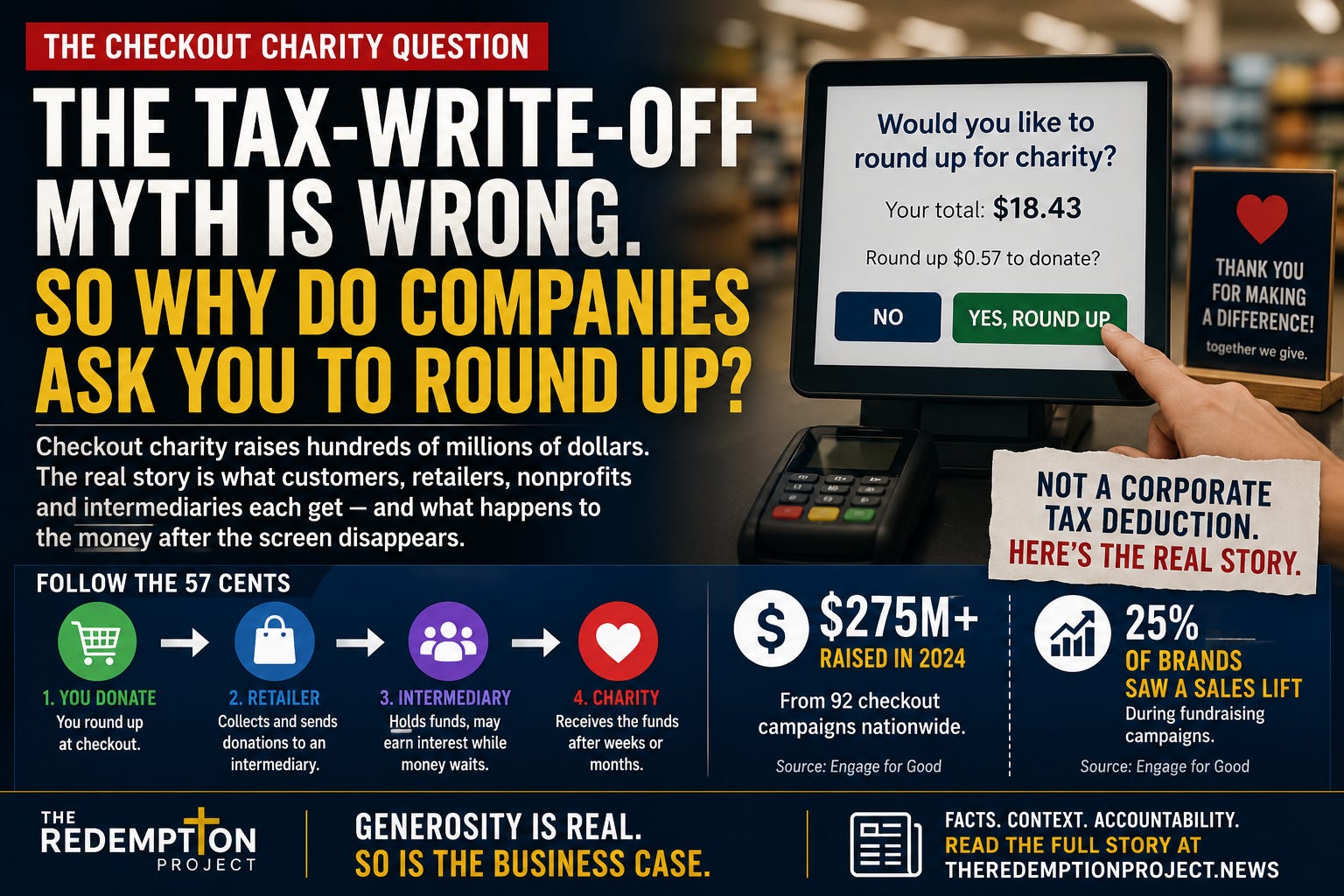
Your total is $18.43, and the register asks whether you would like to round up 57 cents for charity. You tap yes, finish the transaction and leave.
Then comes the accusation that has circulated online for years: The corporation collected your donation so it can claim the charitable tax deduction.
That explanation is appealing because it is simple.
It is also largely aimed at the wrong question.
In the programs examined by The Redemption Project Newsroom, customer donations are treated as customer charitable gifts or donations to a charitable intermediary, not magically converted into corporate donations. Taco Bell Foundation says directly that Round Up contributions are not claimed as income by Taco Bell Corp. or its franchise organizations, while Walmart tells customers their Spark Good Round Up donations are tax-deductible to the extent otherwise allowed by law.
So if corporations are not simply taking your 57 cents and claiming it as their own charitable gift, another question becomes more useful.
Why do some of the largest companies in America devote checkout space, software, employee attention and marketing resources to asking for it?
Because charity and business value can exist in the same transaction.
There is a business case for asking
Checkout giving is not a tiny corner of philanthropy.
Engage for Good examined 92 point-of-sale fundraising campaigns conducted in 2024 and found that they raised more than $275 million. Taco Bell, PetSmart, Walmart and Petco campaigns accounted for more than $190 million of that total.
The report included another finding worth noticing.
Twenty-five percent of participating brands reported a sales lift during fundraising periods. Engage for Good itself described that result as reinforcing the business case for checkout fundraising.
That does not prove asking for a donation causes customers to spend more. It does establish that companies involved in the industry are measuring charitable campaigns partly through business outcomes.
The benefits can be less direct, too.
A retailer can associate its brand with children’s hospitals, food banks, schools or another popular cause. Employees can participate in campaigns, local stores build relationships with community institutions, and nonprofits gain access to a fundraising audience that would be extraordinarily expensive to reach donor by donor.
Costco’s longtime partnership with Children’s Miracle Network Hospitals shows the scale. Its 2024 campaign raised about $40 million through checkout donations, volunteering and other participation. For the hospitals, Costco provides enormous fundraising reach; for Costco, the campaign visibly connects its stores, employees and members with children’s hospitals in their own communities.
Both sides can benefit without either benefit making the charity illegitimate.
Customer generosity can be real. Corporate value can be real. Those statements are not opposites.
Then follow the 57 cents
The transaction becomes more interesting after the customer taps yes.
Consider Walmart’s Spark Good Round Up program. Customers shopping online or in the Walmart app can select an eligible nonprofit or school and round up purchases to support that organization. Walmart uses Deed to verify participating organizations and Network for Good, a charitable donor-advised fund, to distribute customer donations.
That means the structure is not simply:
Customer → Walmart → local nonprofit.
The customer completes the donation, and Walmart says that donation is made to Network for Good. The charitable intermediary then distributes the money to the organization the customer selected. Walmart’s FAQ also says no fee is deducted from the donation amount for participating charities.
Network for Good’s donor materials state that money contributed to its donor-advised fund comes under the fund’s legal control, even when the donor recommends the eventual recipient.
That distinction matters because it identifies who controls the charitable dollar between checkout and delivery.

Walmart’s own pages give two different timelines
Here is where a small transparency issue becomes worth reporting.
Walmart’s current Spark Good FAQ says customer Round Up donations are distributed through Network for Good quarterly, approximately 15 to 20 working days after each quarter ends.
Its current Spark Good Round Up guidelines say something different.
Those guidelines say distributions are made monthly, no more than 30 days after the month in which the customer made the donation.
There may be a routine explanation. One page may reflect a newer procedure while another simply has not been updated.
But both pages were publicly available when TRP reviewed them.
And for anyone asking how long checkout donations remain in the system before reaching the intended charity, monthly versus quarterly is not an insignificant distinction.
A customer can decide to donate in two seconds.
Figuring out exactly when the charity receives the money takes considerably longer.
Does somebody earn interest while the money waits?
This is where one viral theory often turns into another.
If millions of small donations are aggregated before charities receive them, people reasonably ask whether somebody earns interest on the money.
The evidence reviewed by TRP does not support one universal answer.
Taco Bell Foundation provides a useful example. Its financial statements show that Round Up generated approximately $50.5 million in 2024, while the foundation separately reported about $3.7 million in net investment return and ended the year with approximately $80.6 million in net assets.
Those figures do not establish that Taco Bell earned $3.7 million by temporarily holding customers’ spare change.
Taco Bell Foundation is a separate nonprofit organization with accumulated assets, contributions and investments. Its statements do not identify that $3.7 million return as interest generated specifically from Round Up money awaiting distribution.
The distinction is critical.
A charitable foundation earning investment income is not evidence that the retailer operating the cash register is pocketing interest from customer donations.
Panda gives a more direct answer
Panda Cares Foundation provides an unusually transparent example of how investment income can function inside a checkout-charity system.
Its 2024 report lists approximately $34.6 million in in-store donations and about $2.1 million in interest and dividend income. Its IRS filing separately reports roughly $41.4 million in total contributions and $47.7 million in year-end net assets.
But Panda also explains what that investment income does.
The foundation says contributions from Panda Restaurant Group and interest income cover its general and administrative expenses, allowing 100% of in-store donations to go toward its community work.
That is an important answer.
Yes, the charitable institution earns investment income.
No, the evidence does not show Panda Express is pocketing interest from customers’ donations.
Instead, the foundation says that income helps pay the cost of operating the charity so checkout donations can support programs.
That is exactly the kind of disclosure that helps replace suspicion with something measurable.
And another checkout charity reported no investment income at all
Round It Up America provides the counterexample.
The nonprofit reported approximately $9.22 million in contributions for 2024.
Its IRS data reported zero investment income.
That makes a broad claim such as “they all make money from the float” difficult to sustain.
Different programs use different structures.
One corporate foundation may maintain large invested reserves. Another organization may distribute nearly everything it receives. A donor-advised fund may control money between the customer transaction and final grant. A retailer may never receive investment income from the donation at all.
The phrase “round up for charity” describes the prompt.
It does not describe one financial system.
“We raised $50 million” can also hide an important distinction
There is another accountability question that has nothing to do with taxes or interest.
Who actually supplied the money?
Companies frequently announce that “we” raised millions of dollars for charity. That language can be perfectly accurate when describing a campaign involving a company, employees, customers and business partners.
It can also blur the contribution breakdown.
Taco Bell Foundation’s reporting offers a good example of how to make that clearer.
Its 2025 annual report says customers generated a record $52 million through Round Up. Franchise owners contributed about $2.5 million through the Owners’ Giving Circle, foundation champions and sponsors contributed another $2.25 million in monetary and in-kind support, and events involving partners brought in another $3.4 million.
That disclosure tells readers more than a single combined fundraising number would.
It shows who supplied the money.
There is a meaningful difference between a corporation donating $10 million, customers donating $10 million through that corporation’s registers, employees raising $10 million and a company matching customer gifts dollar for dollar.
All can legitimately be called charitable fundraising.
They are not the same financial contribution.
The false claim can distract from the better questions
This is why the popular tax-write-off accusation is ultimately less interesting than the system behind it.
If people spend all their energy asking whether Walmart or Taco Bell stole their 57-cent tax deduction, they may never ask questions that public documents can actually help answer.
Who receives the donation first? Who legally controls it? How long does that organization hold it? Are donations distributed monthly, quarterly or on another schedule? Does the charitable institution earn investment income? What pays the administrative costs? Are processing fees deducted? How much of the announced fundraising total came from customers, and how much came from the company?
And then there is the business side.
Did the campaign increase sales? Does the company measure customer participation? What marketing or community value does the partnership provide? Does the company match any of the money its customers give?
Those questions do not assume wrongdoing.
They assume transparency matters.

So who benefits?
The answer is not one participant.
The charity can benefit enormously from access to millions of customer transactions. Costco’s 2024 campaign alone generated about $40 million for Children’s Miracle Network Hospitals, while Taco Bell’s Round Up generated more than $50 million in 2024.
Customers receive a convenient way to make small gifts.
Retailers can receive reputational, community and customer-engagement value — and at least some brands report sales increases during campaigns.
Financial intermediaries make large-scale digital giving possible, while foundations and nonprofits may maintain reserves, earn investment returns and pay the costs required to operate charitable programs.
None of that makes checkout charity a scam.
It makes checkout charity a system.
And systems deserve better questions than rumors.
The person standing at the register is asked only one:
Would you like to round up?
The more important questions begin after the customer taps yes.
I am a retired detective and criminal justice / government educator based in Tennessee. I am a commentary write for Tennessee Lookout and a weekly columnist with Knox TN Today. My work examines public policy, public safety systems and civic responsibility. My reporting and commentary have also appeared in Governing, The Arizona Capitol Times, South Florida Sun Sentinel, Police1, among other state and regional outlets.