



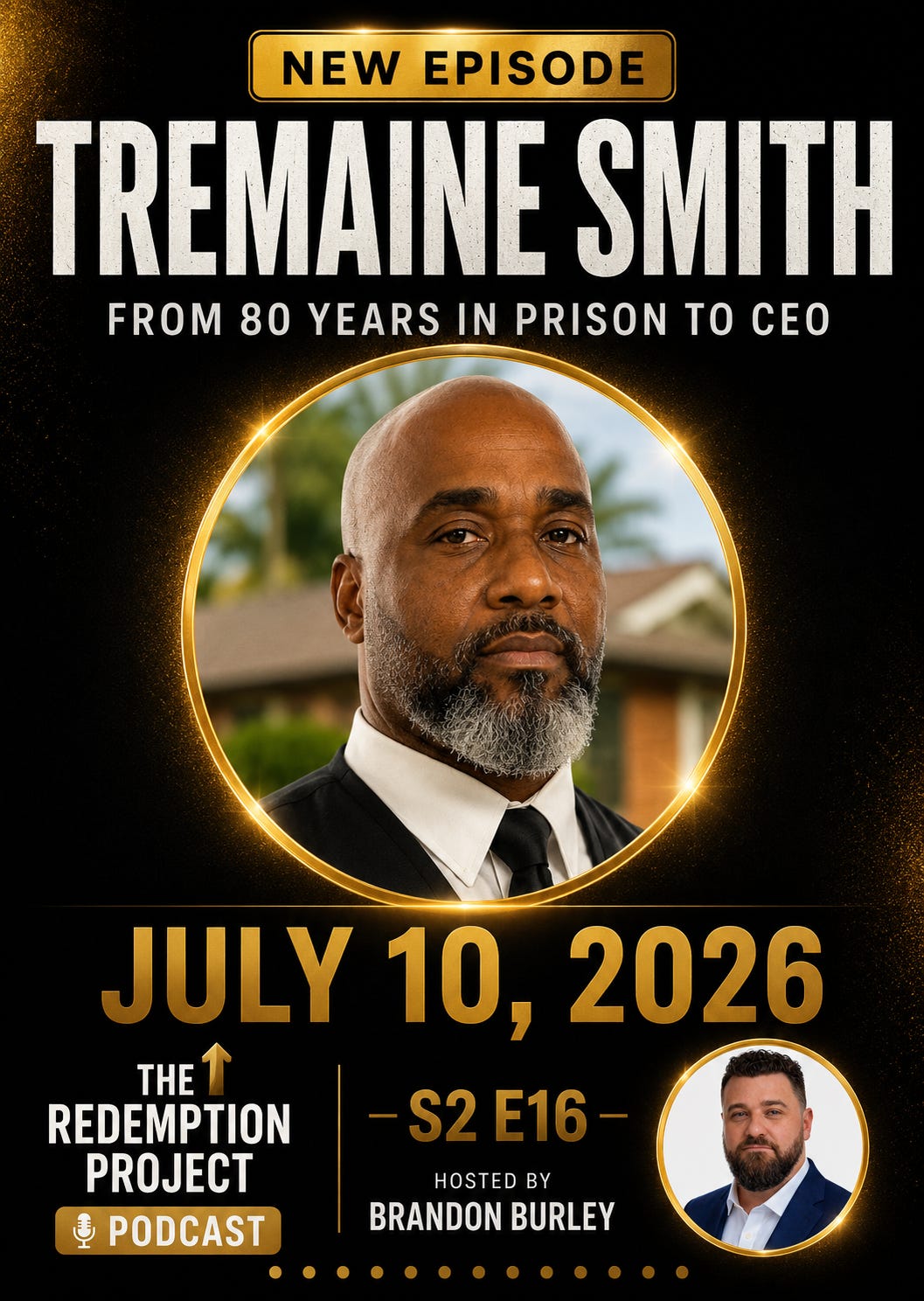
Tremaine Smith was 15 years old when his life changed.
Before that, life had been good.
He was not the kid people expected to end up in prison. He was a straight-A student. He played football. He played basketball. He had popularity in school. He had people who believed in him.
Then came the night that altered everything.
Tremaine went out with a group of guys. A crime happened. He was arrested with them. According to Tremaine, the victim testified that he was there but did not participate.
The prosecutor offered him a deal.
Six months in boot camp.
Two and a half years of probation.
But Tremaine refused to testify.
Maybe it was loyalty.
Maybe it was the street code.
Maybe it was a 15-year-old trying to reason through something he did not yet have the maturity to understand.
He has replayed that decision in his mind more times than he can count.
The result was two 40-year sentences.
At 15 years old, with no prior record, Tremaine was sent into a prison system that would take 31 years of his life.
That is where this redemption story begins.
Not with a man who had everything figured out.
Not with a clean moral lesson tied in a bow.
But with a teenager making a decision that would follow him into adulthood, middle age and every year in between.
Tremaine did not come home on parole.
He reached the end of his sentence.
He earned enough gain time to walk out in 2023, no longer under state supervision, but also no longer in the world he had known as a child.
He went in before the modern internet.
Before smartphones.
Before social media.
Before the world became searchable from a device in your hand.
When Tremaine was incarcerated, cell phones were still large, awkward devices with rubber antennas.
When he came home, the entire world had changed.
That kind of reentry is hard to explain to people who have never experienced it.
It is not just finding a job.
It is not just getting identification.
It is not just learning technology.
It is walking into a world that moved forward for 31 years while your life was measured by count times, chow halls, prison rules, concrete, violence, survival and loss.
Tremaine does not pretend prison was easy.
He talks plainly about the violence. He says he had multiple stabbing cases. He says he caught additional time in prison after nearly killing an officer. He says he became a completely different person behind the wall because, in his words, prison did not allow happiness.
A smile could be seen as weakness.
Joy could be dangerous.
Vulnerability could get a person hurt.
That is one of the painful truths in Tremaine’s story.
Prison did not just take his time.
It trained his emotions for survival.
And survival has a cost.
Even after coming home, Tremaine describes moments when he still goes into what he calls “turtle mode.” When something hurts him or bothers him, he pulls back into himself. He shuts down. He processes inside the shell because, for decades, that was how he survived.
Freedom does not instantly erase prison.
The gate can open in one day.
The habits of survival take longer to unlearn.
But Tremaine did not waste his time inside.
While incarcerated, he became a certified law clerk. He worked in the law library. He learned post-conviction work. He wrote an 11-book series. He began building something in his mind long before he could build it in the world.
When he came home, he started Phoenix Legal Support and Post Conviction Solutions. He began working with attorneys as an independent contractor, especially on post-conviction cases where his lived experience and legal training gave him a unique eye for the record.
He also built True Phoenix Media.
The phoenix matters to Tremaine.
It is not just a logo.
It is the image of a life rising from ashes.
It is second chance language.
It is resilience language.
It is redemption language.
Tremaine’s first book, Remember the Phoenix, follows a character named Corey one week after prison. Corey is fiction, but he is also rooted in Tremaine’s own experience. Through fiction, Tremaine found a way to tell the truth about reentry, survival, memory and starting over.
His next book, Buried Alive, goes back to the beginning — the sentencing, the years lost, the story of a teenager facing two 40-year sentences.
He is also preparing an autobiography called Breaking Chains, where the story is no longer told through a character.
It is Tremaine’s story.
His name.
His life.
His scars.
His survival.
His second chance.
That matters because Tremaine is not only trying to sell books.
He is trying to reach people.
He has already spoken at a youthful offender prison. He wants to do more speaking engagements. He wants to start a foundation. He wants to build a platform that gives incarcerated writers a legitimate path to publish their work, tell their stories and earn money legally.
That last word matters.
Legally.
Tremaine is clear about that because he knows the cost of the other path.
After 31 years in prison, he says he is not giving his freedom back.
Some people from his old life expected him to stay connected in old ways. But when someone asked him to do something illegal after he came home, Tremaine realized he could not keep those ties.
If someone is truly for him, they cannot ask him to risk going back to the place that took most of his life.
That is growth.
That is clarity.
That is a man learning that loyalty cannot require self-destruction.
There are small moments in this episode that say as much as the big ones.
Tremaine talks about opening the refrigerator just because he can.
He talks about sitting outside in the rain just because he is free.
He talks about hugging the woman who waited for him and helped him rebuild. His high school sweetheart had once tried to support him while he was incarcerated, but he cut off communication because he believed it was unfair to ask her to wait on him.
Years later, they reconnected.
Now she is part of his life, his rebuilding and his future.
That does not mean everything is easy.
Tremaine is honest about the scars.
He is honest about nightmares.
He is honest about struggling with vulnerability.
He is honest about trying to become a man in freedom after spending his formative years learning how to survive in prison.
That is what makes his story powerful.
It is not redemption as a slogan.
It is redemption as work.
One step.
One business.
One book.
One conversation.
One honest look at the past.
One choice not to go back.
Tremaine says he never thought he would be here.
Not sitting outside prison.
Not building companies.
Not writing books.
Not speaking to young people.
Not telling his story on a podcast.
But he is here.
And that is the point.
A 15-year-old made a decision that cost him 31 years.
A grown man came home determined not to waste the years he had left.
The ashes were real.
So is the rising.
This is Tremaine Smith’s story.
And this is The Redemption Project.
I am a retired detective and criminal justice / government educator based in Tennessee. I am a commentary write for Tennessee Lookout and a weekly columnist with Knox TN Today. My work examines public policy, public safety systems and civic responsibility. My reporting and commentary have also appeared in Governing, The Arizona Capitol Times, South Florida Sun Sentinel, Police1, among other state and regional outlets.

Episode Themes
Juvenile sentencing
Life after prison
Reentry after long incarceration
Second chances
Redemption after incarceration
Prison survival
Violence behind the wall
Former inmate entrepreneur
Writing after prison
True Phoenix Media
Post-conviction work
Legal support and lived experience
Resilience and reinvention
High school sweetheart after prison
Freedom after 31 years
Trauma after incarceration
Vulnerability and survival
Youthful offender prison outreach
Rising from the ashes


