



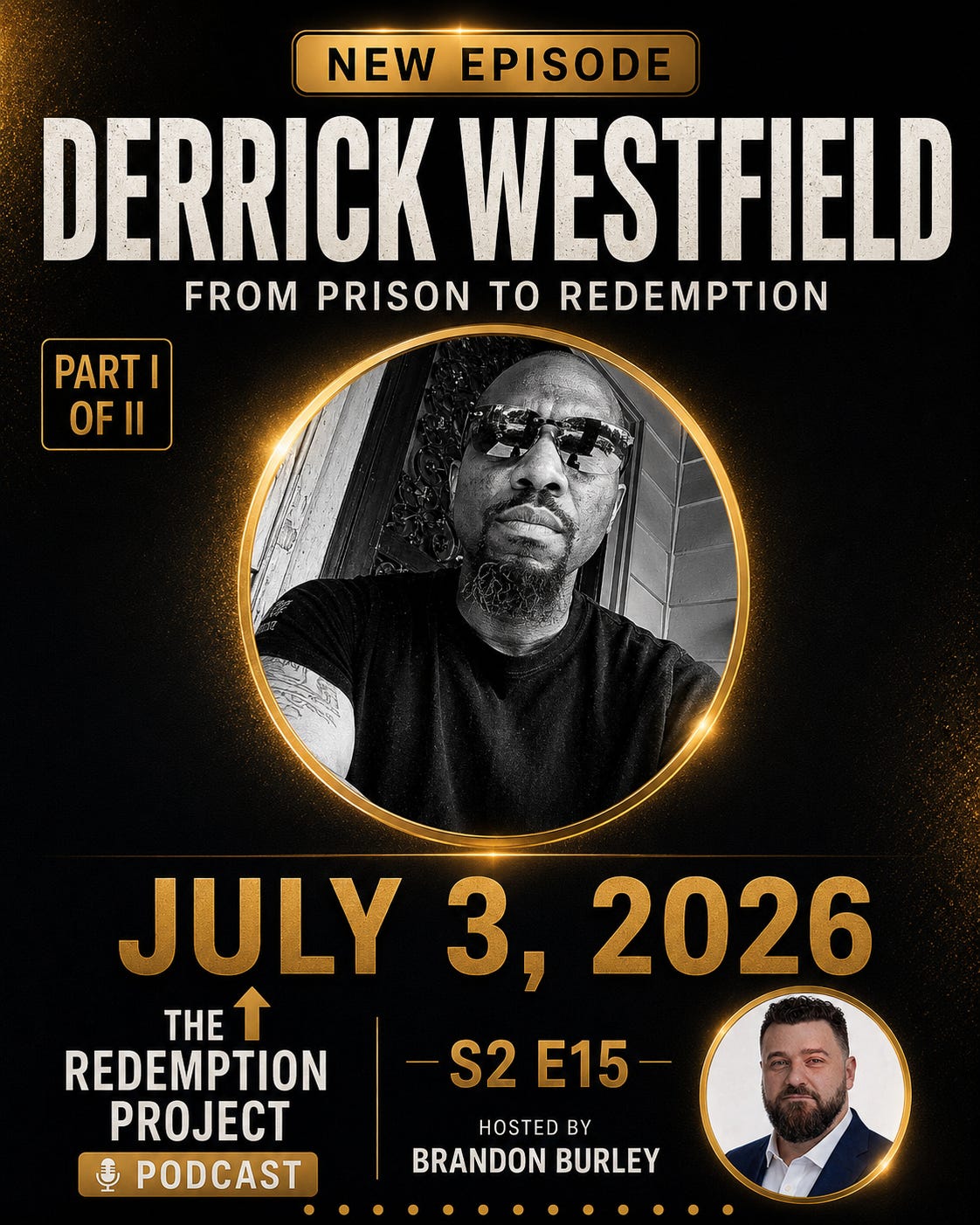
Derrick Westfield did not begin life with the story many people might expect.
He was not raised in a home without both parents.
He did not describe his childhood as a broken home.
His mother and father worked. His family was together. He had a nice childhood.
Then, when Derrick was 12 years old, his father died on his birthday.
That loss changed the shape of the family.
The structure began to loosen. The brothers began moving in different directions. Derrick found himself drawn more and more toward the neighborhood, toward the streets, toward the people and patterns that would eventually help define the next part of his life.
By 16, Derrick was carrying a gun.
Then a drug deal went wrong.
The result was a murder charge, an attempted murder charge and a prison sentence that would follow him for years.
Derrick was sentenced as an adult. He received 22 years for murder and eight years for attempted murder, with the sentences running together. He served 10 years, made parole in 2004, violated parole, returned to prison, got out again, violated again and eventually flattened that original sentence in 2011.
But prison did not immediately transform him.
In those early years, Derrick said prison was not filled with programs, school or structured rehabilitation the way people may imagine today.
“You just did time.”
That is one of the hard truths of this episode.
Prison can punish a person without changing him.
It can separate a man from society without giving him the tools, accountability, discipleship or structure needed to become someone different.
For Derrick, prison also became the place where gang identity became more official. The streets had already shaped him, but prison hardened the identity. He described those years simply: banging, smoking weed and doing time.
But even then, God was not absent.
Derrick can look back now and see moments when the Lord was knocking.
One of those moments came during a Christmas banquet inside the prison. A group from the outside came in. Derrick had a name tag on. Some women recognized his last name because they knew his mother.
One of them took him aside, grabbed his hand and began to pray.
Derrick was not spiritually grounded at that time. He was not walking with the Lord. But something about that prayer stayed with him.
The woman prayed about the love of money.
Later, Derrick opened a small Bible-like booklet and landed on Proverbs 13:11, a verse about wealth gained dishonestly diminishing.
That verse hit him because greed and the love of money were part of the bondage that had helped lead him into the life he was living.
He did not fully change in that moment.
That is important.
Sometimes a seed is planted long before the harvest shows up.
Derrick remembers the prayer more than the messenger. He does not remember the woman’s name. He does not remember her face. But more than two decades later, he remembers what happened when she prayed.
That was not the end of the story.
After Derrick came home, he went back to the life.
Not because he did not know better.
Because the old identity was still there.
The streets were still there.
The money was still there.
The temptation was still there.
And the lie was still there: this time, I can do it smarter.
That lie is not unique to Derrick.
It is one of the oldest traps in the world.
The belief that a person can return to the same destructive pattern but somehow control the ending this time.
Derrick could not.
During one parole violation, he went back to prison and encountered a man who called himself Brother Derrick. The man came in preaching and speaking about a life that lined up directly with Derrick’s own. He walked past other cells, came back to Derrick’s, tapped on the window and began speaking life over him.
Derrick saw that as another moment where God was reaching for him.
He began reading more. He started going to church. He watched sermons. Something was stirring.
But when he got out again, the old life pulled him back.
Then came another violent incident.
During a fight inside a home, Derrick ran through a painted-over glass door and severely cut his arm. He could see the bone. He had severed an artery. Blood was everywhere. When he reached the hospital, a doctor told him he may have had only about 90 seconds left.
Then the doctor told him something Derrick never forgot:
“Just change it.”
Derrick does not remember the doctor’s name.
He does not remember his face.
But he remembers the message.
Just change it.
He was taken from the hospital back to jail and eventually back to prison. This time, something began to deepen. Derrick started reading, writing poetry, journaling and praying. Other men noticed. They began asking questions. They began coming around him. A small Bible study began to form.
But when he got out, he was separated from that spiritual community.
One man told him, “When a banana gets separated from the bunch, it gets peeled.”
That is exactly how Derrick describes what happened.
He came home. He needed a job. He needed to catch up. He felt behind. And instead of staying rooted, he went back to selling drugs.
That led to another arrest.
This time, Derrick faced a new 12-year sentence at 100%.
Before prison, he spent about 10 months in county jail.
That is where the real transformation began.
He was placed in a cell where he could not see the television. He said he did not have a mat for two weeks. He did not have the basic items he expected. He was angry. He was frustrated. He was sitting at the bottom.
Then the breakdown came.
He thought about the time he was facing.
He thought about his daughter, who was still very young.
He thought about his life.
And then the tears came.
For weeks, Derrick said it felt like God was washing him clean. Memories came back. Things he had forgotten came to mind. He began repenting, not casually, but deeply.
He wanted something to read.
He prayed for something to read.
Then a man came through with a cart. He went to other cells. He started to leave. Then he looked around, came upstairs, tapped on Derrick’s window and held up a Bible.
Derrick still has that Bible.
When he opened it, he landed in Romans 8.
For the first time, he said, he understood what he was reading. It was not just words on a page. It was as if the Scripture was being opened to him.
From that moment on, he could not get enough.
He started another Bible group in jail. He prayed with other men. He made prayer lists. He began walking in a different identity.
And when he returned to prison, the first thing he felt God call him to do was let go of the old one.
He denounced the gang.
He told the men who knew him not to call him by that name anymore.
Just call me by my name.
That was not a small thing.
For years, that identity had shaped him. It had given him a place, a name, a code and a role. Letting it go could have made prison harder. It could have put him in danger.
And at one point, it almost did.
Derrick was called to the ballfield by someone with influence. Younger men were nearby. Derrick understood body language. He knew something was off.
But as he began explaining what God had done in his life, the conversation changed.
The man told him the others had been there to get him.
Then he said that was not going to happen.
Instead, he wanted to talk. He wanted to understand how Derrick had gotten free. He wanted to know how to let go.
That is redemption.
Not that the past disappeared.
Not that the harm was erased.
Not that consequences vanished.
But that the identity which once held Derrick began to lose its grip.
In Part I of this conversation, Derrick’s story moves through grief, violence, prison, gang life, parole violations, spiritual encounters, repentance, Romans 8 and the beginning of a new life.
The wound did not get the final word.
The charge did not get the final word.
The gang did not get the final word.
The sentence did not get the final word.
God was writing in places Derrick did not yet know how to read.
And by the time Derrick opened that Bible in a county jail cell, the story he thought was over was only beginning to change.
This is Derrick Westfield’s story.
And this is The Redemption Project.
I am a retired detective and criminal justice / government educator based in Tennessee. I am a commentary write for Tennessee Lookout and a weekly columnist with Knox TN Today. My work examines public policy, public safety systems and civic responsibility. My reporting and commentary have also appeared in Governing, The Arizona Capitol Times, South Florida Sun Sentinel, Police1, among other state and regional outlets.


