


Restaurants, delivery apps, hotels and ticket sellers increasingly add charges called “service,” “operations,” “processing” or “hospitality” fees. The names sound explanatory. Legally and financially, they can describe very different things.
By Brandon L. Burley
Systems Explained
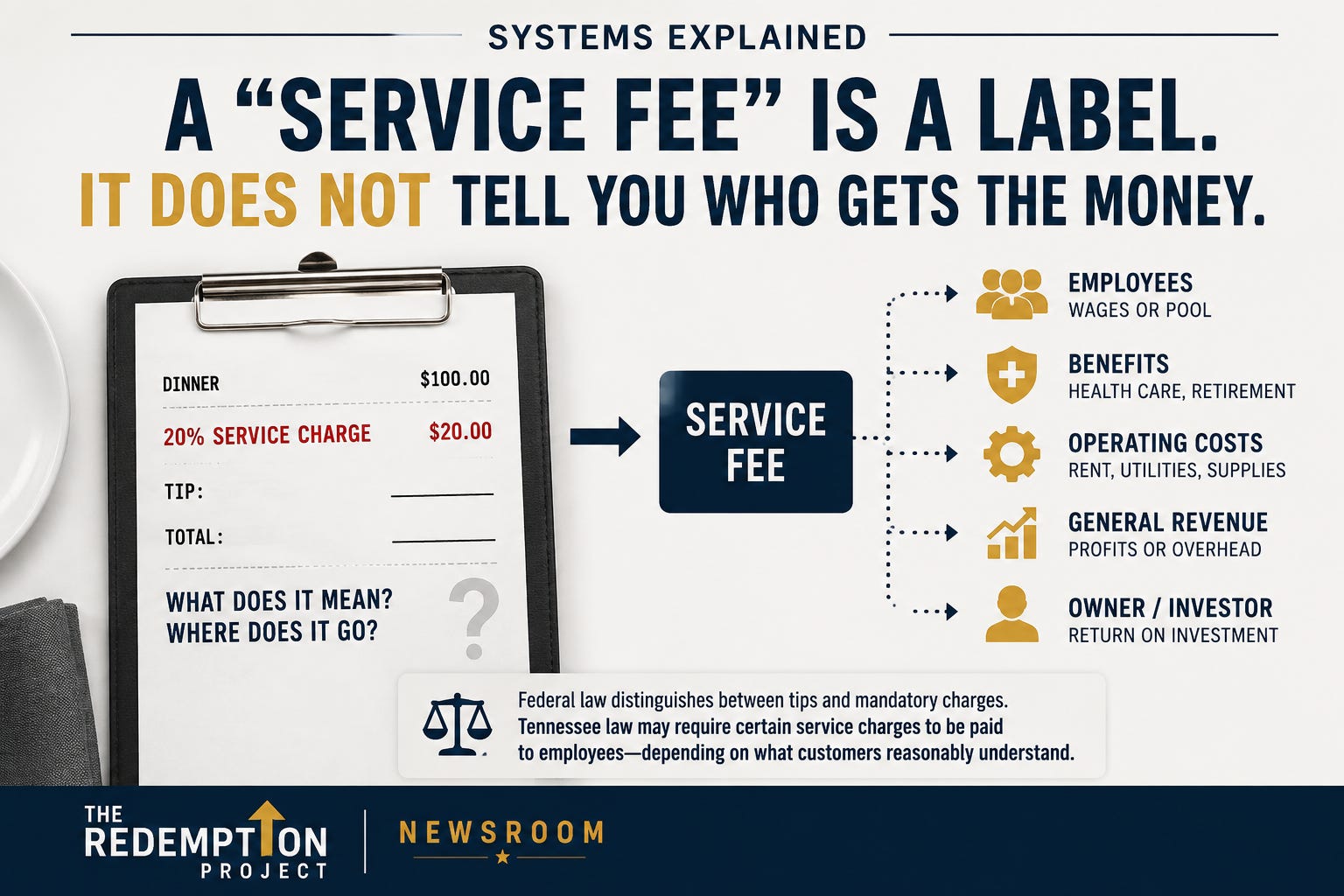
The dinner costs $100.
Then the restaurant adds another line:
20% service charge: $20
Underneath it is another line:
Tip: ______
Now the customer has a surprisingly difficult question.
What did the $20 pay for?
Did it go to the server?
The kitchen?
Higher wages?
Employee health insurance?
General restaurant expenses?
The owner?
Some combination of them?
And if the server already received the $20, is another 20% tip expected?
The words “service charge” seem as though they should answer those questions.
They do not.
A service fee is a label.
It is not an accounting trail.
That distinction becomes important once the same language begins appearing across restaurants, delivery apps, hotels, vacation rentals, tickets and other services — because the money behind those words can travel to very different places.
In Tennessee, the question can become more than confusing.
It can become a matter of law.
Federal law starts with whether the customer had a choice
Federal labor and tax rules draw a basic line between tips and mandatory charges.
A tip is voluntary.
The customer decides whether to leave one and generally controls how much.
A compulsory service charge is different.
The U.S. Department of Labor says a mandatory service charge — its example is 15% automatically added to a bill — is not a tip under the Fair Labor Standards Act. If an employer later distributes that money to employees, it is treated as compensation rather than a voluntary customer tip.
The IRS makes the distinction even clearer.
Mandatory service charges are income to the employer. If the employer distributes some or all of that money to workers, the distributed amount generally becomes wages. Under federal tax rules, an employer may retain some or all of a mandatory service charge unless another law says otherwise.
That gives us the first rule.
If you choose the amount, it may be a tip.
If the business chooses the amount, it is generally a service charge.
But in Tennessee, that is not the end of the analysis.
Tennessee asks what customers would understand the charge to mean
Tennessee Code § 50-2-107 contains another protection.
If a restaurant, bar, private club or similar business automatically places an amount on a customer’s bill as a service charge, tip, gratuity “or otherwise,” and the charge is the kind customarily assumed to be intended for the employees who served the customer, Tennessee law says the money must be paid to or distributed among those employees.
Violations can constitute a Class C misdemeanor.
That creates a much more interesting question than whether the receipt says “service charge.”
What would the customer reasonably understand that particular charge to mean?
A mandatory 20% charge described in a way that resembles a gratuity may present one set of circumstances.
A separately disclosed 5% “employee health benefits fee” may present another.
A 3% “restaurant operations fee” may present another still.
The label matters.
But so does the explanation surrounding it.
And ultimately, so does where the money goes.
Federal law tells us that a compulsory charge is not technically a tip.
Tennessee law tells us that simply calling something a service charge does not necessarily allow a business to ignore what customers customarily understand that money to be for.
Those rules are not necessarily contradictory.
They are answering different questions.
Federal law classifies the payment.
Tennessee law can govern who is entitled to certain mandatory charges.
The same $20 can therefore pass through more than one legal framework before it reaches its final destination.

Now put a tip line underneath it
This is where confusion becomes practical.
Dinner: $100
Service charge: $20
Tip: ______
Total: ______
What is the diner supposed to do?
If the $20 goes directly to the server, leaving another $20 would effectively create a 40% addition to the meal.
If the restaurant keeps the $20 as operating revenue, declining to leave another tip may mean the server receives nothing beyond wages.
If the $20 funds higher hourly wages for the entire staff, the answer becomes different again.
Customers cannot make an informed tipping decision unless they know what the first $20 did.
Washington, D.C., confronted exactly that problem after diners complained about restaurant fees.
The District’s attorney general said consumers were frequently confused about whether mandatory service fees went to workers or were retained by restaurants for expenses such as wages. Officials warned that unclear fee descriptions could affect both ordering and tipping decisions and said restaurants should disclose the fee and its purpose before customers order.
That is a useful consumer test even outside Washington.
The question is not simply whether the business disclosed a fee.
It is whether the disclosure told the customer anything meaningful.
“Service fee” can mean something entirely different one screen later
Leave the restaurant and open a delivery app.
Now “service fee” describes another financial relationship.
Uber Eats tells customers that various fees can apply depending on the order. Its materials distinguish delivery charges from service or marketplace fees and say some service-related fees help operate the Uber platform or cover delivery-related costs.
That money is not automatically a driver tip.
The tip is another line.
Now book a place through Airbnb.
Airbnb also uses the words service fee, but its explanation points to the platform itself: products, customer support and other services required to operate Airbnb.
Same two words.
Different service.
Different recipient.
Different economics.
A restaurant’s service charge may be connected to labor.
A delivery platform’s service fee may help finance the marketplace.
A lodging platform’s service fee may help operate the booking system.
A ticketing service can impose still another combination of service and order-processing charges.
The words themselves do not tell you where the money ends up.
“Service” identifies a category. It does not identify a beneficiary.
Ticket and hotel fees changed federal policy
For years, ticketing and lodging exposed another problem with mandatory fees.
Timing.
A ticket advertised at $50 might ultimately cost considerably more once mandatory charges appeared later in checkout.
A hotel room advertised at $149 could become something else after a mandatory resort or destination fee appeared.
That made comparison shopping harder because consumers were not necessarily comparing final prices.
The federal government eventually intervened.
Since May 12, 2025, the Federal Trade Commission’s Rule on Unfair or Deceptive Fees has required businesses selling live-event tickets and short-term lodging to display the total mandatory price upfront when they advertise a price.
The rule covers live-event tickets, hotels, motels, vacation rentals and other covered short-term lodging.
But the rule did something narrower than the phrase “junk-fee rule” sometimes suggests.
It did not ban fees.
It did not set a maximum resort fee.
It did not determine what a ticket service charge should cost.
Businesses can still itemize mandatory charges.
The rule primarily requires covered sellers to lead with the total mandatory price rather than revealing unavoidable fees later. It also prohibits misleading representations about fees, including material claims about what a fee is for.
That distinction matters.
The government did not say:
You cannot charge the fee.
It said, in effect:
Do not make the customer discover the real mandatory price after choosing the product.
Restaurants sit outside that specific federal rule
The FTC’s industry-specific upfront-pricing rule covers live-event tickets and short-term lodging.
It does not impose that same rule on every restaurant, salon, delivery service, private event, car rental, technology platform or consumer service in the country. Other deceptive fee practices can still implicate consumer-protection law, but they are not all governed by this particular all-in pricing rule.
That leaves an interesting divide.
A hotel customer now has a federal rule designed to make the unavoidable lodging price easier to see upfront.
So does a concert-ticket buyer.
The restaurant customer staring at a 20% service charge may have a different question entirely.
Not:
How much is the fee?
But:
What did I actually buy with it?

The name can change what customers do
This is one reason fee terminology deserves more scrutiny than a simple price calculation.
Words create expectations.
“Gratuity included” tells the diner something.
“20% service charge” is less clear.
“Employee benefits fee” suggests a purpose.
“Kitchen appreciation fee” suggests a recipient.
“Hospitality charge.”
“Operations fee.”
“Administrative fee.”
“Technology fee.”
Those phrases do not merely describe money.
They influence what consumers believe has already been paid for.
That matters especially in restaurants because the customer may be deciding whether to compensate another human being.
A diner who believes a 20% service charge went to the server may reasonably reduce the voluntary tip.
If the restaurant kept the charge for another purpose, the server could feel the consequence of a misunderstanding created several lines higher on the receipt.
That is why disclosure of the purpose, not merely the existence, of a fee matters.
A fee can also make the advertised price look smaller
Imagine two restaurants.
Restaurant A:
Burger: $20
Restaurant B:
Burger: $18
Restaurant B then imposes an unavoidable 11% operating fee.
The minimum prices are nearly identical.
But the customer comparing menus initially saw $18 versus $20.
That is the competitive consequence of separating unavoidable costs from the advertised price.
The fee does not only change what the customer pays.
It changes what the customer thought they were comparing.
For hotels and live-event tickets, the FTC’s rule now addresses that problem by generally requiring the advertised total price to include mandatory fees that can be calculated upfront.
For many other transactions, the customer may still have to do the arithmetic.
None of this means added fees are automatically illegitimate
That conclusion would be too simple.
Businesses have costs.
Labor costs money.
Insurance costs money.
Payment processing costs money.
Software costs money.
Delivery networks cost money.
Customer support costs money.
A business can increase its base price to cover those expenses.
Or it can separate some of those costs into another charge.
Economically, the final amount could be identical.
There can also be legitimate reasons to show customers why prices are changing. A restaurant may want diners to understand that a particular charge supports employee health benefits or higher wages rather than simply increasing every menu price without explanation.
Transparency can add information.
Poorly designed fees can subtract it.
That is the distinction.
A statement such as:
5% employee health-benefits fee used to help fund employee health coverage
tells the customer something that a higher entrée price would not.
A line reading:
5% service fee
may tell the customer almost nothing.
Follow one $20 charge
Return to the $100 restaurant check.
Mandatory service charge: $20.
Where can that money go?
It may be distributed to the workers who served the table.
It may become wages paid to a broader group of employees.
Some mandatory charges in some jurisdictions may be retained partly or entirely by the business.
A specifically described fee may finance employee benefits or other operating expenses.
Which arrangement is lawful can depend on the wording, circumstances and applicable federal, state or local law.
That is precisely why the receipt cannot be treated as the final answer.
The receipt tells us the business collected $20.
It does not necessarily tell us who received $20.
This can become an investigation built from receipts
That makes the next reporting step unusually tangible.
Collect the receipts.
Restaurant receipts across Tennessee.
Delivery orders.
Hotel bookings.
Event tickets.
Catering contracts.
Tourist attractions.
Online platforms.
For every mandatory additional charge, record the same information:
What was the advertised price?
What was the final mandatory price?
What was the fee called?
How much was it?
When did the customer first learn about it?
Was the charge optional?
Was a separate gratuity requested?
What explanation did the business provide?
Was sales tax applied to the fee?
Then ask the businesses the question the receipt cannot answer.
Where did the money go?
For restaurants:
How much of the service charge was distributed to employees?
Which employees?
Was any retained by the business?
Did management receive any portion?
Does the fee fund wages or benefits?
Did it replace an increase in menu prices?
How much did the restaurant collect through the fee last year?
Why was that particular name chosen?
For online platforms:
What does the fee finance?
Is any part passed to the worker performing the service?
How is it different from a delivery, booking or processing fee?
How much is retained by the platform?
Now the fees become comparable.
Not by rhetoric.
By money flow.
The real price is one question. The destination is another.
The national debate over mandatory fees has largely focused on price transparency.
That makes sense.
Customers should know the minimum amount they must pay before they make a purchasing decision.
But service fees create another transparency problem that all-in pricing alone does not solve.
Suppose the menu clearly says:
Dinner: $100
Mandatory service charge: $20
Minimum total before tax: $120
The customer now knows the actual price.
One problem is solved.
The customer may still have no idea what the $20 is for.
That is a separate question.
Price transparency asks:
How much must I pay?
Fee transparency asks:
Why am I paying it, and where does it go?
Those are not the same thing.
Follow the dollar
The $100 dinner becomes $120.
Perhaps tax follows.
Perhaps another voluntary tip follows that.
Nothing about the final amount, standing alone, proves the customer was mistreated.
The business may have disclosed every dollar.
The charge may be lawful.
The money may support employees.
It may support operations.
It may finance the platform through which the purchase was made.
But when a business separates part of its price and gives that money a name, the name creates an expectation.
“Tip.”
“Delivery.”
“Processing.”
“Employee benefits.”
“Service.”
If the label is going to explain why the customer is paying more, it should actually explain something.
Because the smallest question about a 20% service fee is how much it costs.
The better question is where it goes.
A fee tells you what left your wallet.
Following the dollar tells you whose wallet it entered.
I am a retired detective and criminal justice / government educator based in Tennessee. I am a commentary write for Tennessee Lookout and a weekly columnist with Knox TN Today. My work examines public policy, public safety systems and civic responsibility. My reporting and commentary have also appeared in Governing, The Arizona Capitol Times, South Florida Sun Sentinel, Police1, among other state and regional outlets.