


The Redemption Project Newsroom
San Francisco police did not give federal or out-of-state agencies direct access to the city’s Flock license plate reader system.
The agencies did not hack the network.
They did not steal an officer’s password.
They did not exploit a software malfunction.
They still searched San Francisco’s data nearly 300 times
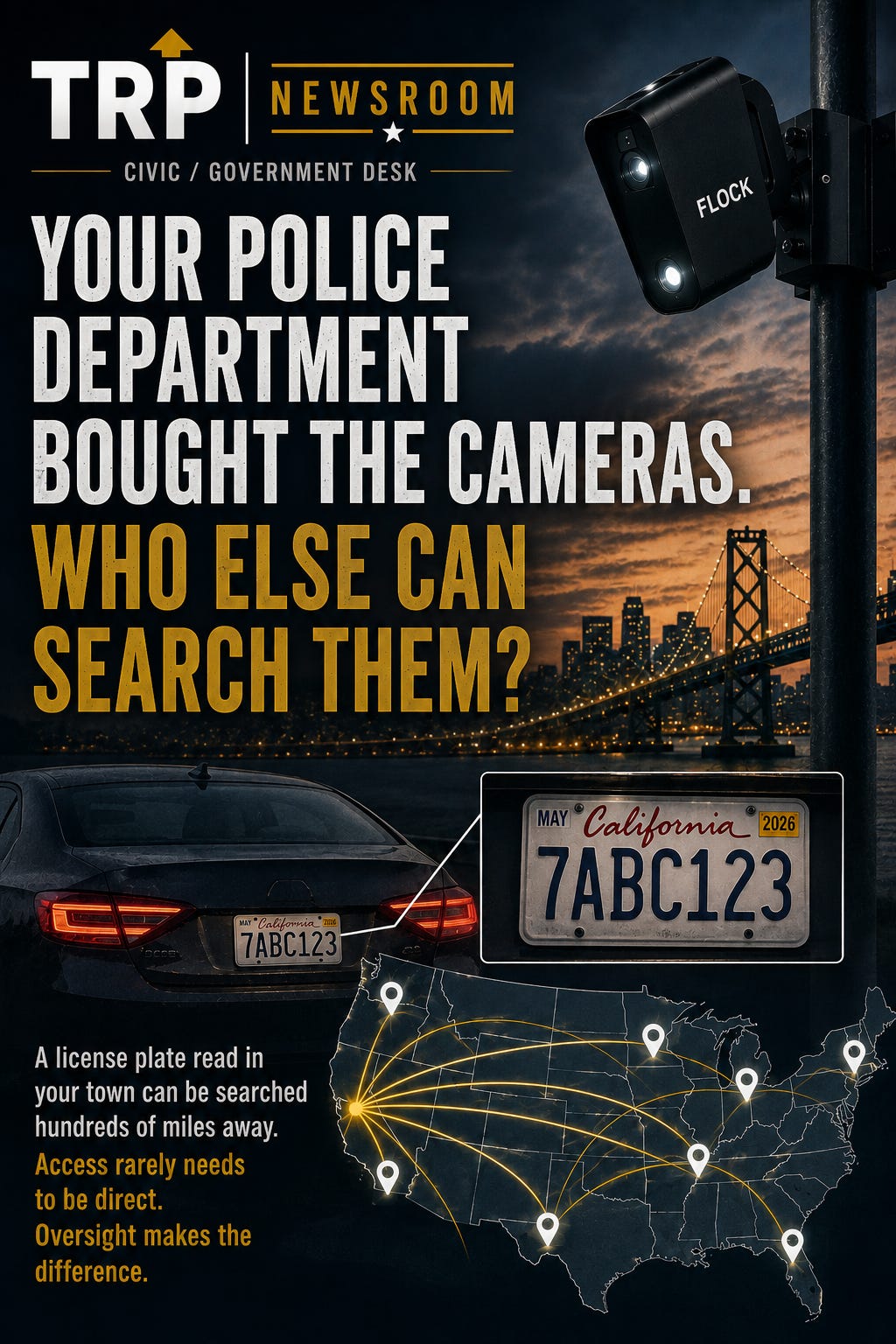
A police audit released in June 2026 found that analysts working through two regional information-sharing organizations had conducted 299 improper searches on behalf of federal and out-of-state agencies. The outside agencies included the Drug Enforcement Administration, Internal Revenue Service, Bureau of Alcohol, Tobacco, Firearms and Explosives, and state agencies in Oregon and Washington.
Those agencies were not authorized under California law to search San Francisco’s automated license plate reader data.
But a regional intelligence center was.
That distinction sits at the center of the third article in this series.
The most important question is not always whether an outside agency has direct access to a community’s cameras.
It is whether someone who does have access can search the cameras on that agency’s behalf.
Sharing is part of what makes the system useful
As the first article in this series explained, Flock license plate readers create searchable records showing when and where vehicles were observed.
A single police department can search its own cameras.
The system becomes more powerful when departments combine their reach.
A vehicle connected to a kidnapping may leave one city, cross several counties and enter another state. A burglary crew may strike multiple jurisdictions. A missing person may pass through a camera network hundreds of miles from home.
An agency limited to its own city boundaries may lose the vehicle.
A connected network may find it.
That is not an accidental feature of Flock’s system.
It is one of its primary selling points.
Flock says customers own the data collected by their cameras and control whether that data is shared. According to the company, an agency can limit searches to its own cameras, establish one-to-one sharing relationships, share within a geographic radius or state, or participate in a broader National Lookup network.
National Lookup allows participating agencies to search a complete, known license plate across cameras whose owners also have opted into the network.
That collaboration can be valuable.
It also means a camera purchased by one town may become part of an investigative network extending far beyond that town.
There is more than one kind of access
Public discussions about license plate reader sharing often treat access as a simple yes-or-no question.
Does another agency have access?
The better answer may require several questions.


