
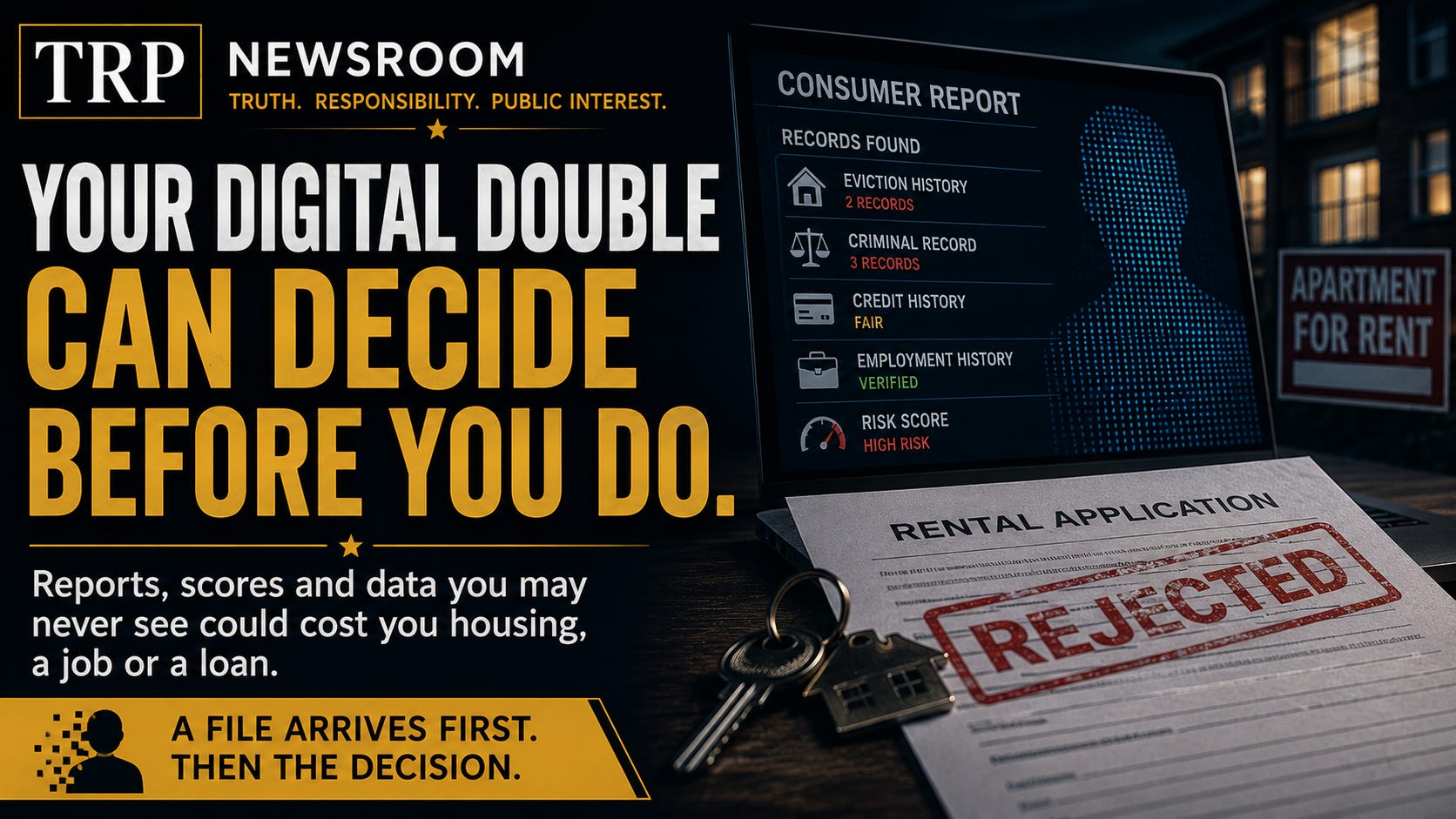
You apply for the apartment, job or loan. But before anyone decides, another version of you may already be in the room — assembled from records, histories, scores and data you may never have seen.
You apply for an apartment.
Your income is stable.
You fill out the application.
Pay the fee.
Wait.
Then the answer comes back.
No.
Or maybe the apartment is still available, but the security deposit is suddenly higher.
You ask why.
That may be the first time you learn that someone else entered the room before you did.
Not another applicant.
A report.
In July 2026, the Federal Trade Commission announced that tenant-screening company RentGrow would pay $2.25 million to settle allegations that it violated federal consumer-reporting law.
Among the allegations was something remarkably simple.
RentGrow reports could include duplicate records — multiple entries involving the same criminal case or eviction action — creating the false appearance that an applicant had more criminal convictions or eviction cases than was actually true.
Think about the consequence.
The database does not merely contain an error.
The error can reach the landlord.
The landlord can make a decision.
And suddenly a bad record has become a housing problem.
That is the larger issue.
We talk constantly about companies collecting information about us.
The more consequential question may be what happens when that information starts helping other people decide what happens to us.
Your credit report is only the beginning
Most Americans know Equifax, Experian and TransUnion.
The consumer-reporting system extends much further.
The Consumer Financial Protection Bureau maintains a list of specialty reporting companies involved in areas including tenant screening, employment screening, checking-account histories, insurance and other consumer decisions.
There may therefore be information capable of affecting an important decision about your life held by a company whose name you have never heard.
That creates what I think of as a digital double.
Not because the file is a complete copy of you.
It is not.
The problem is almost the opposite.
It is incomplete.
A credit history.
An eviction record.
Employment verification.
A criminal-history search.
Previous bank-account problems.
A driving record.
A risk score.
Pieces.
Under the right circumstances, those pieces can reach a decision-maker before the human being they supposedly describe gets any chance to provide context.
The file arrives first.
A record is not the same thing as a judgment
This distinction matters.
A record says something happened.
A score or recommendation goes further.
It tries to say what that history means.
Tenant-screening reports may include credit information, eviction history, rental-payment information, identity verification, income or employment information and criminal-background data.
“An eviction case was filed” is information.
“This applicant presents unacceptable rental risk” is a judgment.
A human being may ultimately make the decision.
But the information has already helped frame the person being judged.
Once information is compressed into a score, recommendation or risk category, nuance becomes harder to see.
Why was the eviction filed?
Was it dismissed?
Does the criminal record belong to the same person?
Was the account the result of identity theft?
Is the information outdated?
Was there context the database never received?
A file can be technically impressive and still be incomplete.
No database contains the full measure of a person.
Wrong data can become a real-world consequence
That is what makes the RentGrow case important.
The FTC allegations went beyond typographical mistakes.
The agency alleged that duplicate criminal and eviction records could give landlords an exaggerated picture of applicants’ histories and that RentGrow failed to maintain reasonable procedures designed to assure maximum possible accuracy.
Federal law recognizes the stakes.
When information from a tenant-screening report leads to a rental denial or less favorable terms, such as a larger security deposit, landlords generally must provide an adverse-action notice identifying the reporting company and explaining certain consumer rights.
But notice the sequence.
You need housing.
You apply.
The report arrives.
The decision happens.
Then you may discover the report exists.
You can meet your digital double only after it has already introduced itself.
Jobs can work differently — but the file still matters
Employment screening provides another example.
When an employer uses a covered consumer report for employment purposes, federal law generally gives the applicant additional protections before certain adverse employment decisions become final.
That can include receiving a copy of the report and a summary of rights, giving the applicant an opportunity to identify errors in information being used against them.
The principle is simple.
If information is powerful enough to cost someone an opportunity, accuracy matters.
So does the chance to respond.
Technology can make screening faster.
It can process more applicants.
It may make some decisions more consistent.
But scale works in both directions.
A human being can make an unfair decision about one applicant.
A flawed system can repeat the same mistake thousands of times.
Efficiency magnifies whatever is inside the system — including the error.
Prediction is not knowledge
There is another temptation surrounding scores and algorithmic systems.
Numbers feel objective.
Scores feel precise.
Predictions can arrive with decimals.
That can make them feel more certain than they are.
But prediction is not knowledge.
Imagine a model that accurately identifies that people sharing a collection of characteristics are more likely, on average, to miss loan payments.
That may make the model valuable to a lender.
The model can still be wrong about you.
A prediction describes probability.
A human life happens one person at a time.
That does not make statistical models useless.
Banks have legitimate reasons to measure credit risk.
Landlords have legitimate reasons to evaluate applicants.
Employers have legitimate reasons to verify backgrounds.
Financial institutions have legitimate reasons to detect fraud.
The mistake is treating useful prediction as infallible judgment.
A model can be good at describing a group and still be wrong about the person standing in front of it.
Human versus machine is the wrong argument
It would be comforting to conclude that human judgment is better.
History does not support that.
Humans discriminate.
Humans use stereotypes.
Humans misunderstand people.
Humans play favorites.
Humans make inconsistent decisions.
Automation can reduce some of those problems.
It can also reproduce others at a scale no individual decision-maker ever could.
So the better question is not:
Should a human decide or should a computer decide?
It is:
Who is accountable for the decision?
If a landlord relies on a screening report, responsibility does not disappear.
If an employer purchases background information from a vendor, responsibility does not disappear.
If a lender uses a complicated scoring model, responsibility does not disappear.
Technology can assist judgment.
It should not become a place where responsibility goes to hide.
A trustworthy system must be able to correct itself
For decades, technology has been optimized for speed.
Faster approvals.
Faster screening.
Faster fraud detection.
Faster underwriting.
A different measure matters just as much.
How quickly can the system correct itself?
If information is wrong, can you see it?
Can you learn where it came from?
Can you dispute it?
Will someone actually investigate?
Can a human reconsider a decision when the file and the person do not match?
Federal consumer-reporting law already gives people rights to obtain many reports and challenge inaccurate information, and the CFPB encourages consumers to review relevant specialty reports around major events such as seeking housing or employment.
Most people carefully maintain the version of themselves they expect others to see.
The résumé.
The application.
The references.
The interview.
The explanation.
But another reputation can develop alongside it.
The machine-readable one.
You may not have written it.
You may not know which companies maintain parts of it.
And you may not see it until somebody uses it.
Knowing has become doing
That is where this issue changes the larger privacy conversation.
First, information is collected.
Then it is assembled.
Eventually, somebody uses it.
That final stage changes the stakes.
Privacy asks who knows something about you.
Decision systems ask what that knowledge is allowed to do.
Can it affect housing?
Employment?
Credit?
Insurance?
Access to a bank account?
At that point, the discussion is no longer simply about being watched.
Information has entered the distribution of opportunity.
That requires a different set of questions.
Was the information accurate?
Was it relevant?
Who supplied it?
Who interpreted it?
Can the person see it?
Can the person challenge it?
Who remains responsible when the system gets it wrong?
Those questions will become more important as decision-making becomes more automated.
Which version gets believed?
Somewhere today, someone will apply for an apartment.
They will tell the truth about their income.
Their job.
Their history.
Who they are.
A report may tell another version.
Sometimes that version will be accurate.
Sometimes it will identify a legitimate risk the applicant would rather a landlord, employer or lender not see.
Accountability does not require pretending accurate negative information should disappear.
But sometimes the file will be incomplete.
Sometimes context will be missing.
And sometimes, as federal regulators alleged in the RentGrow case, the report itself can be wrong.
A database is not character.
A score is not worth.
A prediction is not destiny.
They are tools.
Very powerful ones.
And when society allows those tools to help distribute housing, employment and credit, the important question is not whether we should stop using data.
It is whether the person described by the data still has a meaningful way to be heard.
Because the digital version may get there first.
The real question is whether it gets the final word.
I am a retired detective and criminal justice / government educator based in Tennessee. I founded The Redemption Project, as a place to focus on civics, rebuild non-partisan trust, and provide educational and emotional grace while learning about the news. I also have a column in Knox TN Today. My reporting and commentary have also appeared in other outlets including; Governing, The Arizona Capitol Times, South Florida Sun Sentinel, Police1, among other state and regional outlets.


