


By Brandon Burley · Friday Book Review
A surprising amount of modern church discussion begins with the wrong person.
Do I like the music? Did the sermon hold my attention? Did I feel something? Was the service relevant? Would I invite someone back?
Adriel Sanchez begins somewhere else.
What has God called his church to do when it gathers before him?
That question changes nearly everything.
In Why We Worship, Sanchez makes a thoroughly biblical and recognizably Reformed argument that corporate worship is not primarily a religious experience Christians manufacture for themselves. God summons his people. God speaks. God exposes sin. God announces forgiveness. God feeds his people. God blesses them and sends them back into the world.
The worshiper responds. That order matters.
God calls the meeting
Sanchez structures the book around an arresting image: when the church gathers for worship, Christians are ascending Mount Zion into the heavenly assembly described in Scripture.
The physical building may be ordinary. The congregation may meet in a cathedral, storefront, school auditorium or parking lot. Those are circumstances.
Sanchez carefully distinguishes those circumstances from the elements of worship itself. Scripture gives the church the enduring substance: the reading and preaching of the Word, prayer, singing, the sacraments and the fellowship of God’s people.
That distinction will sound familiar to readers shaped by historic Reformed worship. It should.
One of Calvinism’s great corrections to the church was the insistence that God determines how he is to be worshiped. Worship is not a blank canvas on which clergy display creativity or congregations project their preferences.
Sanchez does not spend much time labeling this the regulative principle of worship, but much of the book operates within its logic.
The church is not authorized to reinvent worship every generation simply because the culture has changed.
The church needs more than inspiration
One of Sanchez’s strongest critiques is aimed at the domestication of worship.
Modern churches can become so concerned with creating an accessible experience that transcendence becomes awkward.
Sin becomes uncomfortable. Confession feels negative. The sermon becomes advice. Communion becomes occasional. Music is expected to create the encounter with God.
The service gradually becomes something the congregation produces rather than something God uses to minister to his people.
A Calvinistic theology should immediately recognize the problem.
Human beings do not naturally ascend toward God through sufficiently moving music or religious enthusiasm. Fallen people require God to act. That is why the ordinary means of grace matter.
Sanchez repeatedly returns the reader to something contemporary evangelicalism can easily forget: God’s promises do not depend upon our emotional intensity.
The Word remains God’s Word when the preacher is unimpressive. The Supper remains Christ’s gift when the recipient does not have an overwhelming experience. Prayer remains worship when it feels ordinary.
The efficacy of worship ultimately rests upon God’s promise and the Spirit’s work, not the congregation’s ability to manufacture a religious atmosphere. That is one of the book’s greatest strengths.
Confession belongs in Christian worship
Sanchez’s chapter on confession is especially strong. He draws directly on Calvin and the Reformers to recover public confession as an ordinary part of Christian worship.
That is not because Christians need to be repeatedly re-justified. It is because Christians who have been justified still sin.
The church therefore comes before God neither pretending innocence nor despairing of mercy.
The pattern is profoundly Reformed:
God’s law exposes us.
We confess.
The gospel answers.
That rhythm protects the church from two opposite errors.
One is moralism: God accepts us because we have performed adequately. The other is therapeutic Christianity: our primary problem is that we do not feel sufficiently affirmed.
Reformed Christianity says something considerably more serious and considerably more hopeful. We are sinners. Christ is sufficient. Sanchez understands that.
The sermon is not a religious TED Talk
His treatment of preaching is similarly helpful.
The preacher is not simply giving thoughts about God. Faithful preaching places the congregation underneath God’s Word. That creates both authority and limitation.
A minister possesses no authority to invent revelation. His authority exists precisely to the extent that he faithfully proclaims what God has already spoken.
Sanchez also handles the traditional Reformed distinction between law and gospel well.
The law reveals God’s righteousness and exposes sin. The gospel announces what Christ has accomplished for sinners who cannot save themselves.
Confuse those two voices and preaching becomes distorted. Law without gospel crushes. Gospel emptied of God’s law becomes sentimentality. Faithful preaching needs both.
Communion is more than remembering information
The Lord’s Supper is where Sanchez will probably challenge some contemporary evangelicals most directly.
He refuses to reduce Communion to a mental exercise in remembering a historical event. Neither does he move into Roman Catholic transubstantiation. His position is much closer to classical Reformed sacramental theology.
Christ is truly given to believers in the Supper, not physically or through a change in the substance of bread and wine, but through the mysterious ministry of the Holy Spirit.
The believer participates in Christ. The Supper is therefore not an empty symbol. It is a sign and means through which God strengthens faith.
Calvin would recognize the concern. So would the Reformed confessions.
This is an important corrective for churches that have unintentionally moved the experiential center of worship away from Word and sacrament and placed it almost entirely in music.
A congregation may sing magnificently and still possess a thin theology of worship.
Where a Reformed reader may hesitate
There are places where Sanchez’s catholic breadth occasionally creates less precision than a stricter confessional Reformed reader might prefer.
He draws appreciatively from Eastern Orthodox, Roman Catholic, Anglican, Lutheran, patristic and Reformed sources. Much of that historical retrieval is illuminating.
But not every practice that appears early or broadly in church history is therefore warranted for Christian worship.
At times the book’s language about priests, altars, Eucharist and absolution sounds more catholic than Presbyterian, even though Sanchez generally explains those concepts in ways compatible with Protestant theology.
I would have welcomed an even clearer distinction between historical evidence and biblical authority.
The church fathers can tell us what Christians did. Only Scripture finally establishes what the church must do. That difference matters.
Likewise, Sanchez distinguishes the scriptural elements of worship from changing circumstances, but a more sustained treatment of the regulative principle itself would have strengthened an already Reformed argument.
The chapter on the universal priesthood also uses the phrase ministerial priesthood for ordained clergy. Sanchez explicitly denies that every baptized Christian is thereby an ordained pastor and clearly affirms Christ as the great High Priest, but historic Presbyterians and many Reformed Baptists will understandably prefer the language of minister, elder or pastor because Christ’s once-for-all priestly sacrifice leaves no continuing sacrificial priesthood in the new covenant.
Those are qualifications. They are not reasons to dismiss the book.
Worship forms us because God meets us
The larger achievement of Why We Worship is that Sanchez refuses to make worship fundamentally about us.
The congregation does not gather primarily to express itself. It gathers because God has called a people out of darkness and into Christ.
Those people come carrying real guilt, weakness, distraction, suffering and doubt.
God answers them with his Word. He calls them to repentance. He reminds them of Christ. He nourishes their faith. He blesses them.
Then he sends them back into ordinary life to love their neighbors, bear witness to Christ and live as a royal priesthood.
That sequence keeps grace ahead of obedience. It should.
The Christian does not worship in order to make God gracious. The Christian worships because the God revealed in Jesus Christ has already shown himself gracious to sinners.
For Reformed Christians, that may be the most important point in the book.
Church is not a weekly attempt to climb high enough to reach God. In Christ, God has already come down for us.
And every Lord’s Day, through the ordinary means he has appointed, he gathers his people again.
Recommendation: Strongly recommended, particularly for pastors, worship leaders and Christians formed by contemporary evangelical worship culture. Confessionally Reformed readers will find much to affirm, while occasionally wanting sharper Protestant boundaries around some of the broader catholic terminology.
Disclosure: IVP provided a digital review copy. The opinions in this review are my own.
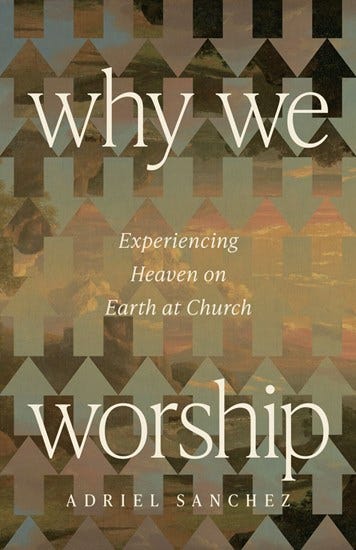
The book: Why We Worship: Experiencing Heaven on Earth at Church by Adriel Sanchez. InterVarsity Press.
Buy from IVP or choose a retailer.
Advertisement · From Brandon Burley / Project Forge Books
Keep Scripture at the center of your next read. Explore my book Walking Through the Word: One Story. One Savior. One Faithful God. See the current format, price and availability before ordering.
View Walking Through the Word on Amazon
A promotion for my own book, separate from this independent review.
