



The announced agreement could eventually give U.S. interests a major stake in 17 Venezuelan oil fields. Getting from oil in the ground to cheaper gasoline in Tennessee, however, requires several steps that have not happened yet.
By Brandon Burley
NASHVILLE, Tenn. — President Donald Trump says the United States has entered into what he calls the largest oil agreement in history, a deal involving 17 Venezuelan oil fields and potentially tens of billions of barrels of crude.
For Tennessee drivers looking at gas prices, the important word is not oil. It is eventually.
The agreement described Friday could become consequential for global energy markets. According to The Associated Press, Venezuela’s government says the 17 fields have a “proven potential” of 65 billion barrels and could attract $100 billion in investment. A U.S. official told AP that an unnamed private operator would partner with the United States in a new company with 100-year development rights, while the United States would receive a 55% effective share of output through an ownership stake and rights to purchase oil at cost.
Those are extraordinary numbers.
They are not the same thing as additional gasoline arriving at a Tennessee station.
At the bottom of this and all articles, you will find the behind the scenes to better understand how this information was gathered.
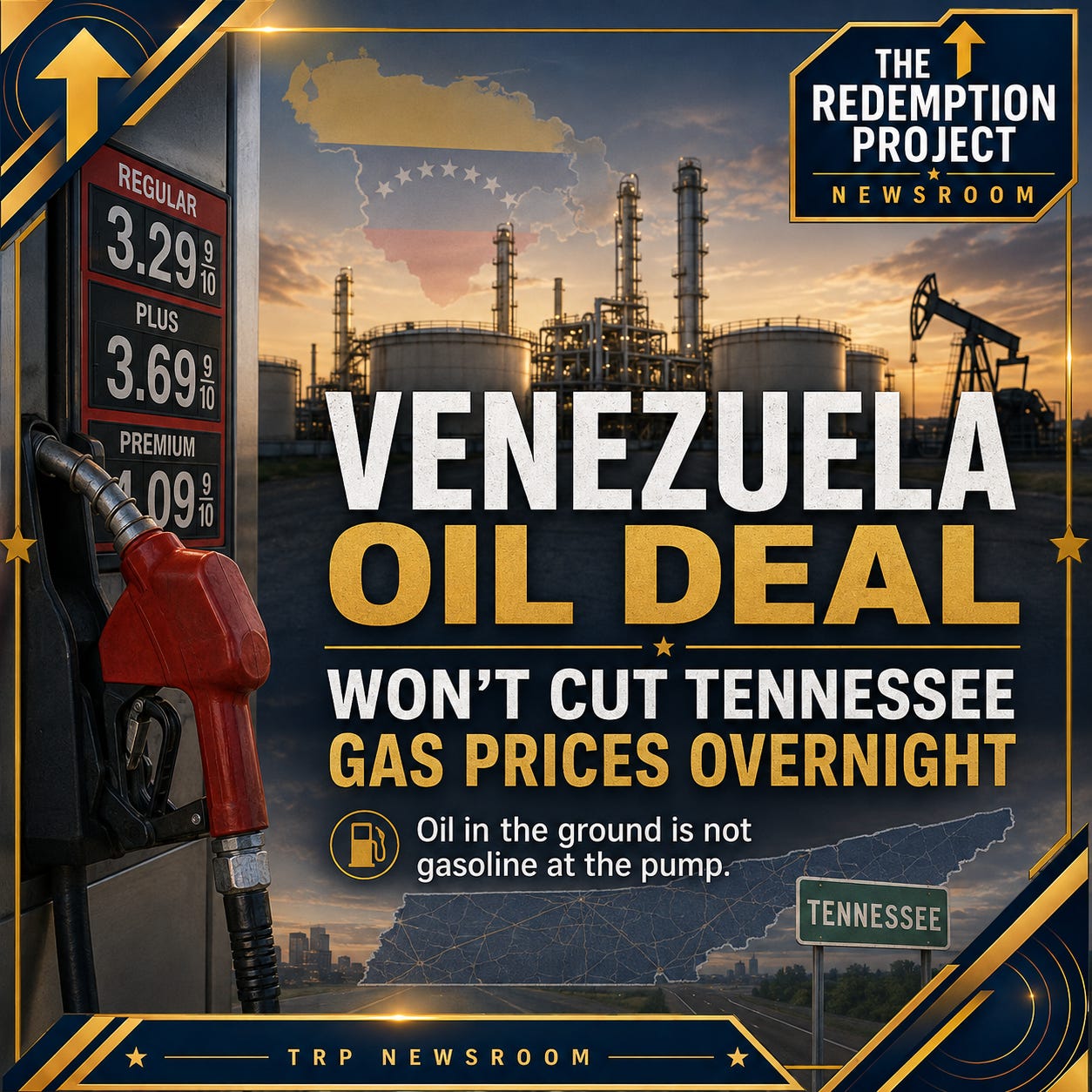
Oil in the ground is not gasoline at the pump
Retail gasoline prices are produced by an entire supply chain.
The U.S. Energy Information Administration divides the price motorists pay into four broad components: the cost of crude oil, refining costs and profits, distribution and marketing costs and profits, and taxes. Changes in wholesale energy markets also do not necessarily appear at retail stations immediately. EIA says there is typically a lag as retail prices catch up with changes in spot markets.
That matters when evaluating political promises that a major oil agreement will lower gasoline prices.
A barrel identified underground in Venezuela does not lower the price of regular unleaded in Knoxville.
Neither does a contractual right to develop that barrel.
The chain would have to move from a legally enforceable agreement, to financing, field restoration and drilling, to actual production, to transportation, to U.S. refinery inputs, to additional refined products entering the supply network serving Tennessee.
Only then could analysts begin separating the agreement’s effect from everything else moving oil and gasoline prices at the same time.
The deal still has major unanswered questions
Trump announced the agreement Friday, but the public information available so far does not answer several questions that would be necessary to evaluate its economic effect.
AP reported that the private operator involved in the proposed company has not been publicly identified. The complete agreement also was not included in the public material reviewed by The Redemption Project.
That leaves important details unresolved: exactly who owns and controls the venture, how production will be divided, which fields are included, how reserve estimates are defined, what capital the operator is legally required to invest, how disputes would be resolved and what happens if either government later attempts to change the arrangement.
Those are not technical footnotes.
They determine whether a headline announcing tens of billions of barrels eventually becomes tens of billions of barrels that can actually be produced.
The history of Venezuela’s oil industry makes that distinction especially important. AP reported that American oil executives have been cautious about returning to Venezuela because of years of political instability and deteriorated infrastructure. ExxonMobil CEO Darren Woods previously described the country as “un-investable.” AP also reported that experts expect repairing and expanding Venezuela’s petroleum infrastructure to require billions of dollars and potentially years before production could increase substantially.
A long-term resource opportunity and a short-term gasoline supply increase are two different stories.
Venezuelan oil is already reaching the Gulf Coast
The United States also is not beginning from zero.
EIA data show Venezuelan crude was already entering the U.S. Gulf Coast before Friday’s announcement. Gulf Coast refineries received about 14.2 million barrels of Venezuelan crude in May, the latest month shown in the agency’s current country-of-origin table.
That makes the relevant economic question more precise.
It is not simply whether Venezuelan oil can reach the United States.
It is whether this agreement eventually causes a sustained, meaningful increase in production and U.S. supply large enough to change refinery economics or broader crude prices.
Even then, the effect on Tennessee would have to be demonstrated rather than assumed.
EIA classifies Tennessee as part of Petroleum Administration for Defense District 2, or the Midwest petroleum region. Tennessee is not part of EIA’s Lower Atlantic district, which consists of Florida, Georgia, North Carolina, South Carolina, Virginia and West Virginia.
That regional distinction matters because gasoline markets do not move uniformly. Supply routes, refinery conditions, inventories, transportation costs and local taxes can produce different price movements from one part of the country to another.
Sanctions are another piece of the puzzle
The sanctions environment is already changing.
On Aug. 27, one day before Trump announced the agreement, the Treasury Department’s Office of Foreign Assets Control amended several Venezuela-related general licenses. Those included licenses covering certain transactions involving Venezuelan-origin oil and petrochemical products, U.S.-origin diluents, services and equipment, oil and gas operations, and transactions involving Venezuela’s state-owned oil company, Petróleos de Venezuela.
Those licenses matter because companies need to know what transactions U.S. sanctions law permits before committing capital or moving petroleum.
But an OFAC license is not an oil-field development contract.
The sanctions changes may make particular transactions legally possible. They do not establish how much money will actually be invested, how quickly damaged fields can be restored, how many barrels will be produced or where those barrels will ultimately go.
AP reported that oil purchased through the new company would be intended in part for the U.S. Strategic Petroleum Reserve and military use, according to the U.S. official familiar with the arrangement. That further complicates any attempt to translate the announcement directly into Tennessee retail gasoline supply.
What would actually matter for Tennessee
There are several measurable developments that would turn Friday’s announcement into a Tennessee energy story.
The first would be publication of the signed agreement itself.
That would allow the public to see whether the reported ownership, production rights, field commitments and investment figures are contractual obligations or broader political descriptions of the deal.
The second would be identifying the operator and financing. A company willing to commit billions of dollars, equipment and personnel provides considerably more evidence of future production than an announced investment estimate by itself.
Then come physical milestones: repaired infrastructure, drilling or restoration work, increased Venezuelan production and sustained increases in U.S. imports.
After that, analysts could watch whether additional supply begins affecting crude prices, Gulf Coast refinery economics or wholesale gasoline markets.
Finally, the Tennessee test is straightforward: Do prices or supply conditions here actually move differently than the broader national market for a reason energy analysts can trace to additional Venezuelan supply?
Until those links can be demonstrated, assigning a particular Tennessee pump-price movement to the agreement would be speculation.
A potentially enormous deal — on a much longer clock
None of that means the Venezuela agreement is economically insignificant.
Sixty-five billion barrels, if the Venezuelan government’s estimate proves commercially recoverable under the agreement, would represent an enormous petroleum asset. Long-term U.S. access to that production could affect energy security, refinery supply, strategic reserves and eventually global oil markets.
But reserves are not production.
Production is not U.S. imports.
U.S. imports are not automatically gasoline.
And additional gasoline somewhere in the American supply system is not automatically a measurable price reduction in Tennessee.
The agreement may eventually become part of the answer to America’s energy costs.
For Tennessee motorists, there is not yet evidence that it has changed the price of a gallon of gas.
I am a retired detective and criminal justice / government educator based in Tennessee. I founded The Redemption Project, as a place to focus on civics, rebuild non-partisan trust, and provide educational and emotional grace while learning about the news. I also have a column in Knox TN Today. My reporting and commentary have also appeared in other outlets including; Governing, The Arizona Capitol Times, South Florida Sun Sentinel, Police1, among other state and regional outlets.

Behind the Reporting
For paid members: What TRP is watching next and what the public record does — and does not — establish.
What is verified
The announcement: Trump announced the U.S.-Venezuela agreement Aug. 28. Venezuela’s government says 17 fields are involved with a potential 65 billion barrels of oil.
