



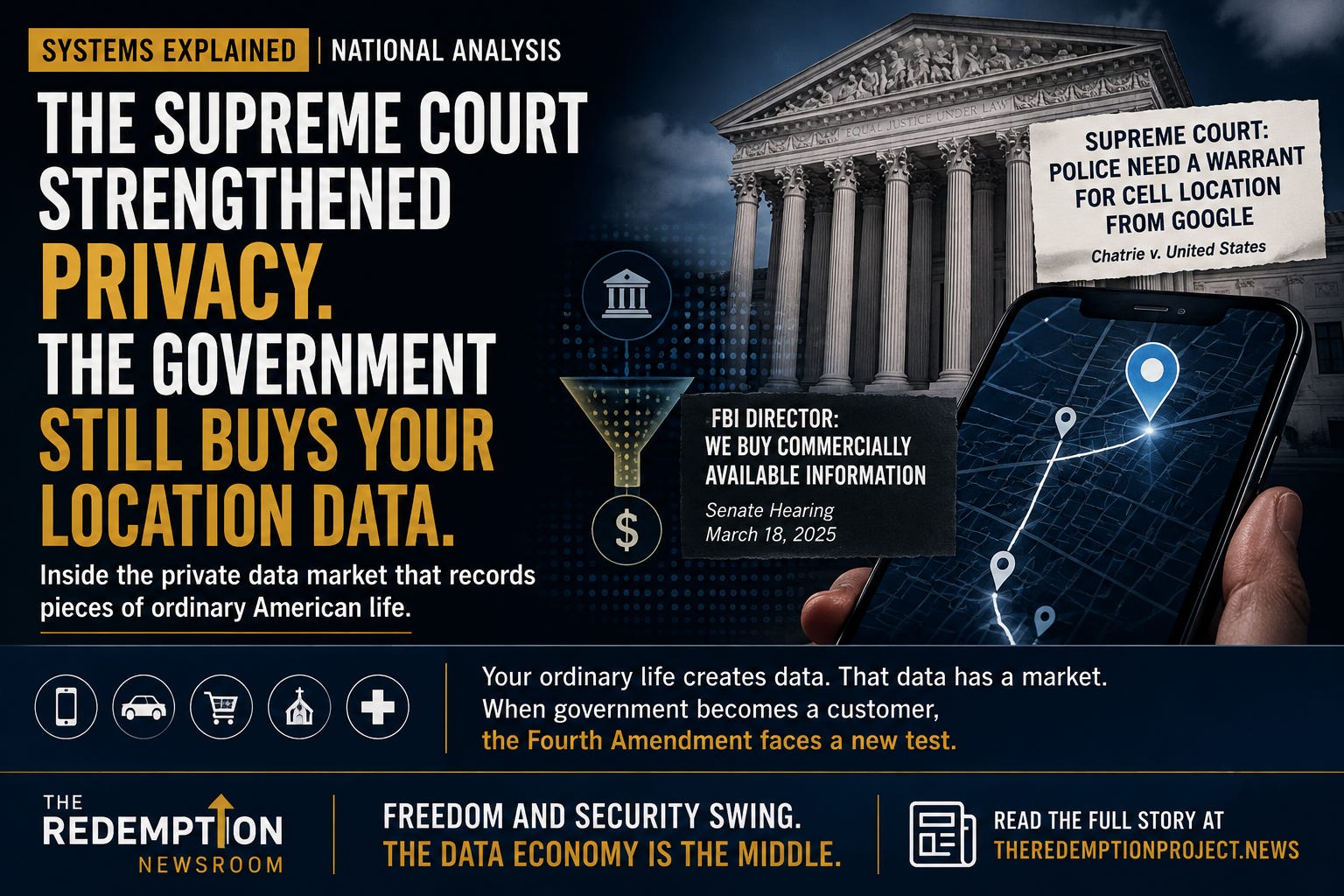
The Supreme Court has just strengthened constitutional protection for cellphone location data. The FBI acknowledges purchasing commercially available information. Between those two facts sits a private data economy capable of recording pieces of ordinary American life.
SYSTEMS EXPLAINED | NATIONAL ANALYSIS
On March 18, FBI Director Kash Patel sat before the Senate Intelligence Committee and was asked whether the bureau would stop buying Americans’ location data.
Patel did not make that commitment.
Instead, he acknowledged that the FBI purchases commercially available information, defended that practice as consistent with the Constitution and federal law, and said it had produced valuable intelligence.
Three months later, the Supreme Court drew an important constitutional line in a different kind of location-data case.
In Chatrie v. United States, decided June 29, the Court held that police conducted a Fourth Amendment search when they acquired Okello Chatrie’s cellphone location information from Google. The fact that Google possessed the information did not erase Chatrie’s reasonable expectation of privacy in it.
Those two events do not answer the same legal question.
But put them beside each other and the larger problem becomes difficult to miss.
The government can face constitutional limits when it demands sensitive information from a company.
Meanwhile, an enormous private marketplace already collects, aggregates and sells information about where people go, what devices they use and pieces of how they live.
What happens when government does not compel the information?
What happens when it becomes a customer?
That may be one of the defining Fourth Amendment questions of the digital age.
The middle of the cradle
A Newton’s cradle looks simple.
Pull back the steel ball on one end and let it go. It strikes the others, the force passes through the center, and the ball at the opposite end swings outward.
Americans have debated freedom and security in roughly the same rhythm for generations.
A terrorist attack, mass shooting, violent crime or foreign threat pushes public policy toward security.
An unconstitutional search, surveillance scandal or abuse of government power pushes it back toward liberty.
We tend to watch the two ends.
Freedom.
Security.
But in the digital age, what sits between them increasingly matters just as much.
Phones.
Apps.
Vehicles.
Advertising networks.
Technology companies.
Data brokers.
Government contractors.
The force no longer travels directly from the citizen to the state.
There is an information economy in the middle.

Your life does not have to be suspicious to create data
Consider an ordinary day.
You wake up and check the weather.
You drive to work with a navigation app running. Your phone connects to your vehicle. You stop at a pharmacy. At lunch, you search for information about a medical problem.
