


I thought I had found a better alternative to checkout charity. Then I realized the person serving me might be the one paying for my generosity.
COMMENTARY | BRANDON L. BURLEY
It happens so often now that most of us probably barely notice it.
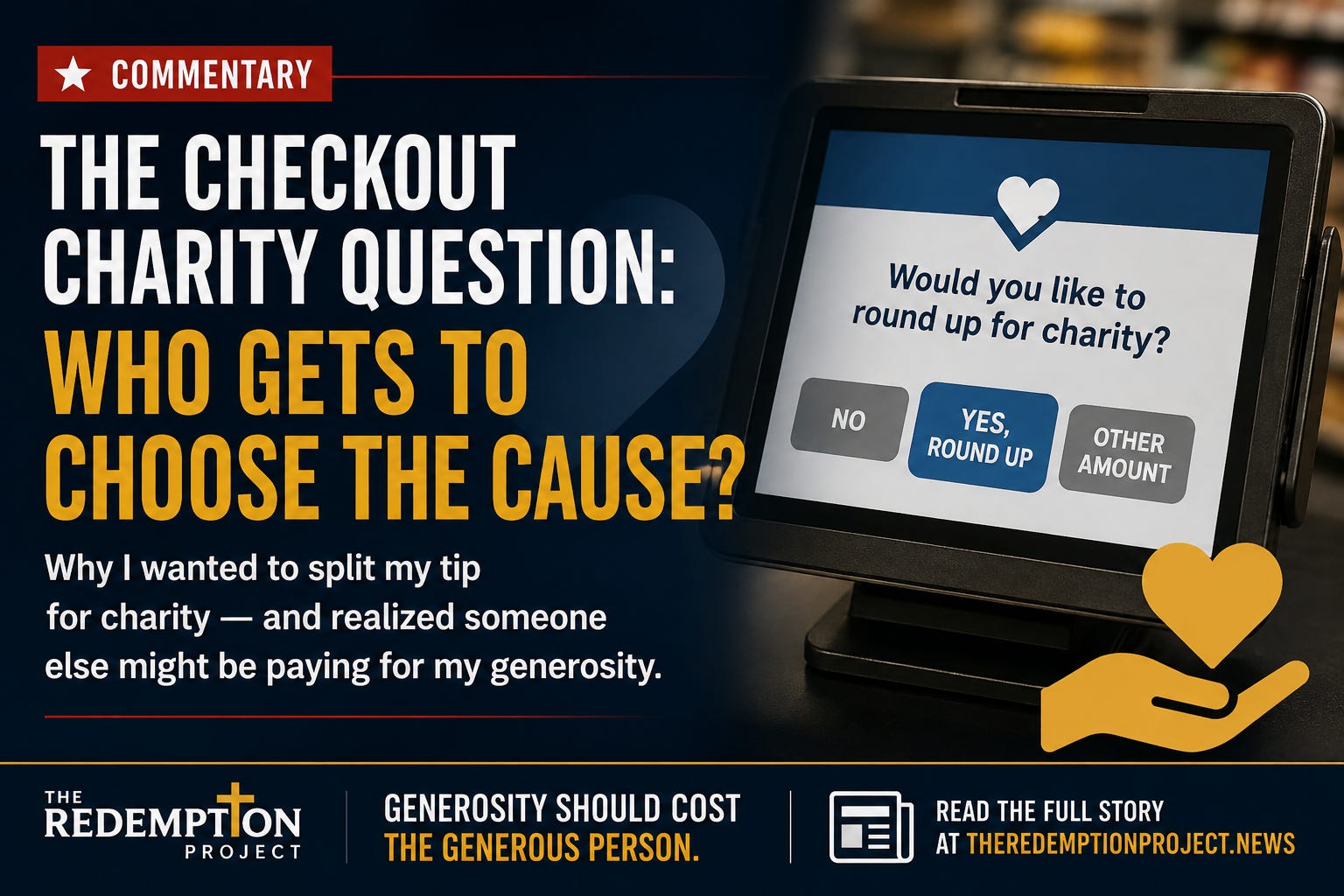
You buy groceries, order lunch or pick up something at a store. Before the receipt appears, the screen asks whether you would like to round up your purchase for charity.
Sometimes it is 37 cents. Sometimes it is a dollar. Sometimes several suggested amounts appear while an employee stands on the other side of the register.
There is nothing wrong with charitable giving. I believe we should be generous.
But after spending time looking into checkout-charity programs, I kept returning to a different question:
Why does the company get to choose the cause?
That question gave me an idea.
Then the idea gave me a problem.
Let the server choose
The experiment seemed simple.
The next time I was somewhere I would normally leave a tip, I would ask the person serving me:
What charity matters to you?
Not the organization their employer selected. Not whatever cause happened to have a national campaign that month.
Theirs.
Maybe it would be St. Jude Children’s Research Hospital. Maybe a food pantry, animal rescue, veterans organization, pregnancy center or recovery ministry. Maybe it would be a small nonprofit I had never heard of but that had helped their family through something difficult.
Then, if I had planned to leave a $20 tip, I could give the server $10 and donate the other $10 directly to the organization they chose.
The server gets something.
The charity gets something.
And I get introduced to a cause that matters to another human being.
I liked the idea.
Until I asked myself whose $10 I was being generous with.
The problem with giving away somebody else’s tip
A tip and a charitable donation are not interchangeable.
The person serving me did work for me. If I normally believe that work deserves a $20 tip, reducing it to $10 because I decided the other half should go to charity does not necessarily make me more generous.
From the server’s perspective, I may simply have cut the tip in half.
I can attach a charitable receipt to the other $10. I can tell myself the money went somewhere meaningful. I can even let the worker choose the organization.
But the worker is still financing part of my charitable decision.
That changes the moral equation.
If my generosity requires someone else to receive less, I should probably be careful about calling it generosity.
That realization nearly killed the experiment.
Instead, I think it made the idea better.
I had another assumption to correct, too
Part of what originally made checkout giving bother me was the claim I had heard repeatedly that corporations collect customer donations and then claim those donations as their own charitable tax deductions.
That criticism needs more precision.
A customer’s charitable contribution does not simply become the retailer’s charitable contribution because the retailer collected it. Tax deductions generally depend on who actually makes the qualifying contribution and whether the required rules and records are satisfied.
The IRS also changed the landscape beginning in 2026. Taxpayers who do not itemize may now deduct up to $1,000 in qualifying cash charitable contributions, or $2,000 for married couples filing jointly, subject to the rules. Gifts directly to individuals do not qualify.
That does not make every checkout campaign transparent or every solicitation worthwhile.
It just means criticism should be aimed at what can actually be supported.
The New York attorney general makes a point I think is especially useful: consumers do not have to feel pressured by charitable solicitations. They can research the organization, find out where the money goes and donate directly if they prefer.
That is closer to what interests me now.
Not who gets to claim the deduction.
Who gets to choose the mission?
Maybe the better version costs me more
There is an obvious solution to the tipping problem.
Leave the full tip.
Then make the charitable donation separately.
If I intended to tip $20, the worker still gets $20. Then I ask what charity matters to them and give another $10 or $20 to that organization.
The worker chooses the destination.
I supply the additional money.
Nobody else’s compensation has to subsidize my experiment.
Of course, that version costs more.
Maybe that is the point.
Generosity is easy when all we are doing is reallocating money we were already planning to give someone else. It becomes more meaningful when something actually comes out of our own pocket.
The cleaner rule might be:
The server chooses. I pay.

What I actually want is the conversation
The more I think about it, the money may not even be the most interesting part.
I want to know what people care about.
Imagine asking someone who has spent the last hour serving your table which organization they would help if someone handed them $20 to give away.
Maybe they tell you about the children’s hospital that treated their daughter.
Maybe it is the animal rescue where they found their dog.
Maybe a food pantry helped their family during a bad year. Maybe a veterans group helped their father. Maybe a recovery ministry helped them survive addiction. Maybe a tiny local organization is doing extraordinary work three streets from your house and you never knew it existed.
Now the donation has context.
It has a story.
It has another person attached to it.
That seems different from tapping a button because a screen gave me three seconds to decide.
The checkout screen asks the easiest question
There is nothing inherently wrong with rounding up at the register.
Those small gifts can become real money for organizations doing real work. Convenience can make people more generous than they otherwise would have been.
But checkout giving usually begins with a decision someone else has already made.
The company chose the partner.
The campaign chose the cause.
The software chose the prompt.
I choose yes or no.
What if, every once in a while, we added another human being to that process?
Not because servers should become our charitable advisers. Not because anyone should feel obligated to discuss personal experiences with a customer.
Just as an invitation:
If you could send $20 to a charity right now, where would you send it?
They can answer.
Or they can decline.
Either is fine.
But when someone does answer, I may learn something I would never have learned from the checkout screen.
Generosity should cost the generous person
I started with an idea that sounded clever.
Split the tip. Let the worker choose where half goes. Turn an ordinary transaction into something charitable.
I no longer think that is the best version.
The criticism is too strong: if the charitable gift exists because the worker receives less compensation, then part of what I am calling my generosity actually belongs to them.
So I think the experiment needs one rule.
Do not make someone else poorer so I can feel more charitable.
Leave the tip I believe the service deserves.
Then ask the question.
What charity matters to you?
If I can afford the extra gift, make it.
If I cannot, I may still walk away knowing about an organization I did not know existed and something that matters to a neighbor I might otherwise have known only as the person who brought my food.
That has value too.
The checkout screen asks whether I want to give.
I am increasingly interested in another question:
What do you believe is worth giving to?
Then comes the part that may matter most.
Listen.
Because perhaps generosity is not only about deciding where our own values deserve money.
Sometimes it begins by becoming curious about what someone else values enough to give theirs.
I am a retired detective and criminal justice / government educator based in Tennessee. I am a commentary write for Tennessee Lookout and a weekly columnist with Knox TN Today. My work examines public policy, public safety systems and civic responsibility. My reporting and commentary have also appeared in Governing, The Arizona Capitol Times, South Florida Sun Sentinel, Police1, among other state and regional outlets.