



Federal auditors say demand for explosive material is at an “all-time high” because of U.S. support to Ukraine and the nuclear-stockpile refurbishment mission. In East Tennessee, those two national-security demands converge at the Holston Army Ammunition Plant.
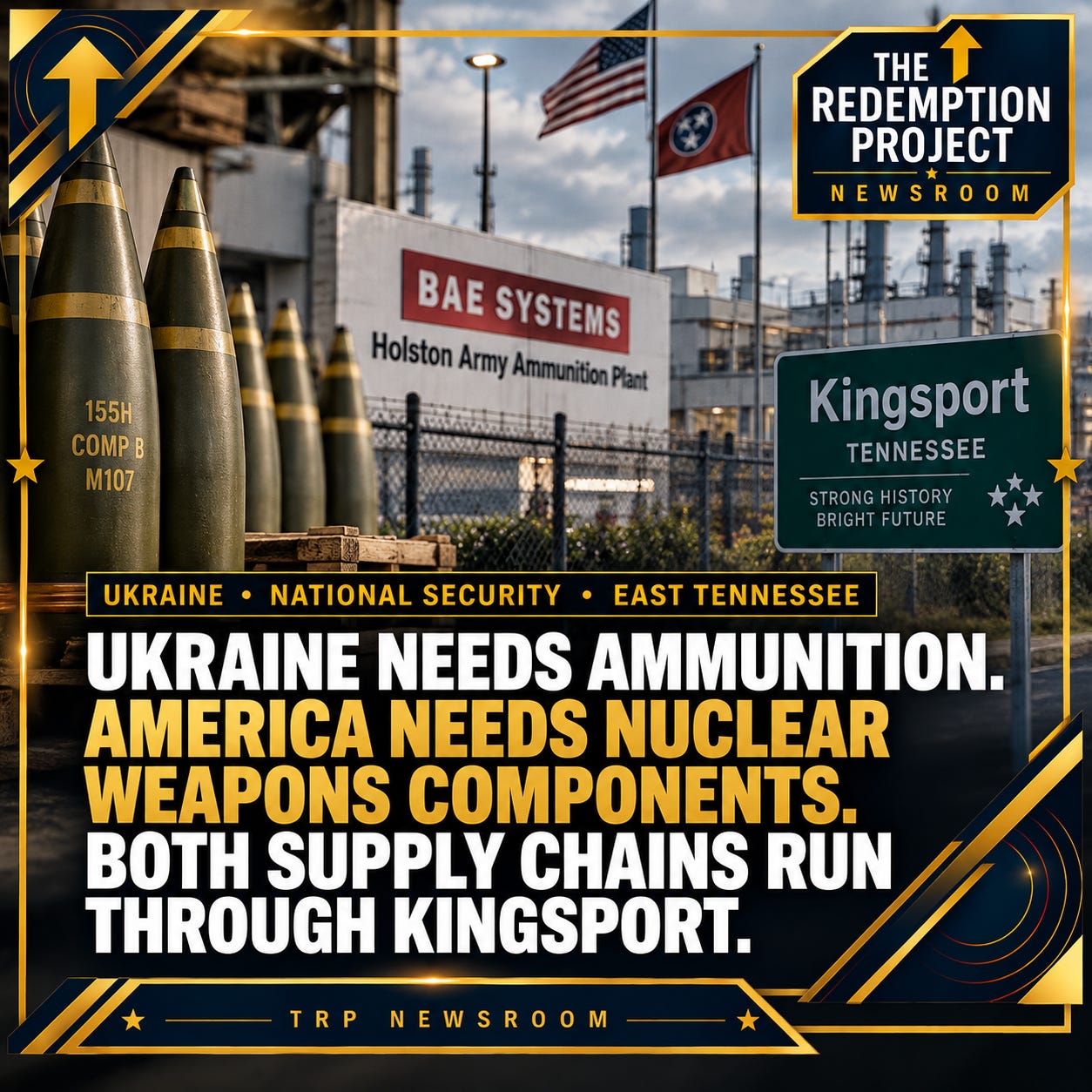
KINGSPORT, Tenn. — A war in Europe and the modernization of America’s nuclear arsenal are placing pressure on the same explosives supply chain in East Tennessee.
That connection is not an assumption.
The Government Accountability Office put it in writing.
In a March 2025 examination of the National Nuclear Security Administration’s explosives supply chain, federal auditors identified the Holston Army Ammunition Plant in Kingsport as NNSA’s major supplier of certain explosive materials.
Holston’s primary customer, however, is the Department of Defense.
According to NNSA officials interviewed by GAO, Holston and the nuclear agency were struggling to meet increasing demand for explosive material as demand reached what officials described as an “all-time high” because of U.S. support to Ukraine and the nuclear-stockpile refurbishment mission.
That sentence connects two national-security systems that are usually covered separately.
One is the enormous conventional ammunition system supplying the U.S. military and its allies while the war in Ukraine continues.
The other is the federal system responsible for maintaining and modernizing the U.S. nuclear stockpile.
Both need explosives.
And both depend, in part, on a government-owned plant along the Holston River in Kingsport.
There is also an important boundary to this story.
The public records reviewed by The Redemption Project do not establish that a particular batch of explosive manufactured at Holston was loaded into a specific weapon and sent to Ukraine.
GAO establishes something different: U.S. support to Ukraine is contributing to extraordinary overall demand on the explosives system in which Holston operates.
So does what happens next.
Don’t forget to read the: Behind the Reporting section at the end of the article to understand the sources and methodology used to write this article
What Holston actually does
Holston Army Ammunition Plant is a roughly 6,000-acre, government-owned, contractor-operated industrial complex spanning portions of Hawkins and Sullivan counties.
Its history goes back to World War II.
Its mission today remains explosives manufacturing.
An Army environmental review describes Holston as a production-scale manufacturer of explosives used in conventional military ordnance, including bombs, mortars, artillery and missiles. BAE Systems Ordnance Systems Inc. has operated the facility since 1999.
The Army’s current industrial-base material identifies Holston’s mission as manufacturing explosives based on RDX, HMX and insensitive munitions formulations. Its modernization priorities include expanding RDX and IMX production capacity.
Those names can make the story sound more technical than it is.
RDX and HMX are high explosives used across military applications. Insensitive munitions explosives are designed to reduce the likelihood of accidental detonation while still performing their intended military function.
Holston also produces material for the nuclear side of the government.
GAO says the plant produces new TATB — triaminotrinitrobenzene, an insensitive high explosive — for both the Department of Defense and NNSA.
That is where Kingsport enters the nuclear-weapons production system.
The nuclear connection is direct
Nuclear weapons require more than uranium or plutonium.
They also require conventional chemical explosives engineered to perform with extraordinary precision.
GAO explains that high explosives in a nuclear weapon are used to compress the weapon’s plutonium core, or pit, beginning the nuclear reaction. NNSA is responsible for ensuring that its weapons programs have a sufficient and reliable supply of those explosives.
Holston is part of that supply chain.
GAO found that precursor materials from other suppliers frequently pass through Holston before explosive material moves onward into the nuclear-security enterprise.
Pantex, the nuclear-weapons assembly and dismantlement plant in Texas, receives explosives manufactured at Holston and uses them in testing, pressing, machining and assembly of explosive weapons components.
That gives Kingsport a role in the nuclear arsenal that is easy to miss.
Holston does not assemble nuclear warheads.
It manufactures some of the explosive materials that other facilities need to manufacture nuclear-weapons components.
At the same time, Holston’s main customer remains the Pentagon’s conventional military system.
That overlap is where the pressure emerges.
The two demands can compete
GAO went beyond saying Holston serves two customers.
The auditors identified competition for production capacity as a risk.
According to the report, Defense Department demand for high explosives used in conventional munitions has the potential to compete with NNSA’s needs.
That is an unusually important sentence for East Tennessee.
It means the connection between Ukraine and U.S. nuclear modernization is not merely that both happen to purchase material from the same company.
They can place demand on the same production system.
Holston also faces manufacturing constraints.
GAO reported that the plant’s existing emissions systems and limits on toluene emissions can restrict its ability to meet both Defense Department and NNSA delivery schedules. Under existing technology, the plant could reach its emissions limit before producing all of the explosive material required, potentially causing production delays.
NNSA is helping pay for equipment and facility upgrades at Holston as part of its effort to protect the nuclear explosives supply.
The agency is also working with the Defense Department to establish another production capability at a different military location, reducing its reliance on one supplier. The location is not identified in the public GAO report because additional details were placed in a controlled annex.
That tells us something else about Kingsport’s importance.
The government itself considers dependence on Holston a supply-chain risk.
That does not mean nuclear programs have already been delayed
There is another distinction worth making.
GAO did not find that the identified explosives problems had already delayed a nuclear-weapons program.
At the time of its review, auditors said the risks had not yet affected the schedules of any weapons systems.
The concern is prospective.
GAO said current risks could affect modernization programs if they are not mitigated. NNSA documentation warned that a further reduction or halt in Holston operations could affect production of insensitive high explosives and, in turn, nuclear-weapons modernization schedules.
NNSA representatives went further, telling auditors that reliance on a single supplier for parts of the nuclear-security enterprise’s explosives needs affects nearly every part of production modernization and creates a broader national-security risk.
The agency’s own documentation concluded that the existing explosives industrial base was insufficient to meet nuclear-security-enterprise demand.
So there are two different statements here.
Documented: Holston is under significant demand pressure from conventional and nuclear requirements.
Not documented: A specific nuclear-weapons program has already missed its schedule because of Holston.
The difference is important.
The Army is trying to build more capacity
The pressure is visible in what the Army is building.
A February 2025 environmental review says the Defense Department needs additional insensitive munitions explosives capacity at Holston to support artillery production and anticipated future demand.
The Army described an “urgent necessity” to increase IMX production beyond the plant’s existing capacity to meet current Defense Department requirements and potential wartime surge requirements.
The review evaluates additional production facilities and related infrastructure after Holston completed only part of an earlier planned IMX expansion.
The Army’s current modernization portfolio separately lists both RDX capacity expansion and IMX capacity expansion among Holston’s primary modernization priorities.
Those projects should not automatically be labeled “Ukraine projects.”
The Army documents describe broader military requirements, current demand and future surge capacity. They do not attribute every Holston construction project exclusively to support for Ukraine.
But the records can be read together.
The Army says it urgently needs more conventional explosives production capacity.
NNSA officials told GAO overall explosive demand is at an all-time high because of Ukraine support and nuclear-stockpile refurbishment.
And GAO says conventional Defense Department demand can compete with NNSA for capacity at Holston.
That is the connection the records support.
An $8.8 billion contract shows the scale — but not the spending
The federal contracting footprint is enormous.
In December 2023, the Army awarded BAE Systems Ordnance Systems a $8.823 billion contract for explosives production and operation and maintenance of Holston from Jan. 1, 2024, through Dec. 31, 2033.
That number needs context.
It does not mean the federal government handed BAE $8.8 billion to spend in Kingsport on the day the contract was awarded.
The Defense Department said work locations and funding would be determined with each individual order.
In other words, the contract establishes the long-term vehicle and potential scale of the government’s explosives-production relationship with BAE. Actual work and funding move through orders issued under it.
That distinction is especially important when federal contract announcements produce very large headline numbers.
Contract value is not the same thing as cash already paid.
But $8.8 billion still tells the public something.
The Army has established a decade-long procurement framework for operating Holston and producing explosives whose potential value reaches into the billions of dollars.

Another major project is being built beside it
There is a second money trail.
In May 2025, Parsons Government Services received a $169.4 million Army contract to design and build a new ammonium nitrate solution tank farm at Holston. At the time of award, the Defense Department said the full $169.4 million had been obligated and construction was expected to be completed in 2029.
That figure has since changed.
USAspending, the federal government’s spending database, currently lists the award at approximately $176 million obligated, with a June 2029 current completion date.
The tank farm may sound disconnected from weapons production.
It is not.
Ammonium nitrate solution, or ANSol, is a byproduct of explosives manufacturing at Holston. Army procurement documents say existing storage was insufficient to handle the increased volume expected from expanded explosives production.
Federal contracting documents describe the new facility as having roughly 425,000 gallons of storage capacity, enough to manage increased ANSol resulting from higher production rates.
That is what industrial expansion looks like beneath the weapons themselves.
More explosives production requires more than another production line.
It requires acids, water systems, filtration, storage, emissions controls, waste handling, utilities and the infrastructure capable of supporting the entire chemical process.
The Army has been modernizing those systems across Holston.
A World War II plant confronting modern demand
Holston was built in 1942.
More than eight decades later, the same site is being asked to serve a military environment its original designers could not have imagined.
The Army has described modernization across its ammunition industrial base as necessary because many of the facilities date to World War II.
At Holston, recent and continuing projects have included new or upgraded steam generation, RDX milling, acid recovery, water systems, environmental controls and explosives-production infrastructure.
Some of that modernization predates Russia’s full-scale invasion of Ukraine.
That matters because it would be misleading to present every dollar being spent at Holston as a response to the war.
The United States already had an aging munitions industrial base.
Ukraine increased demand on that system.
Nuclear modernization added another demand stream.
The result is not one simple cause.
It is pressure accumulating on infrastructure that was already being rebuilt.
Kingsport sits at the intersection
A missile fired in Ukraine and a nuclear warhead being refurbished in the United States are very different weapons serving very different missions.
Their production chains are not identical.
But farther upstream, those chains can depend on some of the same industrial capacity.
That is what the GAO report makes visible in Kingsport.
The Defense Department needs conventional explosives for bombs, artillery, mortars, missiles and other munitions.
NNSA needs specialized explosives for the nuclear stockpile.
Holston supplies both systems.
Federal officials say overall demand has reached an all-time high because of Ukraine support and nuclear-stockpile refurbishment.
And GAO says one customer’s conventional-munitions demand can compete with the other customer’s nuclear requirements.
That is more precise than saying weapons manufactured in Kingsport are being sent to Ukraine.
The records reviewed by TRP do not establish that.
They establish something arguably more important for understanding the national defense industrial base:
Two of the most consequential military demands facing the United States are drawing on production capacity connected to the same East Tennessee explosives plant.
The Army is adding capacity.
NNSA is helping finance improvements and looking for additional suppliers.
Hundreds of millions of dollars are moving into supporting infrastructure, while a decade-long explosives-production contract carries a potential value measured in billions.
The test now is execution.
Can Holston expand conventional explosives production without squeezing the nuclear supply chain?
Can NNSA reduce its dependence on one major supplier before a disruption affects a weapons schedule?
And when billions of dollars move through the Kingsport operation over the next decade, which investments actually produce more usable capacity?
Those are questions federal budgets, task orders, construction records and production milestones can answer.
For East Tennessee, they are no longer distant questions about wars and weapons somewhere else.
Part of that system runs through Kingsport.
I am a retired detective and criminal justice / government educator based in Tennessee. I founded The Redemption Project, as a place to focus on civics, rebuild non-partisan trust, and provide educational and emotional grace while learning about the news. I also have a column in Knox TN Today. My reporting and commentary have also appeared in other outlets including; Governing, The Arizona Capitol Times, South Florida Sun Sentinel, Police1, among other state and regional outlets.

Behind the Reporting
The Redemption Project reviewed a March 2025 Government Accountability Office examination of NNSA’s high-explosives supply chain, Army environmental records for Holston Army Ammunition Plant, Army modernization documents, Defense Department contract announcements and federal spending records.
Several evidence distinctions are central to this report.
Ukraine connection: GAO reported that NNSA officials described explosive-


