



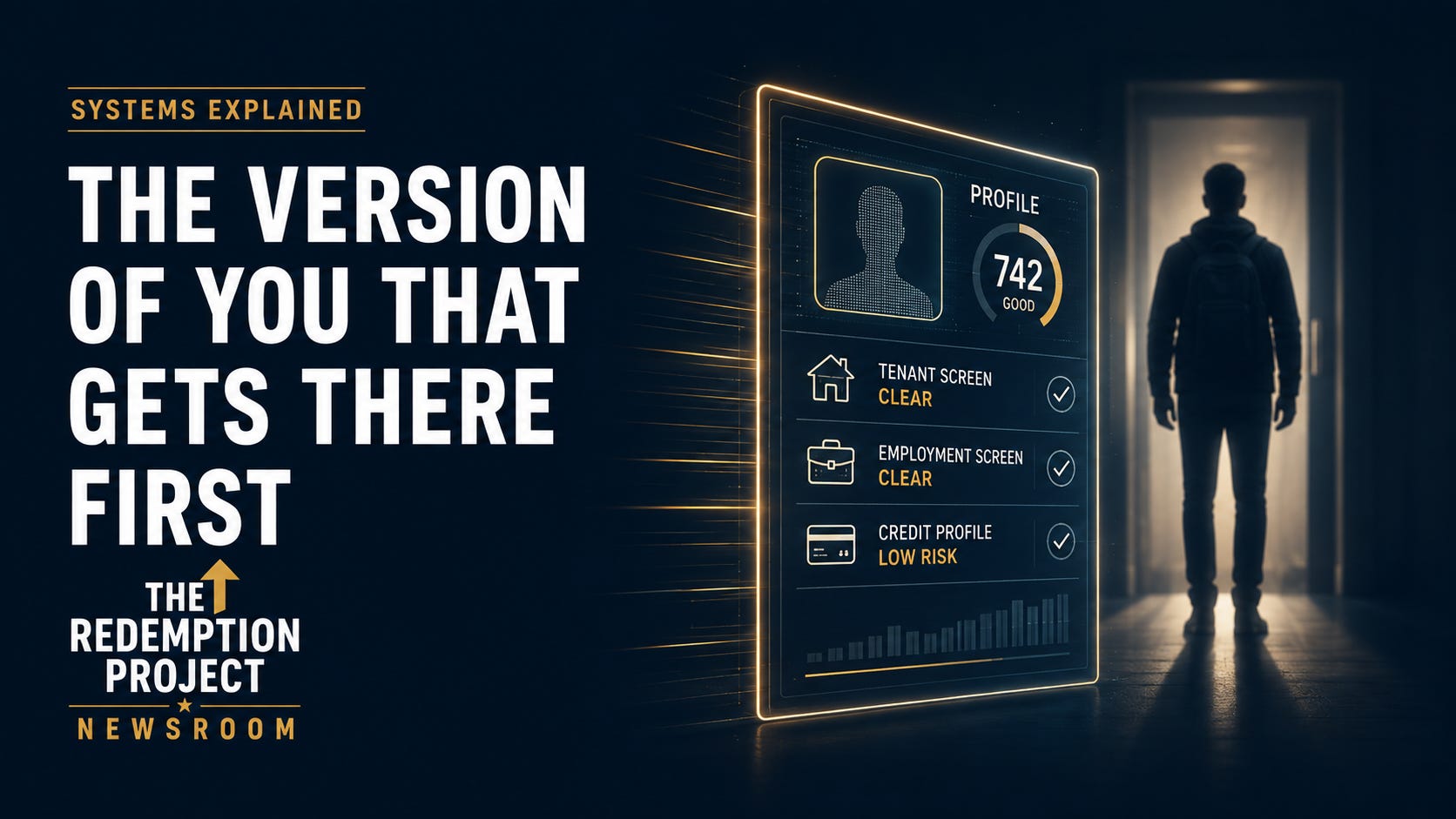
You apply for the apartment, job or loan. But before anyone decides, another version of you may already be in the room — assembled from records, histories, scores and data you may never have seen.
By Brandon L. Burley
The Redemption Project Newsroom
You apply for an apartment.
Your income is stable.
You fill out the application.
Pay the fee.
Wait.
Then the answer comes back.
No.
Or maybe the apartment is still available, but the security deposit is suddenly higher.
You ask why.
That may be the first time you learn that someone else entered the room before you did.
Not another applicant.
A report.
In July 2026, the Federal Trade Commission announced that tenant-screening company RentGrow would pay $2.25 million to settle allegations that it violated federal consumer-reporting law.
Among the allegations was something remarkably simple.
RentGrow reports could contain duplicate records — multiple entries involving the same criminal case or eviction action — creating the false appearance that an applicant had more criminal convictions or had been sued for eviction more times than was actually true.
Think about the consequence.
The database does not merely contain an error.
The error can arrive at the landlord.
The landlord can make a decision.
And suddenly a bad record has become a housing problem.
That is the larger issue.
We talk constantly about companies collecting information about us.
The more consequential question may be what happens when that information starts helping other people decide what happens to us.
Your credit report is only the beginning
Most Americans know Equifax, Experian and TransUnion.
The consumer-reporting system extends much further.
The Consumer Financial Protection Bureau maintains a list of specialty reporting companies covering areas such as tenant screening, employment screening, checking-account history, insurance and other consumer decisions.
The bureau tells consumers plainly that these reports can influence whether they receive credit, employment, rental housing, insurance and other products or services.
There may therefore be information capable of affecting an important decision about your life held by a company whose name you have never heard.
That creates what I think of as a digital double.
Not because the file is a complete copy of you.
It is not.
The problem is almost the opposite.
It is incomplete.
A credit history.
An eviction record.
Employment verification.
A criminal-history search.
Previous bank-account problems.
A driving record.
A risk score.
Pieces.
But under the right circumstances, those pieces can reach the decision-maker before the human being they supposedly describe gets any chance to provide context.
The file arrives first.
A record is not the same thing as a judgment
A record says something happened.
A score or recommendation goes further.
It tries to say what that history means.


