


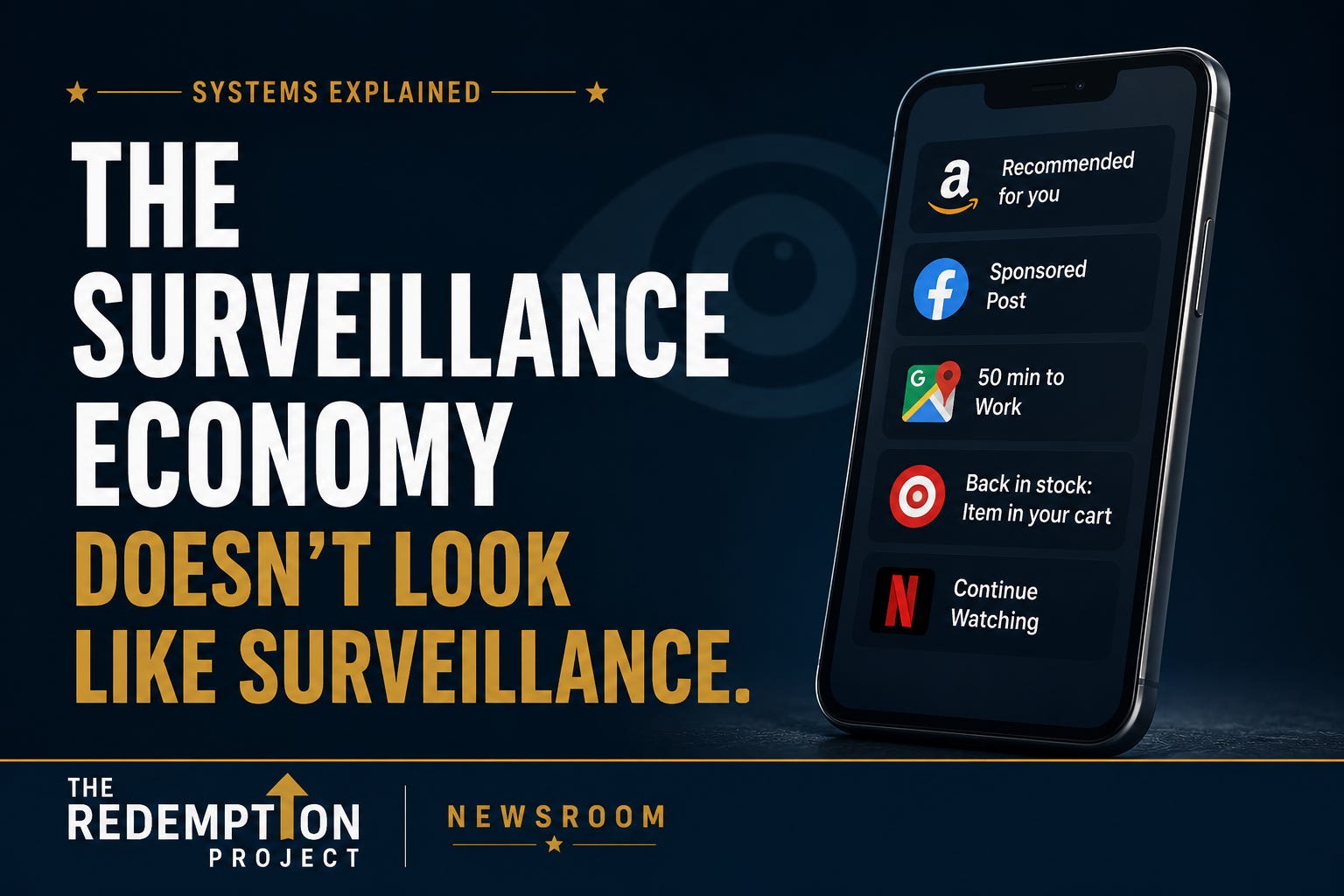
Your car can record where you drive. Health platforms have shared sensitive information with advertisers. Retail systems can study what you browse, where you are and even what you leave in a shopping cart. The modern privacy question is no longer simply who is watching. It is who is remembering.
By Brandon L. Burley
The Redemption Project Newsroom
You wake up and check the weather.
You open social media while drinking coffee.
Your navigation app calculates the drive to work. Your phone connects to the car. You stop for gas and enter a rewards number.
At lunch, you search for a medical problem that has been bothering you.
On the way home, you use a grocery loyalty account.
Later, you put a pair of shoes in an online shopping cart, decide they cost too much and close the page.
Before bed, a streaming service remembers exactly where you stopped watching last night.
Now imagine someone followed you through that entire day.
Where did you go?
What did you buy?
What did you almost buy?
What did you watch?
What were you worried about?
Americans tend to imagine that level of observation as government surveillance.
It does not have to be.
It can also be Tuesday.
No, one company does not know everything about you
Start with an important distinction.
There probably is not one corporation sitting somewhere with a perfect digital folder containing your entire life.
That is not necessary to create the privacy problem.
The modern information economy is fragmented.
One company may know what you watch.
Another may know what you buy.
Another may know where your vehicle has been.
Another may know which websites you visited.
Another may know what medication you searched for.
Another may know which advertisements you clicked.
And data brokers and advertising systems can obtain information from multiple sources and help connect pieces that began separately.
The Federal Trade Commission has been documenting that structure for years. Its landmark data-broker study found companies collecting information from sources including purchases, social media activity, warranty registrations and magazine subscriptions, then using data to make inferences about characteristics such as income, religion, political leanings, age and health.
The dossier does not have to begin as a dossier.
It can begin as pieces.
Social media sees more than what you post
Most people already understand that social platforms learn from their behavior.
The scale is larger than remembering which video you liked.
In 2024, FTC staff examined major social media and video-streaming companies including Meta, YouTube, TikTok, X, Reddit, Discord and others.
The agency described what it found as “vast surveillance” of consumers.
