
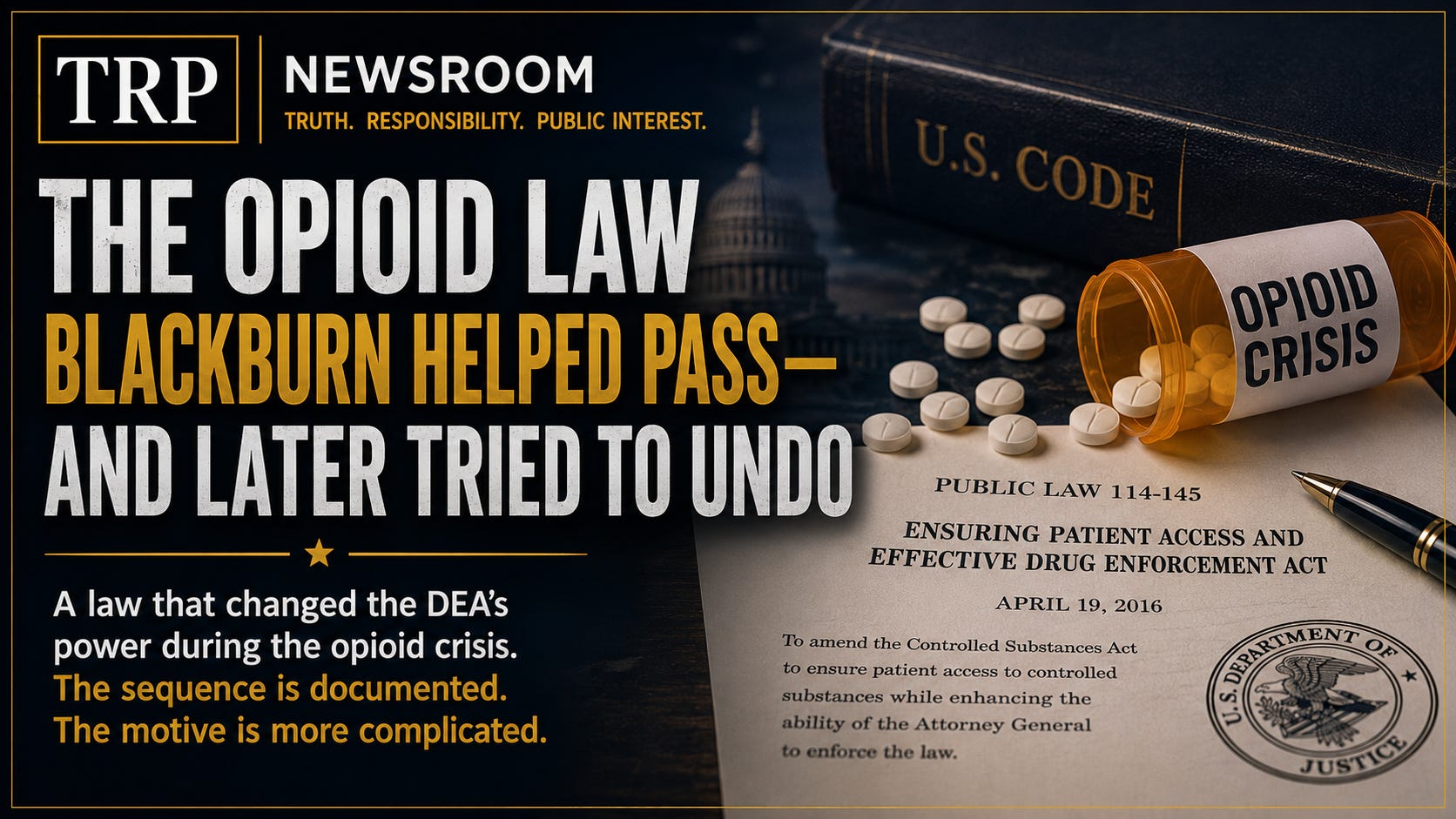
Marsha Blackburn helped advance legislation that changed the DEA’s enforcement standard for drug distributors during the opioid epidemic. After regulators and investigators said the new standard made enforcement harder, she backed legislation to reverse key provisions. The sequence is documented. The motive is more complicated.
There is a simple version of Marsha Blackburn’s opioid record.
She helped weaken the Drug Enforcement Administration and later reversed herself.
The actual record requires more words.
Blackburn was one of four original House sponsors of the Ensuring Patient Access and Effective Drug Enforcement Act when Rep. Tom Marino introduced H.R. 4709 in May 2014. The others were Democratic Reps. Peter Welch and Judy Chu.
When the proposal returned in the next Congress as H.R. 471, Blackburn was again among its original sponsors.
The legislation addressed a real policy conflict, not an invented one.
The DEA was trying to stop controlled substances from being diverted into illegal markets. Pharmaceutical distributors, health-care interests and patient advocates argued that aggressive enforcement could also interrupt legitimate access to prescription medications.
Blackburn emphasized that second concern.
Federal committee records from the period show her questioning how regulators could preserve legitimate patient access while still combating diversion, and she publicly advocated for legislation intended to clarify the rules governing DEA enforcement.
The problem was real.
The argument was over the remedy.
What the law actually changed
The final measure became Public Law 114-145 after moving through Congress without a recorded partisan fight and being signed by President Barack Obama on April 19, 2016.
It was not Blackburn’s law alone.
It was not narrowly partisan.
But she had been involved with the legislation from its earlier House versions.
One of the law’s most consequential provisions defined when DEA could immediately suspend the registration of a manufacturer, distributor or dispenser of controlled substances.
The new statute said an “imminent danger to the public health or safety” required a “substantial likelihood of an immediate threat” that death, serious bodily harm or controlled-substance abuse would occur without immediate suspension. It also established a process allowing registrants to submit corrective-action plans during certain enforcement proceedings.
Those words became the controversy.
DEA still possessed enforcement authority after the law took effect.
The dispute was whether Congress had raised the standard enough to make one of the agency’s fastest enforcement tools substantially harder to use.
A law can begin as an attempt to solve one problem and later become evidence in another.
The criticism came later — and it was serious
By 2017, the law was receiving national scrutiny.
Former DEA officials and other critics argued that the new standard had hindered the agency’s ability to act quickly against distributors suspected of allowing suspicious opioid shipments to continue.
DEA itself later told Congress that it supported changing the statute so the agency could more effectively stop actors engaged in diversion.
Maryland Attorney General Brian Frosh argued even more forcefully during Senate oversight, saying the law constrained DEA’s ability to use immediate suspension orders and urging Congress to repeal it.
Those were serious criticisms.
There was also important context on the other side.
At a December 2017 Senate Judiciary Committee hearing, Chairman Chuck Grassley said DEA and the Justice Department had participated in the legislative process and that Congress had received assurances that federal enforcement officials accepted the final language. He also said DEA had advised the Obama administration to sign the measure.
Grassley disputed the idea that the statute had simply stripped DEA of its enforcement power and pointed to enforcement data he believed complicated that claim.
That does not establish that the law worked as intended.
It establishes something narrower and important:
the legislative history was more complicated than lawmakers openly disregarding unanimous DEA opposition.
Blackburn did not reverse immediately
When criticism intensified in 2017, some lawmakers began calling for repeal or modification.
Blackburn did not immediately abandon the policy she had supported.
She initially defended the legislation and argued that policymakers needed more information about its effects.
During 2018, the issue became both a policy dispute and a campaign issue as Blackburn ran for the U.S. Senate and Democratic nominee Phil Bredesen attacked her role in the 2016 law.
Then Blackburn changed course.
On Sept. 5, 2018, Rep. Gus Bilirakis introduced H.R. 6702, the DEA Enforcement and Authority Act of 2018, with Blackburn as its original cosponsor.
The bill sought to modify key immediate-suspension and corrective-action provisions that had been added by the earlier law.
It did not become law.
The legislation was referred to House committees and did not advance to enactment before the Congress ended.
That distinction is essential.
Blackburn helped enact the original policy.
She later tried to undo key parts of the enforcement framework she had helped create.
A willingness to correct policy matters. So does the record that made correction necessary.
So what should voters call it?
A flip-flop?
A correction?
A response to new evidence?
Political pressure?
The record establishes that Blackburn’s position changed.
It does not establish why.
The timing is relevant. So are the intervening criticisms from DEA officials, investigators, attorneys general and lawmakers.
Voters can reasonably consider both.
But journalism should not claim to know a motive the documentary record cannot prove.
The record proves the change.
It does not prove the motive.
There is also no responsible basis for saying this statute caused Tennessee’s opioid epidemic or assigning particular overdose deaths to it based on the evidence presented here.
The opioid crisis developed through a much larger combination of prescribing practices, pharmaceutical manufacturing and distribution, diversion, illicit markets, addiction, treatment access, law-enforcement failures and eventually the rapid spread of illicit fentanyl.
One statute does not explain all of that.
But Blackburn’s role remains relevant.
She helped advance a federal law that changed the enforcement standard governing one of DEA’s fastest tools during a devastating public-health crisis.
Federal regulators and other officials later raised serious concerns about that change.
Blackburn initially defended the approach.
She later supported legislation designed to restore stronger DEA authority.
That sequence is not an attack advertisement.
It is not an absolution.
It is a governing record.
And records become most useful when voters are allowed to see the entire sequence.
I am a retired detective and criminal justice / government educator based in Tennessee. I founded The Redemption Project, as a place to focus on civics, rebuild non-partisan trust, and provide educational and emotional grace while learning about the news. I also have a column in Knox TN Today. My reporting and commentary have also appeared in other outlets including; Governing, The Arizona Capitol Times, South Florida Sun Sentinel, Police1, among other state and regional outlets.


