

The Fourth Amendment does not disappear inside Google’s database
When Everything Becomes Searchable Safety, Privacy and Freedom in the Digital Era


The Redemption Project Newsroom
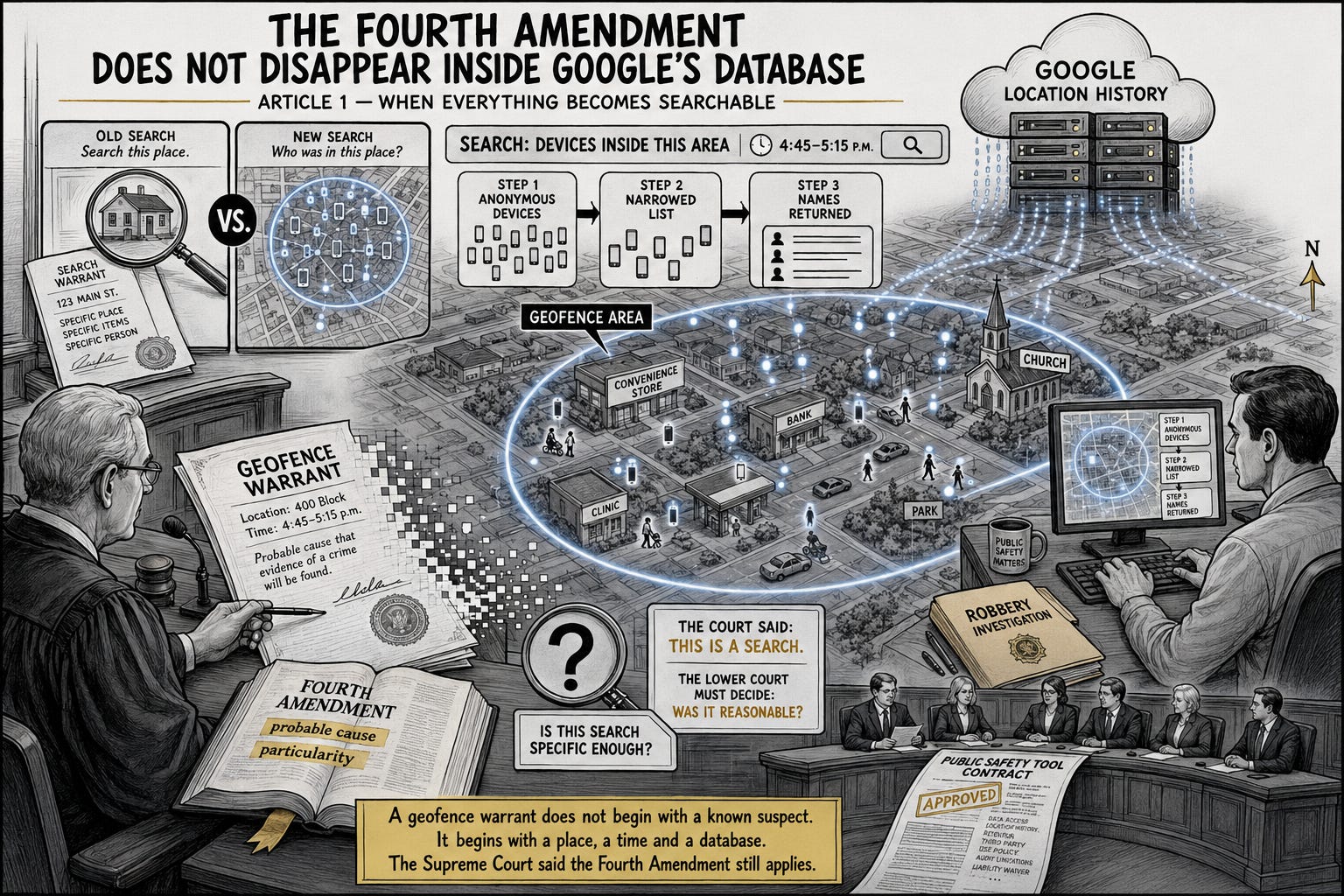
A police officer once needed a suspect, a place or a thing to search.
A house. A car. A phone. A person. A known account. A specific address.
Digital policing has changed that order.
In some modern investigations, police can begin not with a suspect, but with a location and a time. They can ask a technology company which devices were nearby, then work backward from the data toward a person.
That is the basic idea behind a geofence warrant.
It is also why the U.S. Supreme Court’s ruling in Chatrie v. United States matters far beyond one robbery case in Virginia.
The Court ruled Monday that police conduct a Fourth Amendment search when they obtain Google Location History through a geofence warrant. The decision does not ban geofence warrants. It does not decide whether the evidence against Okello Chatrie must be suppressed. It does not answer every question about digital policing.
But it does answer one important threshold question: the Fourth Amendment is not avoided simply because police obtain sensitive location information from a private company instead of directly from a person.
That is the first principle in this series.
When everything becomes searchable, constitutional limits matter more, not less.
Chatrie’s case began with a 2019 robbery in the Richmond, Virginia, area. Investigators did not begin with a known suspect. Instead, police obtained a geofence warrant directed to Google, asking for information about devices located near the crime scene around the time of the robbery.
A geofence warrant allows law enforcement to draw a virtual boundary around a place and ask a technology company to search location records for devices inside that area during a specific time window.
That structure is different from a traditional warrant, which usually begins with a known suspect, address, device or account. A geofence warrant begins with the scene and asks the database who was there.
That difference is the constitutional problem.
According to the Supreme Court, Google’s Location History service, for users who had activated it, recorded phone location information roughly every two minutes at the time. In Chatrie’s case, the warrant used a multi-step process. Google first produced anonymized data about devices near the robbery. Investigators then narrowed the list. Eventually, Google gave police identifying information for three users, including Chatrie.
The lower courts had split over what the Fourth Amendment required. The federal district court found serious constitutional problems with the warrant but allowed the evidence under the good-faith exception. A divided panel of the 4th U.S. Circuit Court of Appeals affirmed on different grounds, holding that Chatrie did not have a reasonable expectation of privacy in two hours of Location History data voluntarily exposed to Google. The full 4th Circuit later divided evenly on whether a Fourth Amendment search had occurred.
The Supreme Court rejected the idea that there was no search.
Justice Elena Kagan wrote for the Court that police conducted a Fourth Amendment search when they acquired Chatrie’s location data from Google because a person has a reasonable expectation of privacy in cellphone location information. The Court relied heavily on its 2018 decision in Carpenter v. United States, where it held that police generally need a warrant to obtain historical cell-site location information from a wireless carrier.
The government argued that Chatrie had no reasonable expectation of privacy because the data was held by Google and because he had opted into Location History. The Court rejected that argument.
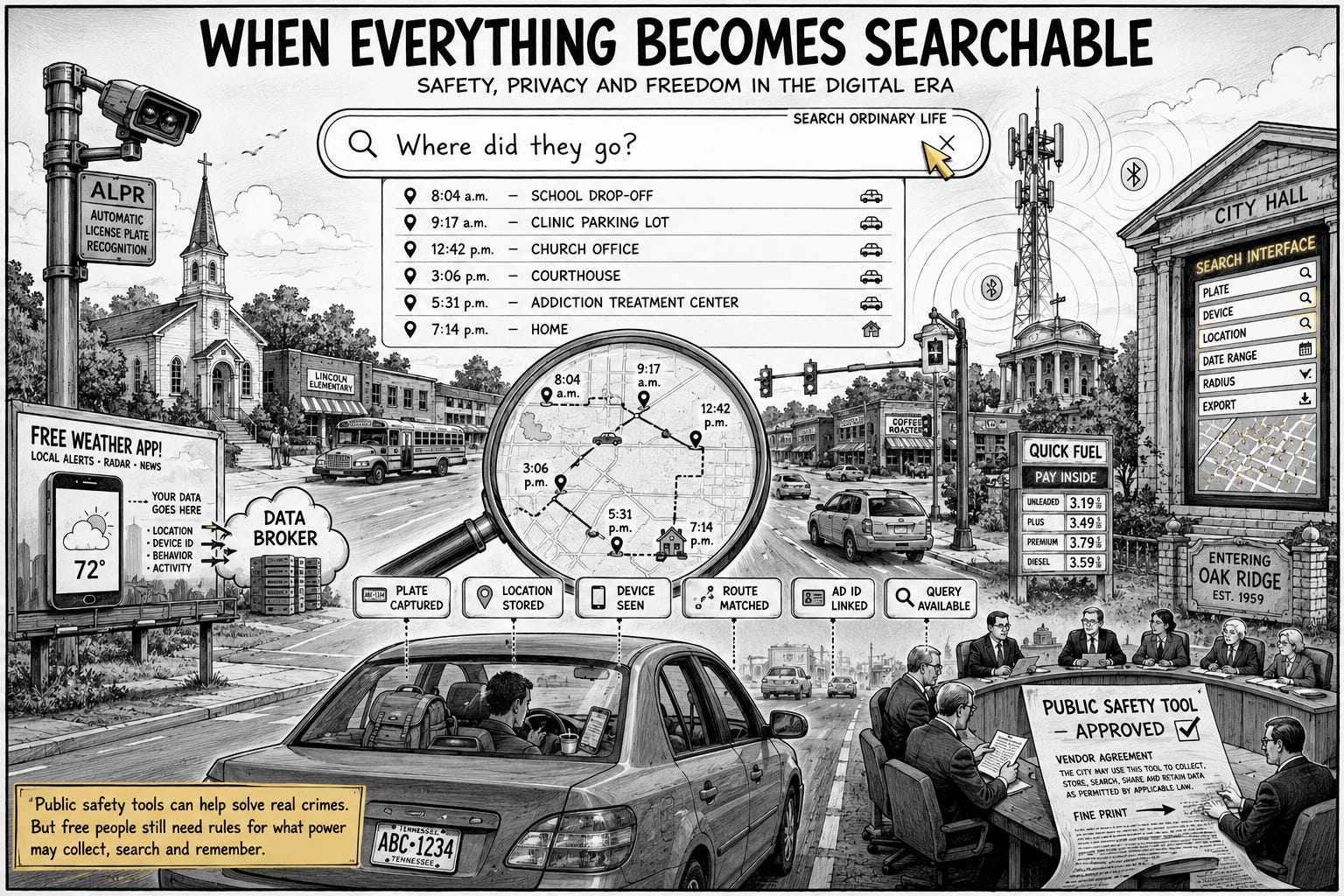
The third-party doctrine has long allowed the government to argue that people lose some Fourth Amendment protection when they voluntarily share information with a company. But the digital age has made that idea harder to apply cleanly. People use phones, apps, maps, email, search engines, cloud services and connected devices as part of ordinary life. Treating every digital record held by a company as outside constitutional protection would give the government a road around the Fourth Amendment wide enough to drive the modern world through.
Chatrie does not erase the third-party doctrine. It does not say every record held by every company requires a warrant. But it does say sensitive location history is different.
Location data is not just a technical record.
It can reveal where someone sleeps, works, worships, receives medical care, attends school, visits family, meets a lawyer, goes to a political event or seeks help in a private moment. It can show not only where a phone was, but the pattern of a person’s life.
That is why Carpenter mattered. And that is why Chatrie matters now.
The Supreme Court did not decide whether the particular geofence warrant in Chatrie’s case was reasonable. That question now returns to the 4th Circuit, which must consider whether the warrant satisfied the Fourth Amendment’s requirements for probable cause and particularity at each stage of the search process. The lower court may also have to consider whether the good-faith exception still allows the evidence to be used.
Those details matter.
A search can be a Fourth Amendment search and still be reasonable if properly supported and limited. A search can also be a Fourth Amendment search and violate the Constitution if it is too broad, lacks probable cause, lacks particularity or gives the government too much discretion.
That is the next fight.
But the threshold holding is already important: police access to Google Location History through a geofence warrant is not outside the Fourth Amendment simply because Google held the data.
That ruling will matter beyond geofence warrants because digital public-safety tools increasingly work by collecting information first and allowing government users to search it later.
Phone-location records are one example.
Commercial app data is another.
Automated license plate readers are another.
Private camera networks, toll records, connected-car data, real-time crime center feeds and vendor platforms all raise related questions. They are not all the same technology. They should not all be treated as if one Supreme Court ruling automatically decides them.
But they share a common tension.
Modern systems can make ordinary movement searchable after the fact.
That is different from ordinary observation.
A police officer seeing a person or vehicle in public is one thing. A government search of a database that can reconstruct where phones, cars or devices appeared across time is something else. The legal question is not only whether something was visible in public. It is whether government access to a searchable location database reveals information ordinary observation could not.
That distinction will likely shape the next wave of digital privacy litigation.
Police agencies argue that geofence warrants, license plate readers and similar tools can help solve serious crimes, recover stolen vehicles, find missing people, identify wanted suspects and support time-sensitive investigations. Those are real public safety interests.
Privacy advocates argue that the same tools can sweep in people who are not suspected of wrongdoing, especially when searches begin with a location and time rather than an identified suspect. That concern becomes stronger when records are retained, searched later, shared across agencies or used near sensitive places such as churches, schools, clinics, shelters, political events, addiction treatment centers or lawyers’ offices.
Both sides are pointing to something real.
The mistake is pretending one concern cancels out the other.
Public safety matters. So does constitutional liberty.
The harder work is deciding what rules are strong enough for tools that can search the past.
Chatrie does not settle the automated license plate reader debate. It does not decide whether Flock Safety cameras or other ALPR systems require warrants for historical searches. It does not say police need a warrant every time they search a license plate reader database.
But it does give future courts and local governments a vocabulary for asking the question.
A real-time alert tied to a stolen vehicle or wanted plate may be one kind of use. A historical search asking where a vehicle traveled over several weeks may be another. A reverse search asking which cars were near a church, clinic, protest or crime scene during a time window may be another still.
The more a tool can reconstruct movement, the more serious the constitutional question becomes.
That is why Chatrie is not the end of the digital-policing debate.
It is the starting line for the next one.
Local governments using location-based public safety tools should be asking questions now, before courts answer them case by case.
Who can search the data?
How long is it kept?
Can outside agencies access it?
Are searches tied to a case number or documented investigative purpose?
Is a warrant required for historical or reverse-location searches?
Are sensitive locations treated differently?
Are audit logs reviewed?
What happens if the system is misused?
Those questions are not anti-police. They are constitutional government questions.
Good rules protect the public. They also protect good police work. A case built with lawful evidence is stronger than a case damaged by an unlawful search, a vague warrant or a database search no one can explain.
The public does not need to choose between solving crimes and preserving the Fourth Amendment. A free society needs both public safety and enforceable limits on government power.
That is the central issue in the digital era.
The government can use powerful tools. But when those tools make ordinary life searchable, the rules must be strong enough for the power being used.
The Fourth Amendment does not disappear inside Google’s database.
And if constitutional liberty is going to survive the age of searchable movement, that principle cannot stop with Google.
I am a retired detective and criminal justice / government educator based in Tennessee. I am a commentary write for Tennessee Lookout and a weekly columnist with Knox TN Today. My work examines public policy, public safety systems and civic responsibility. My reporting and commentary have also appeared in Governing, The Arizona Capitol Times, South Florida Sun Sentinel, Police1, among other state and regional outlets.

 | A guest post by
|