



By The Redemption Project Newsroom
Economy / Agriculture Desk
A Tennessee soybean begins in a field.
It may be harvested by a farmer who never sees the port, never meets the foreign buyer and never watches the crop leave the country.
But the soybean might.
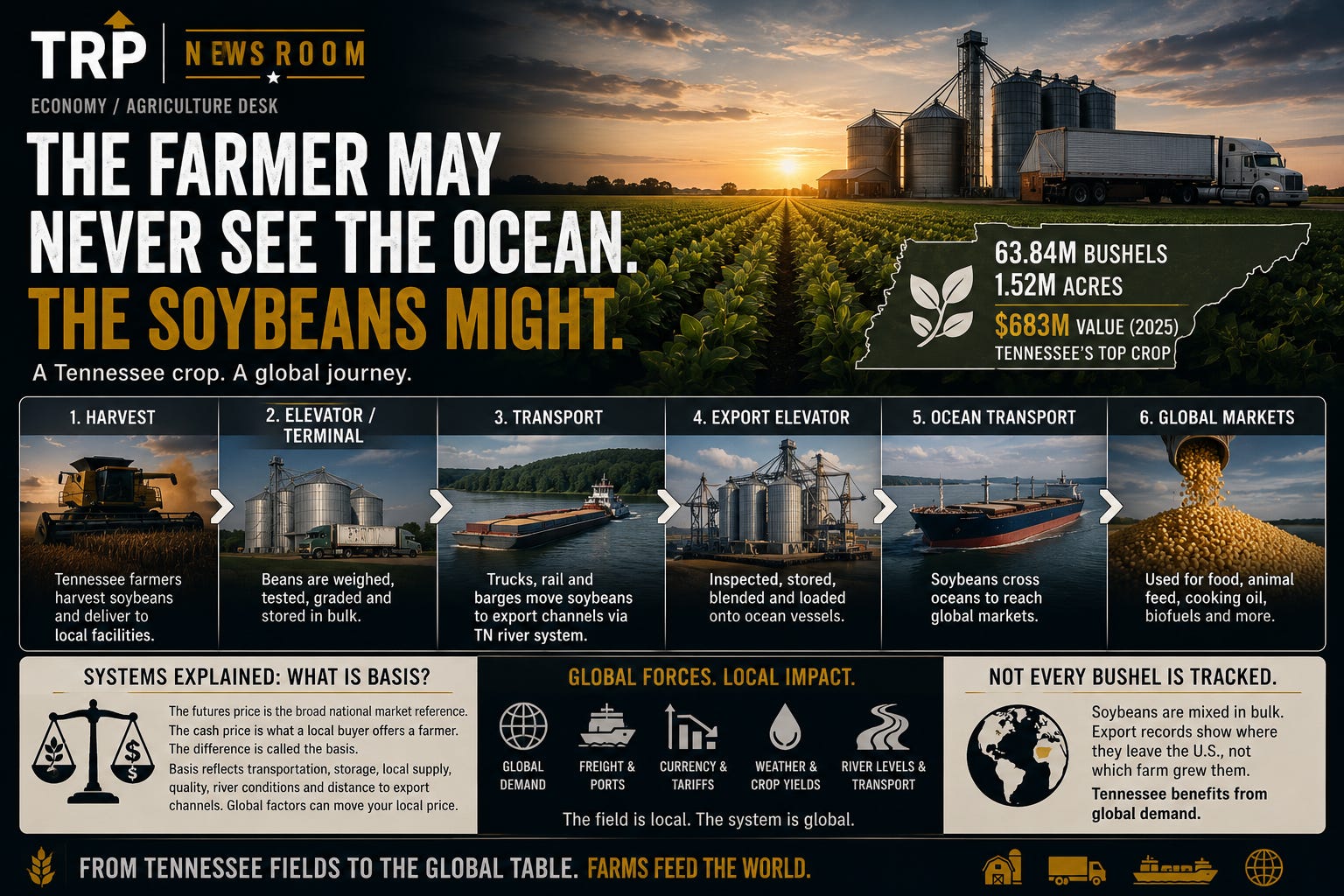
That is the hidden machinery behind one of Tennessee’s most valuable crops. In 2025, Tennessee farmers harvested approximately 63.84 million bushels of soybeans from 1.52 million acres, according to USDA figures included in the state’s agricultural overview. The crop was valued at about $683 million, making soybeans Tennessee’s highest-valued crop that year.
Now the Tennessee Department of Agriculture has joined the U.S. Soybean Export Council, a market-development organization that promotes U.S. soybeans and soybean products overseas. The department said the move is meant to expand domestic and international market opportunities for Tennessee soybean farmers and processors.
The department also announced it had joined the U.S. Grains & BioProducts Council, which works to develop export markets for corn, barley, sorghum and related products, including ethanol and distillers dried grains.
That announcement is the news hook.
The larger story is how a crop grown in Tennessee reaches a global market most Tennesseans never see.
A soybean does not usually move straight from a Tennessee farm to a buyer in Mexico, Europe or Asia. It enters a chain.
After harvest, a farmer usually delivers soybeans by truck to a local grain elevator, cooperative, processor or river terminal. The beans are weighed, tested, graded and unloaded. Samples may be checked for moisture, foreign material, damaged kernels and other quality factors. The truck is weighed before and after unloading to determine how much grain was delivered.
Once accepted, the soybeans usually lose their individual farm identity.
They are placed into large bins and mixed with soybeans from other farms. That is how bulk agriculture works. A foreign buyer is generally not purchasing “soybeans from one farm in Weakley County.” The buyer is purchasing a volume of soybeans that meets contract specifications.
From there, the crop may take several paths.
Some soybeans are crushed in the United States into soybean meal and soybean oil. Soybean meal is a major protein ingredient in animal feed. Soybean oil is used in food products, cooking oil, industrial products and biofuels. A soybean processed domestically can still be connected to global markets if the meal, oil, meat or fuel markets are affected by international demand.
Other soybeans remain in domestic feed, food or manufacturing channels.
Still others move toward export.
For Tennessee, geography matters. The state sits near a freight network built around the Tennessee, Ohio and Mississippi river systems. West Tennessee has direct access to the Mississippi River. The Tennessee River connects to the Ohio River, which connects to the Mississippi near Cairo, Illinois. From there, grain can move toward export terminals near New Orleans and the Gulf.
That river system is one reason Tennessee soybeans can compete abroad.
Soybeans are heavy. Moving millions of bushels entirely by truck would be expensive. Trucks are flexible and essential for the first trip from farm to elevator or terminal. Rail can move large volumes over land. But barges give inland grain one of its most important economic advantages.
A river barge can carry large amounts of grain at comparatively low cost. Grain terminals load soybeans into barges. Tugboats assemble multiple barges into a tow and push them downstream. The grain may pass through terminals, locks, dams and lower Mississippi transfer points before reaching export elevators near New Orleans and the Gulf.
At the export elevator, soybeans are unloaded, stored, blended if necessary, inspected, weighed and loaded onto an ocean vessel.
That is when an inland crop becomes part of international trade.
Systems Explained: What is basis?
The futures price is the broad national market reference. The cash price is what a local buyer offers a farmer. The difference is called the basis. Basis reflects transportation costs, storage space, local supply, processor demand, barge and rail availability, grain quality and distance to export channels. A low river, rail delay or barge shortage may not change how many soybeans a Tennessee farmer grows, but it can lower the local price offered for those beans.
That is why the soybean market is global before the crop ever leaves the county.
A farmer’s local bid can be affected by river levels, port congestion, tariffs, currency values, foreign crop production, fuel prices, ocean freight and demand from buyers thousands of miles away. A large Brazilian soybean crop can pressure U.S. prices. A tariff can make American soybeans less competitive. A strong U.S. dollar can make commodities more expensive for foreign buyers. Low water on the Mississippi can increase transportation costs and weaken local bids.
The soybean is local.
The price is not.
China has historically been the dominant global soybean importer because of the scale of its livestock-feed and cooking-oil markets. But the Tennessee story should not be oversimplified. It is not always accurate to say a specific Tennessee soybean went to China, Mexico or Europe.
Bulk commodity tracking does not work that way.
Trade records often show where soybeans left the country, not where they were grown. A soybean grown in Tennessee and carried downriver may appear in export data as leaving Louisiana because that is where it was loaded onto a ship. It also may be mixed with soybeans from Arkansas, Missouri, Illinois, Kentucky, Mississippi or other states before export.
That means Tennessee-specific export claims must be handled carefully.
Tennessee soybeans enter the larger U.S. soybean supply. That supply is sold as whole beans, meal or oil into domestic and international markets. Tennessee farmers benefit from global demand even when their individual beans cannot be traced to one overseas customer.
Paid subscribers receive access to every article because their support helps make this work possible. If you’d like immediate access — and want to support independent, systems-focused journalism — consider becoming a paid subscriber.
That is where the U.S. Soybean Export Council membership matters.
USSEC promotes U.S. soybeans and soybean products abroad, works with international buyers, supports technical training, promotes quality and sustainability, and helps build demand for whole soybeans, meal and oil. Tennessee’s membership may give the state and its soybean sector greater access to that network.
But the announcement leaves unanswered questions.

