

By Brandon Burley · Friday Book Review
Nathan Walton begins with an observation that is difficult to dismiss.
A church can be racially diverse for ninety minutes on Sunday and function almost entirely within segregated social worlds for the rest of the week.
People can sing together without sharing life. They can talk about reconciliation without knowing one another. They can advocate publicly for people whose homes, tables, neighborhoods and ordinary relationships remain entirely outside their own.
Embodying God’s Multiethnic Kingdom is Walton’s attempt to move the Christian conversation about race from institutional appearance to daily discipleship.
That is a worthy project. It is also one that requires careful theological distinctions.
Beyond diverse photographs
Walton is not satisfied with demographic diversity. That is one of the book’s strengths.
He explicitly argues that numerical diversity can conceal assimilation, shallow relationships or unchanged structures of power. A church cannot simply count faces, publish a photograph and declare reconciliation accomplished.
Instead, Walton asks Christians to examine four ordinary areas of life:
Residence.
Recreation.
Resources.
Religion.
Where do we live? With whom do we spend our discretionary time? Where do our money, opportunities and relationships flow? How does Christian faith shape our willingness to cross ethnic and cultural boundaries?
His central argument is simple: if Christians claim that ethnic reconciliation matters but that conviction never affects the ordinary architecture of life, something is missing.
There is truth here. Biblical love is not merely an attitude.
Hospitality requires a table. Generosity requires resources. Fellowship requires proximity.
The church’s confession that believers are one in Christ should eventually become visible somewhere in Christian life.
Sin does not stop at the individual
Walton is also correct to resist an understanding of sin so individualistic that institutions somehow become morally neutral.
Calvinists should have little difficulty admitting this.
Total depravity does not mean every individual is as wicked as possible. It means the fall reaches every dimension of human life.
Sinners build institutions. Sinners write laws. Sinners design markets. Sinners govern churches.
Sinners inherit arrangements they did not create and can continue arrangements without consciously intending every consequence those systems produce.
There is therefore nothing especially un-Reformed about asking whether patterns of injustice can become embedded in institutions.
The doctrine of sin is large enough to account for personal and structural evil.
Walton’s historical chapters are strongest when they force Christians to acknowledge that churches exist within actual histories rather than theological abstractions.
Residential segregation, denominational division, cultural preference and church-growth strategies did not materialize from nowhere.
Christians should be willing to investigate those histories honestly. Truth does not threaten the gospel.
But guilt requires greater precision
This is also where one of my most significant reservations emerges.
Walton appeals to Adam, original sin and Romans 5 in support of a broader principle of collective responsibility for historical sin.
A Reformed reader should slow down here.
Federal headship in Adam is not simply an illustration of the idea that individuals inherit the guilt of any community to which they belong.
Adam occupies a unique covenantal position as the representative head of humanity. Likewise, Christ’s representation of his people is unique.
Romans 5 is explaining the theological relationship between Adam and Christ, condemnation and justification.
It cannot simply be transferred into a general rule that people bear moral guilt for sins committed by members of their racial or national ancestry.
Scripture certainly contains corporate confession. It recognizes consequences extending across generations.
People can inherit unjust institutions, material advantages, cultural habits and obligations to repair wrongs they themselves did not originate. A church may also have genuine institutional continuity with sins committed by that same church or denomination.
But consequence, responsibility and guilt are not identical categories.
That distinction needs greater protection than Walton gives it.
A Calvinistic doctrine of sin should make us more willing to confess actual sin, not less careful about identifying whose sin is being confessed.
The gospel must not become a social program
A second concern appears in Walton’s treatment of the kingdom and gospel.
He is right that conversion does not produce Christians with no earthly obligations. The gospel creates a people.
Christians must love their neighbors, reject partiality, welcome strangers, practice mercy, pursue justice and treat believers of every ethnicity as brothers and sisters.
Ephesians 2 makes ethnic reconciliation within Christ’s church impossible to dismiss.
Revelation gives us the final picture of redeemed people from every nation, tribe, people and language worshiping the Lamb.
But some passages in Embodying God’s Multiethnic Kingdom move too quickly from those truths to language about Christians building God’s tangible kingdom on earth.
From a confessionally Reformed perspective, the order must remain clear.
The gospel is first the announcement of what Christ has accomplished.
The eternal Son became flesh. He obeyed where Adam failed. He bore the wrath due to sinners. He died. He rose. Sinners are justified through faith in him.
Those united to Christ are then transformed and gathered into his church.
Social reconciliation is a fruit of that gospel. It should not quietly become the definition of the gospel.
The church has enormous social consequences precisely because the church has been given a distinctive spiritual mission: make disciples, preach the Word, administer the sacraments and teach Christ’s people to obey everything he commanded.
Christians then carry that obedience into neighborhoods, businesses, politics, friendships and institutions.
When that order is reversed, gospel ministry can gradually become indistinguishable from social reform.
Walton does not abandon personal conversion, but the distinction occasionally becomes less clear than it should be.
Unity is commanded. Demographic engineering is not.
Walton himself wisely says that diversity alone is not the goal. That qualification is important.
The universal church is unquestionably multiethnic.
A local congregation’s demographic composition, however, is affected by geography, language, population, history and providence.
A faithful church in a nearly homogeneous rural community does not become disobedient simply because its Sunday attendance fails to resemble Revelation 7 statistically.
The biblical command is not to manufacture a particular demographic ratio.
The command is to show no partiality, welcome those whom Christ welcomes, preach the gospel without ethnic distinction, pursue genuine fellowship and refuse to erect sinful barriers between believers.
That distinction protects Walton’s best point.
A church should examine whether its homogeneity is merely geographic—or whether people have actually constructed barriers that keep certain neighbors out.
Those are very different situations.
The Four Rs are useful wisdom
Walton’s Residence, Recreation, Resources and Religion framework is most helpful when treated as a diagnostic tool.
It asks concrete questions.
Who are my neighbors? Who enters my home? Whose experiences shape my thinking? Where does my money go? Who receives my social capital? Do my friendships ever require me to cross cultural boundaries?
Those are good questions. They can expose hypocrisy. But they are not new commandments.
Christians possess legitimate liberty concerning where they live, which music they prefer, which books they read, where their children attend school and how particular vocational or family responsibilities shape their lives.
A believer may prayerfully move into a diverse neighborhood. Another may be called to remain near aging parents in a homogeneous rural county. One is not therefore necessarily a more obedient disciple.
This is where Walton’s final proposal for a multiethnic rule or rhythm of life needs to remain firmly in the category of wisdom rather than law.
The moment a useful spiritual practice becomes a universal test of faithfulness, Christian liberty begins to disappear.
The Reformed tradition has good reason to be cautious there. God alone is Lord of the conscience.
Where Walton is most persuasive
Walton is strongest when he returns to the ordinary demands of Christian love.
Know people rather than categories. Listen before assuming. Practice hospitality. Share resources. Reject partiality.
Do not require cultural assimilation as the price of Christian fellowship. Do not confuse numerical diversity with unity. Be willing to surrender comfort and power for the good of a brother or sister. Tell the truth about history.
Those principles need no fashionable ideology to sustain them.
They arise naturally from Christian anthropology, the doctrine of sin, the communion of saints and the command to love our neighbor.
Most importantly, Christians from different ethnic backgrounds do not achieve unity by discovering that they were secretly similar all along.
Their unity already exists in someone outside themselves. Christ. That is the foundation that cannot move.
Reconciliation starts deeper than demographics
Embodying God’s Multiethnic Kingdom asks an important question of churches that speak easily about reconciliation:
Does the fellowship we proclaim actually shape the lives we live?
Christians should not be afraid of that question.
Walton offers history worth considering, practical habits worth testing and challenges that comfortable congregations should not dismiss simply because the subject has become politically charged.
But Christians should test his prescriptions by Scripture just as carefully as they test the assumptions he critiques.
The church needs racial reconciliation. It needs justice. It needs hospitality across cultural boundaries. It needs Christians willing to sacrifice comfort for their neighbors.
What it needs most, however, is not a new moral program capable of producing sufficiently diverse lives.
It needs the old gospel.
Because the deepest division in humanity is not finally solved by proximity, redistribution, representation or cultural competence.
It is solved when sinners who were alienated from God are reconciled to him through the blood of Christ—and then discover that the same Christ has made strangers into family.
That does not make ethnic reconciliation less important. It tells us where its power comes from.
Recommendation: Worth reading and discussing, particularly for churches wrestling seriously with racial division, assimilation and shallow forms of diversity. Reformed readers will find significant pastoral wisdom but should carefully distinguish biblical commands from prudential applications, inherited consequences from inherited guilt, and the social fruit of the gospel from the gospel itself.
Disclosure: IVP provided a digital review copy. The opinions in this review are my own.
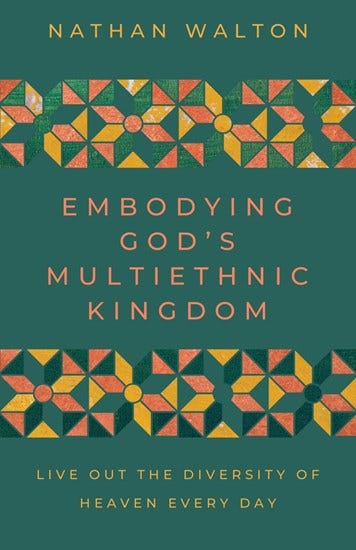
The book: Embodying God’s Multiethnic Kingdom: Live Out the Diversity of Heaven Every Day by Nathan Walton. InterVarsity Press.
Buy from IVP or choose a retailer.
Advertisement · From Brandon Burley / Project Forge Books
Continue the conversation about justice. My book Exploring Criminal Justice: The Basics of Ethics and Theory offers another starting point for readers interested in ethics and the criminal justice system.
Explore the Kindle edition on Amazon
A promotion for my own book, separate from this independent review. Check the retailer for current pricing and availability.