


The Redemption Project Newsroom
Johnson City did not approve a few roadside cameras.
In July 2025, the city authorized a 10-year agreement with Flock Safety for 145 license plate readers, 145 pan-tilt-zoom video cameras, two mobile security trailers, gunshot-detection technology and software for a real-time crime center.
The first-year payment was $300,000. There is no year-two payment. The city’s published payment schedule calls for $970,375 annually during years three through 10.
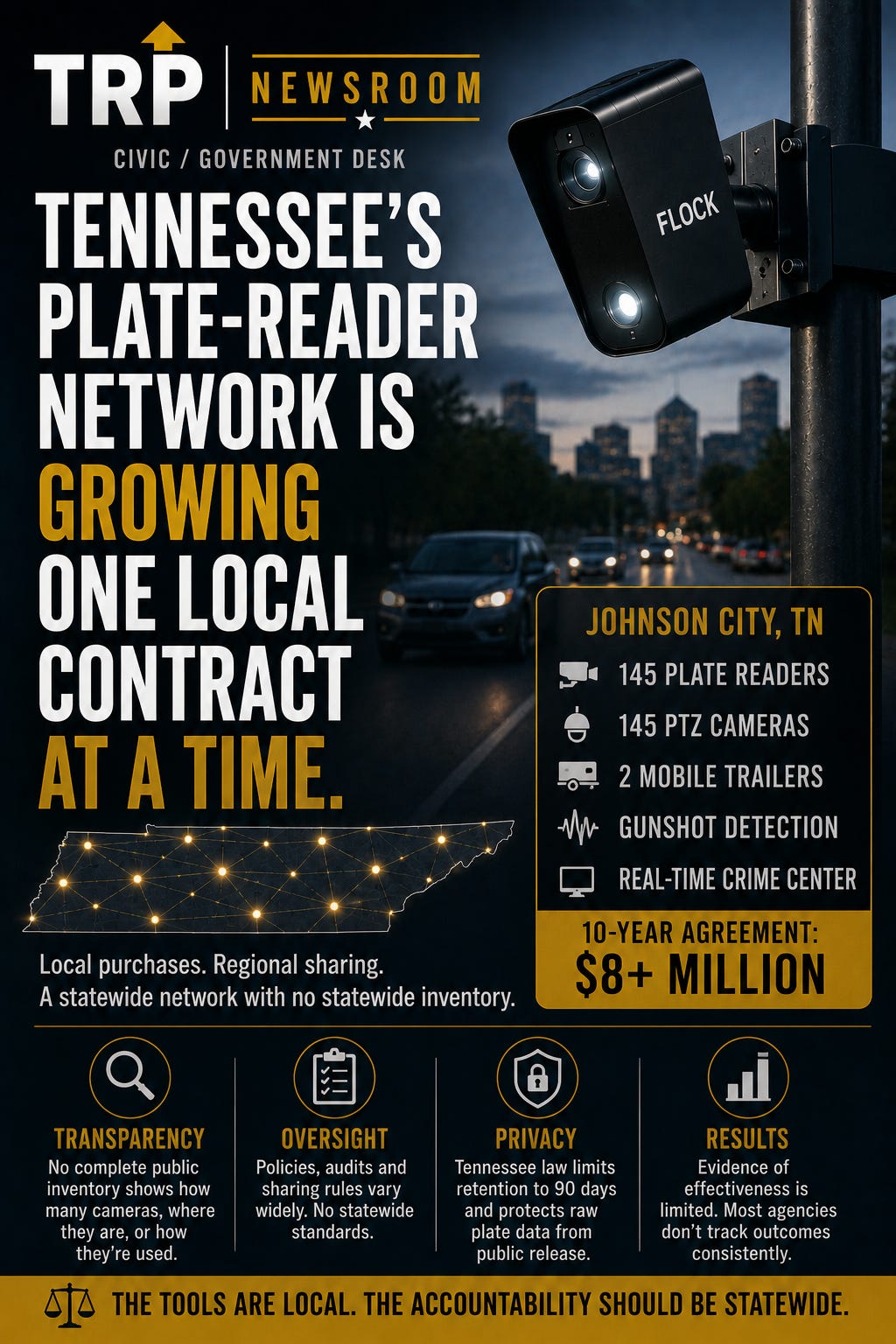
That places the full agreement at more than $8 million.
Johnson City says installation is expected to be completed by Aug. 1, 2026.
The city also says its police department automatically shares Flock data with law-enforcement agencies within a 500-mile radius and has the ability to connect with more than 5,000 other agencies using the company’s platform.
That is more than a camera purchase.
It is a local government buying a place inside a regional surveillance network.
Johnson City has published considerably more information about its system than many communities. The city has disclosed the equipment, cost, general placement strategy, retention period, local sharing partners and portions of its use policy.
That transparency is useful.
It also reveals how many questions Tennessee does not require every agency to answer.
There is no complete statewide public inventory showing how many plate readers are operating, where they are located, which companies provide them, how local sharing settings are configured, how often officers search them or whether the searches produce arrests, prosecutions and measurable reductions in crime.
Tennessee regulates how long ordinary plate-reader data may be stored.
It does not require a full public accounting of what happens while the data exists.
The network was not built through one state plan
The first article in this series explained how automated license plate readers convert roadside observations into searchable records containing a vehicle image, plate number, time and location.
In Tennessee, that capability did not arrive through one statewide deployment.
Cities and counties bought systems separately.
Some began with a handful of cameras at major roads or city entrances. Others added cameras through annual budgets, police drug funds, grants, neighborhood partnerships or contracts with private businesses.
The result is not one centrally designed Tennessee network.
It is a collection of local systems that can become connected through vendor platforms, interagency agreements, regional intelligence centers and requests from other law-enforcement agencies.
By February 2023, WBIR reported that more than 1,000 cameras were already capturing license plates across Tennessee. That count included multiple agencies and was not limited to one vendor.
Deployment has continued since then.
Johnson City previously operated 11 license plate readers. Its new agreement increases that number to 145 while adding an equal number of general-purpose video cameras and several other surveillance and response tools.
Kingsport, Knoxville, Chattanooga, Memphis, Murfreesboro and numerous smaller cities and counties also use plate-reader or real-time crime center technology in various forms.
But no statewide dashboard allows a Tennessee resident to see the network as a whole.
A Tennessee survey found rapid growth and uneven rules
A 2024 survey conducted by the University of Tennessee Municipal Technical Advisory Service and the Howard H. Baker Jr. School of Public Policy and Public Affairs offers one of the clearest available views.
Fifty-three Tennessee municipal police departments participated.
Two-thirds reported using automated license plate readers.
