


The Redemption Project Newsroom
Tennessee’s new political-deepfake law tells campaigns exactly what warning voters must receive when artificial intelligence makes a candidate appear to say or do something that never happened.
What the law does not clearly say is who will be watching.
The Transparency for Deepfakes in Political Advertising Act took effect July 1. It requires certain paid political advertisements to disclose when audio or video falsely depicts a candidate saying or doing something that did not occur.
The required warnings are unusually direct.
An audio advertisement must say at both the beginning and the end: “This communication contains fake content impersonating speech that did not occur.”
A video must display a warning in large letters for the duration of the video. If the video falsely depicts actions, the warning must say: “This communication contains fake content depicting actions that did not occur.” If it falsely depicts both actions and speech, the warning must say: “This communication contains fake content depicting actions and speech that did not occur.”
That is a real disclosure requirement.
It gives voters a clear signal when synthetic media is being used to impersonate a candidate. It also gives campaigns a legal standard they did not previously have.
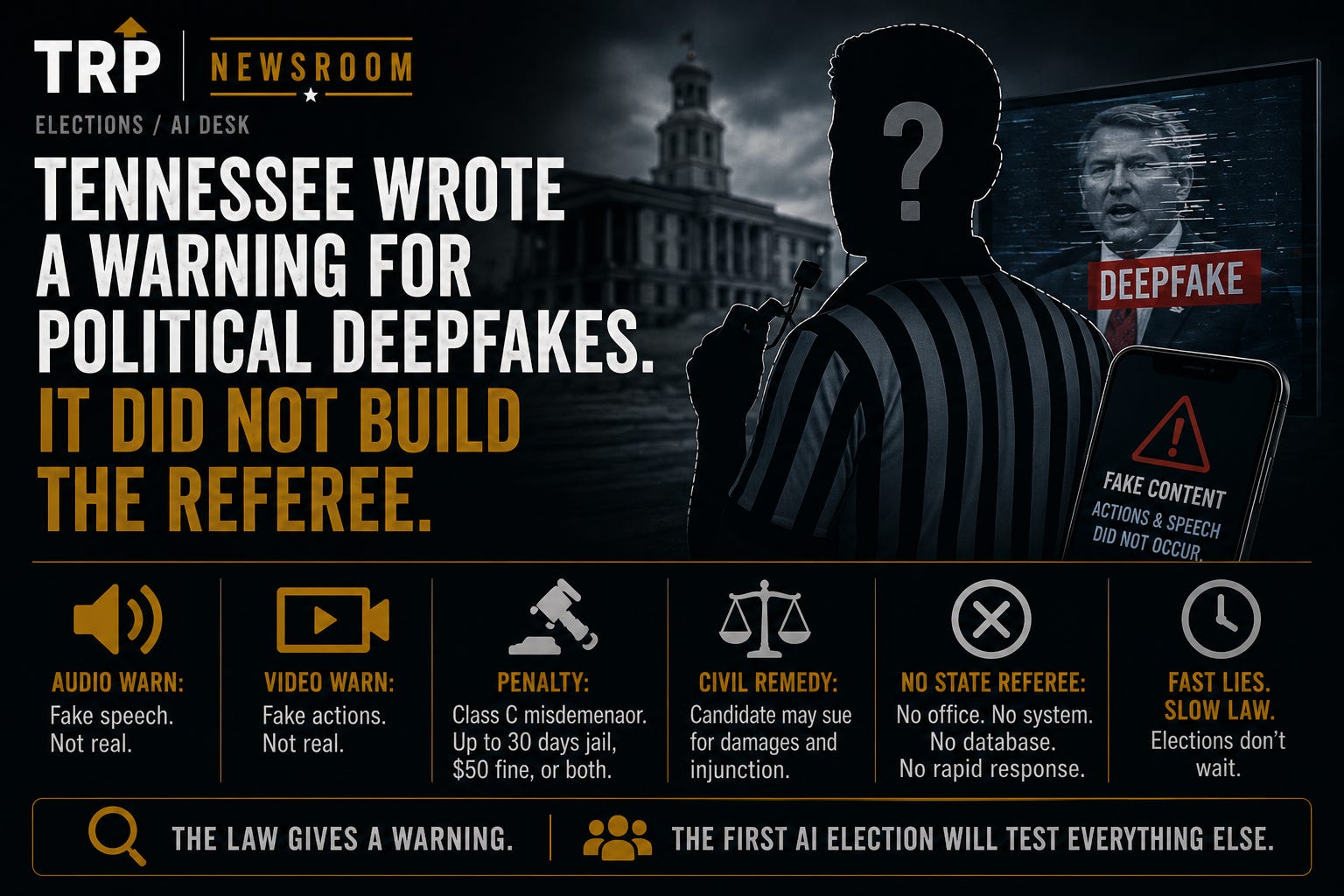
But disclosure is only one part of election protection.
Someone still has to detect the violation.
Someone has to identify who made or paid for the advertisement.
Someone has to preserve the evidence.
Someone has to take the case to a prosecutor or a judge.
And someone has to do all of that before the election clock runs out.
That is where Tennessee’s law may be weakest.
A violation is a Class C misdemeanor. Under Tennessee sentencing law, that generally carries a maximum punishment of 30 days in jail, a fine of no more than $50, or both, unless another statute provides otherwise.

