



Justin J. Pearson and Brent Taylor won their primaries Thursday. Now voters will test a district the state says was drawn for Republican advantage and challengers say diluted Black political power.
By The Redemption Project Newsroom
Elections / Congressional Desk
For two decades, Tennessee’s 9th Congressional District was one of the easiest districts in the state to understand.
It was centered on Memphis, had a majority-Black population and reliably elected Democrats. Since 2006, it sent Steve Cohen to Congress.
That district no longer exists in the same form.
Thursday’s primary produced the first general-election matchup under Tennessee’s dramatically redrawn 9th District. Democratic state Rep. Justin J. Pearson will face Republican state Sen. Brent Taylor in November.
The candidates offer voters sharply different political choices.
But the larger test is the map that brought them together.
The Legislature changed more than district lines
Tennessee lawmakers redrew the congressional map during a May special session after the U.S. Supreme Court weakened federal Voting Rights Act protections governing minority representation. The new boundaries split Memphis and Shelby County among three congressional districts extending outward into more Republican territory.
The state has been unusually direct about its political objective.
In a July ruling allowing the map to remain in place for the 2026 elections, a federal three-judge panel wrote that Tennessee said it redrew the districts to create a Republican advantage in all nine of the state’s congressional seats and help Republicans retain control of the U.S. House.
Black Memphis voters and civil-rights organizations challenging the map argue that race was also a significant motivation and that dividing the former majority-Black 9th District unconstitutionally diluted Black voting power.
The court did not resolve that lawsuit in Tennessee’s favor permanently. It denied a preliminary injunction, finding that the plaintiffs had not shown they were likely to prove discriminatory purpose at this stage. The panel said the racial effects identified by the plaintiffs could also be explained by Tennessee’s acknowledged partisan objective.
The litigation continues.
The election does too.
This is barely the old 9th District
The scale of the change is difficult to overstate.
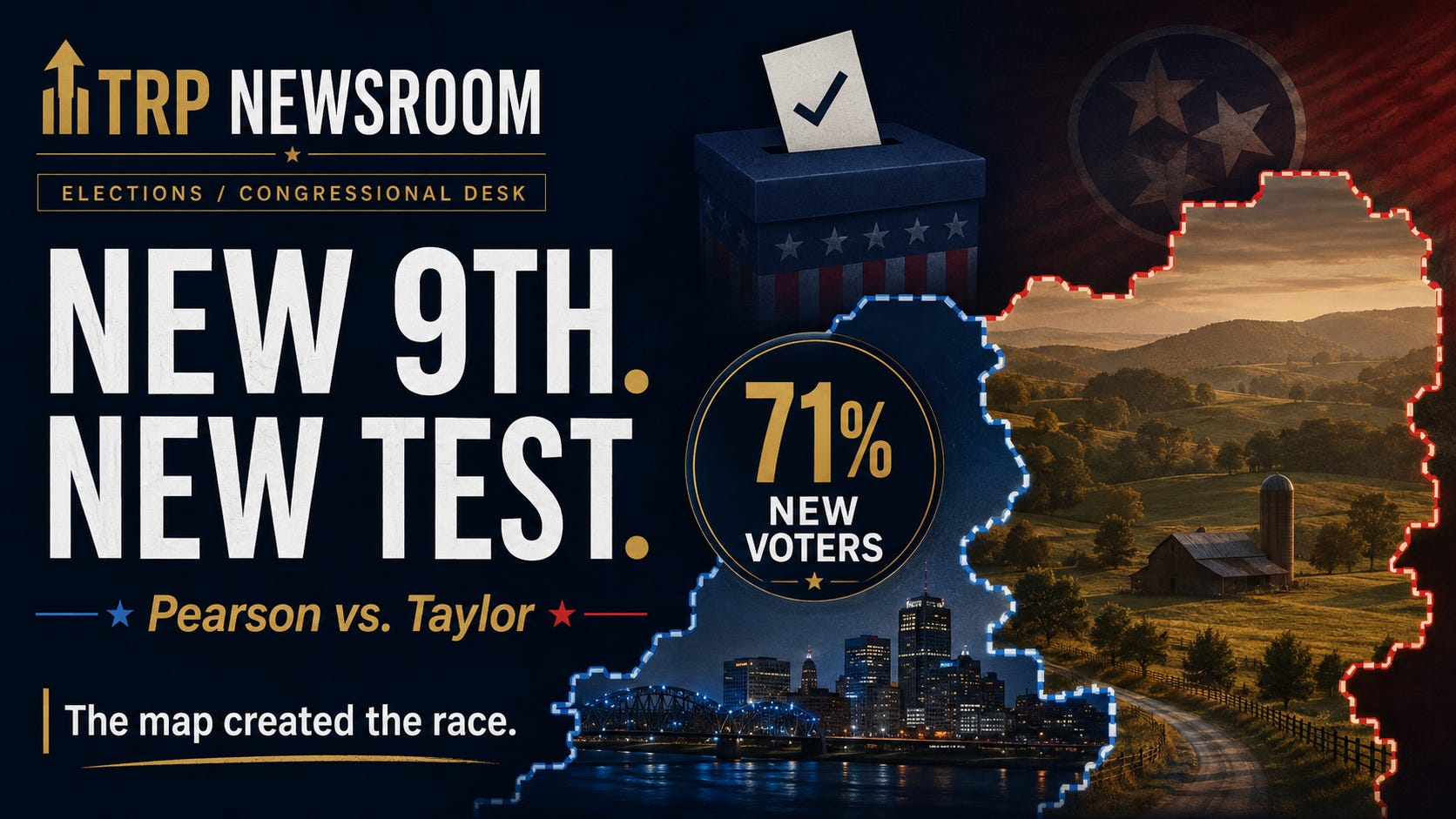
The new 9th stretches roughly 200 miles east from Memphis through rural Tennessee before turning north toward the Nashville area. The Associated Press estimates that 71% of the voters in the new district were not part of the previous 9th District.
The partisan numbers changed just as dramatically.
Kamala Harris carried the previous district with about 71% of the presidential vote in 2024. Under the new boundaries, Donald Trump would have received roughly 60%.
That is not a minor adjustment around the edges.
It is a different electorate.
Cohen announced after the redistricting that he would not seek another term. Pearson, who had originally planned to challenge Cohen in the Democratic primary, remained in the race and won Thursday’s nomination.
Taylor won the Republican nomination after entering a race in which he had President Trump’s endorsement.
Now both candidates have to campaign beyond the political environments that made them prominent.
Pearson’s test extends beyond Memphis
Pearson enters November with national recognition from the 2023 “Tennessee Three” controversy, when he and state Rep. Justin Jones were expelled from the Tennessee House after participating in a gun-control protest on the House floor. Both later returned to office through elections.
His political identity is closely connected to Memphis, progressive activism and arguments about racial and voting representation. On election night, Pearson explicitly tied the new congressional map to the Voting Rights Act and argued that Black political power was being diluted.
His November problem is mathematical and representational.
Pearson cannot win merely by reproducing the Democratic coalition that elected Cohen.
He must compete in a district that now includes large numbers of rural and Republican-leaning voters who were never Cohen’s constituents and may disagree with Pearson on guns, crime, immigration and national politics.
The question is not only whether Memphis turns out.
It is how far Memphis political strength can travel beyond Memphis.
Taylor faces the opposite test
Taylor begins with the map’s Republican advantage.
He supported the National Guard deployment in Memphis that Pearson opposed, and he sponsored a state law requiring law-enforcement agencies to communicate with federal immigration authorities when they encounter people believed to be in the country illegally. Trump endorsed him in July.
Those positions helped define his Republican campaign.
November requires something broader.
Taylor must persuade voters inside Memphis — including Black voters who believe the new map reduced their political influence — that he intends to represent their interests rather than simply benefit from a district designed to improve Republican prospects.
That is a different test from winning a Republican primary.
A congressional representative does not represent the voters who elected him.
He represents everyone inside the district.
One district, very different communities
That may be the most important question created by the new map.
Congressional districts are usually discussed as electoral mathematics: Republican percentage, Democratic percentage, turnout, margins and seats.
