

by Brandon Burley and The Redemption Project
Tennessee governor candidates, side by side: What they believe would most improve public safety statewide
Public safety is where campaign language usually gets exposed fastest.
It is easy to promise safer communities. It is much harder to explain what state government would actually change first, especially in a state where public safety does not look the same in Memphis, Nashville, Knoxville or rural Tennessee.
That is part of why this question matters more than almost any other in the series.
Earlier today, my Knox TN Today column examined how public safety discussions often drift into slogans while avoiding the harder operational questions: who responds, what gets funded, what gets prevented and what systems quietly fail before crime statistics ever make headlines.
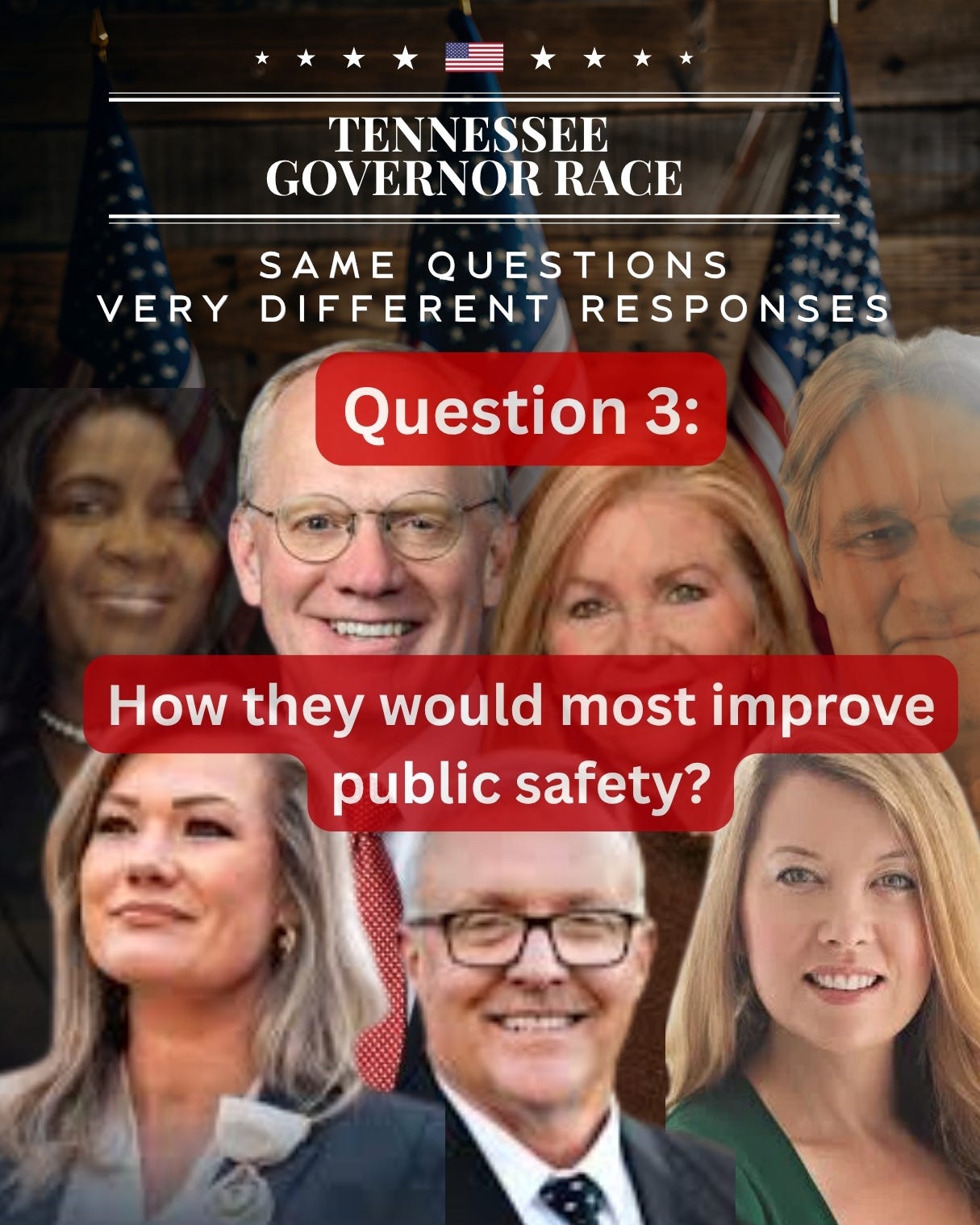
So I asked each gubernatorial campaign one direct question:
What specific change in state policy would most improve public safety statewide?
The answers split sharply.
Some candidates centered enforcement.
Others focused on poverty, mental health or firearms.
Some answered in systems.
Some answered in philosophy.
John Rose answered with the most traditional statewide governing frame.
His response focused on repeat offenders, accountability and mental health access.
That combination reflects a familiar challenge Tennessee already faces: law enforcement often becomes the visible front line for problems that begin much earlier—in untreated behavioral health crises, inconsistent supervision and overloaded local systems.
His answer reads like someone viewing public safety through state structure: enforcement remains necessary, but outcomes worsen when mental health care fails upstream.
Lauren Pinkston gave the broadest answer in the field and the most layered one.
Rather than name one single intervention, she argued that statewide safety cannot honestly be reduced to one answer because rural Tennessee and urban Tennessee experience risk differently.
Her response then broke into four parts: immigration, firearms, mental health and private prisons.
That is notable because she is the only candidate who treated public safety as an interconnected system rather than a single policy lane.
She opposed unconstitutional federal coordination in immigration enforcement, supported safe storage and crisis-based firearm measures while explicitly affirming Second Amendment protections, called for expanded mental health co-responder programs and proposed performance benchmarks for correctional facilities tied to recidivism, staffing and safety outcomes.
Whether voters agree with every piece or not, hers was the most structurally developed answer submitted.
Jerri Green answered from the root-cause side of public safety.
She began with wages, arguing that poverty remains one of the most direct pathways into crime regardless of geography.
Her answer then moved into firearm storage and mental health treatment, specifically arguing that stolen guns from vehicles continue feeding violent crime while untreated addiction and mental illness continue pushing people into jail systems that were never designed to function as treatment centers.
Her answer treats public safety less as punishment policy and more as prevention policy.
Monty Fritts gave the shortest and most ideologically direct answer.
He focused almost entirely on protecting gun rights, arguing that an armed public remains the strongest deterrent against both criminal violence and government overreach.
His answer stands apart because it does not treat public safety as a layered service system; it defines safety first through citizen deterrence.
Tim Cyr also centered mental health, though in a more personal way.
He argued Tennessee should move from near the bottom nationally to the top in mental health care and connected that view to personal experience and family exposure to behavioral health work.
His answer lacked the policy detail of larger campaigns, but it still returned to a recurring theme visible across multiple candidates: mental health is no longer being treated as separate from public safety.
Adam “Ditch” Kurtz approached public safety through criminal justice reform rather than traditional enforcement language.
His answer focused on bail reform for nonviolent offenses, arguing that keeping lower-risk defendants in jail before trial often destabilizes employment, increases pressure on local jails and does little to improve long-term safety outcomes.
He also tied public safety to cannabis legalization, saying Tennessee should redirect resources now spent on low-level possession enforcement into mental health responders, crisis teams and better officer pay so law enforcement can remain focused on violent crime.
His answer introduced something none of the other candidates emphasized directly: reducing system overload itself as a public safety strategy.
Marsha Blackburn did not provide a response in time for today’s post, though her campaign has now opened communication and requested the questionnaire again.
Carnita Atwater also did not provide direct responses.
By the third question, one pattern is becoming difficult to ignore:
Even when candidates disagree sharply, mental health keeps appearing in their answers.
That alone says something about where Tennessee’s public safety debate may already be moving.
The sharper divide is what comes next:
Should public safety begin with stronger enforcement, fewer economic pressures, firearm policy, mental health systems or citizen self-protection?
Because each candidate now appears to be answering that differently.
Tomorrow’s question shifts away from crime and into something more uniquely Tennessee:
I love these because you are seeing their answers without the cinema of a live debate that often ends in click bait and memes rather than hearing the candidates actual positions on things! Thank you!
So thankful for Lauren at this time being a voice for the politically homeless. I hope she succeeds in bringing reason back to the table!