

by Brandon Burley and The Redemption Project
Tennessee governor candidates, side by side: What they say they would do differently than Bill Lee
The second question in this series forces a harder kind of answer because it removes the safety of general campaign language.
It is easy for candidates to talk about Tennessee’s future in broad terms. It is harder when they have to explain what they would actually change if they took over the same office tomorrow.
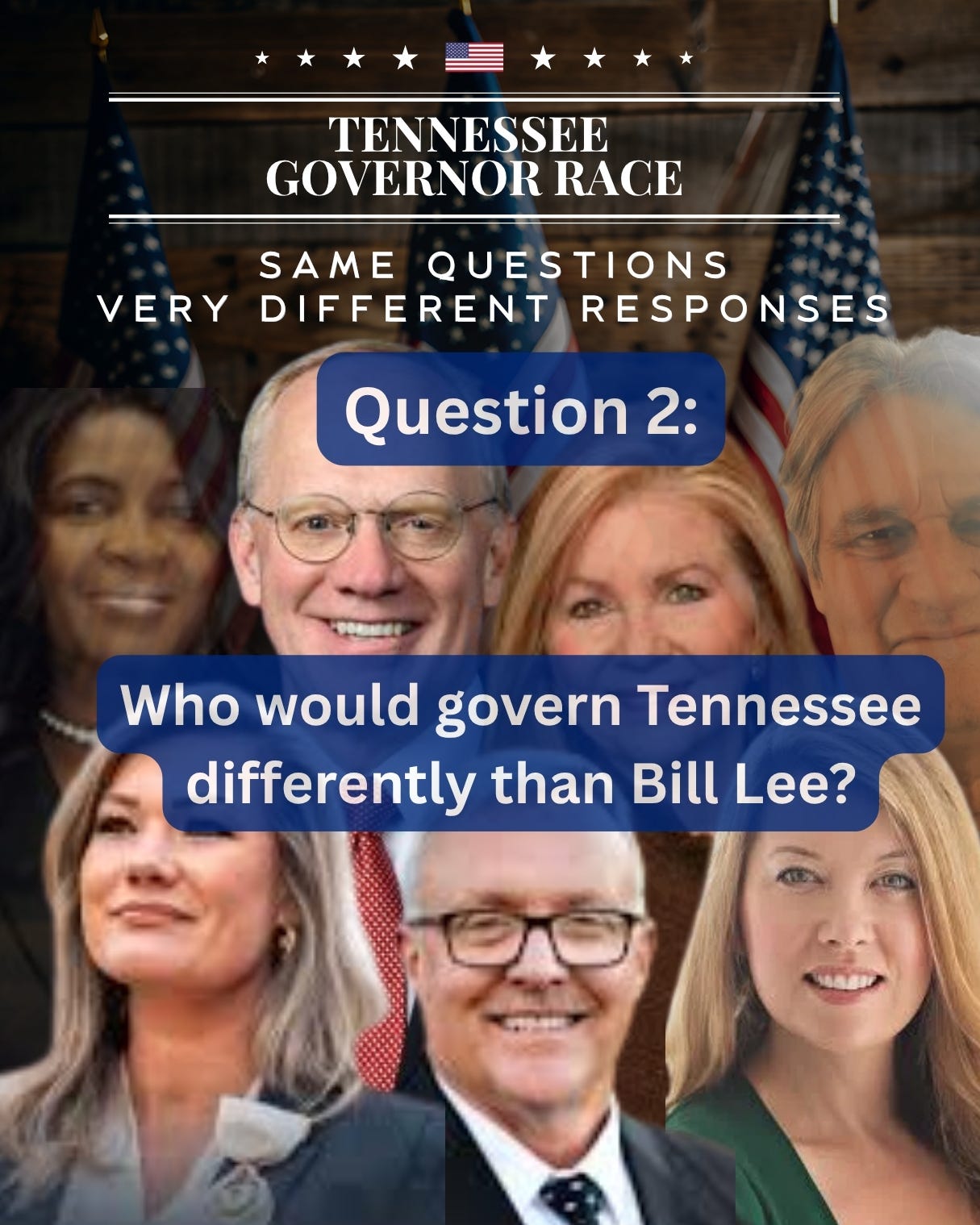
So I asked each campaign one direct question:
What would you do differently from Gov. Bill Lee in practical governing terms rather than simply continue his approach?
The differences appeared quickly.
Some candidates answered like administrators.
Some answered like reformers.
Some answered like critics of the current system itself.
And some chose not to answer at all.
John Rose gave the most measured response in the field.
Rather than identify a specific Lee policy he would reverse, he described a different governing style—listening first, then executing. He pointed to traveling all 95 counties, hearing directly from Tennesseans, and applying what he described as a CEO mindset focused on accountability and results.
It is a disciplined answer because it creates distance without creating conflict. In a Republican primary, that matters. Rose is signaling managerial difference without directly attacking an incumbent Republican administration that remains broadly popular inside much of the party.
The unanswered part is where voters may press further: if the management changes, where would people actually see that first?
Lauren Pinkston answered more structurally.
Her response argued that Tennessee’s one-party political environment has weakened serious debate inside government and allowed lawmakers to focus more on ideological performance than practical problem solving.
Her proposed difference was unusually specific: publishing weekly summaries of verified voter input on active policy issues, distributing them to all legislators, and making them public so voters can see whether their concerns are reaching Nashville in real time.
That answer stands out because it does not begin with a policy promise. It begins with changing how pressure enters the system.
She also framed federal resistance as part of the governor’s role, arguing Tennessee should use legal and legislative tools more aggressively when federal action conflicts with state autonomy or voter privacy.
Jerri Green answered through budget priorities.
Her response argued that Tennessee government has favored corporations, billionaires and well-positioned interests while ordinary Tennesseans continue carrying everyday financial pressure.
She specifically pointed to corporate tax rebates, loopholes, grocery taxes and voucher spending as examples of where she believes current priorities are misaligned.
Her answer does not simply criticize Bill Lee’s administration; it identifies where she believes state money has been signaling the wrong values.
That matters because governors often reveal priorities fastest through what they protect in a budget.
Monty Fritts answered from the clearest limited-government position in the field.
He focused on reducing what he described as top-heavy agencies and shifting state emphasis away from expanding upper administrative layers.
His answer framed the difference from Lee as structural restraint: fewer layers, less centralized influence and more emphasis on the employees actually carrying out state work.
Whether voters agree or not, his answer is internally consistent with the rest of his campaign language. Nearly every issue he answers returns to the same operating principle—government should do less and hold less.
Tim Cyr gave the shortest answer but one of the most direct.
He focused first on restoring funding removed from programs serving disadvantaged children.
Rather than describe broad philosophical differences, he identified one immediate area where he believes state priorities should have stayed different.
It is a simpler answer than others, but it gives voters something concrete quickly.
Marsha Blackburn did not respond to the questionnaire.
Carnita Atwater also did not provide direct responses.
By the second question, a larger pattern is already emerging.
Some candidates define leadership as management.
Some define it as redirection.
Some define it as reducing government itself.
And some are still allowing voters to infer where they stand rather than state it directly.
Tomorrow’s question moves from governing style to something even harder:
What specific state policy would most improve public safety across Tennessee?
That is where candidates usually stop speaking in broad theory and start revealing what they believe government should actually enforce.
At best, some of the candidates talk about their policies and the resulting projects and programs they would focus on.
But is noticeable that not one candidate mentioned that the job of governor is first and foremost to be a public servant.