


A March 31 school-board resolution required a written summary of the final forensic audit within 45 days and established a broader corrective-action process. MSCS has a public reform dashboard, but TRP has not located the document showing how the July 8 final audit was formally handled under the board’s own timeline.
By The Redemption Project Newsroom
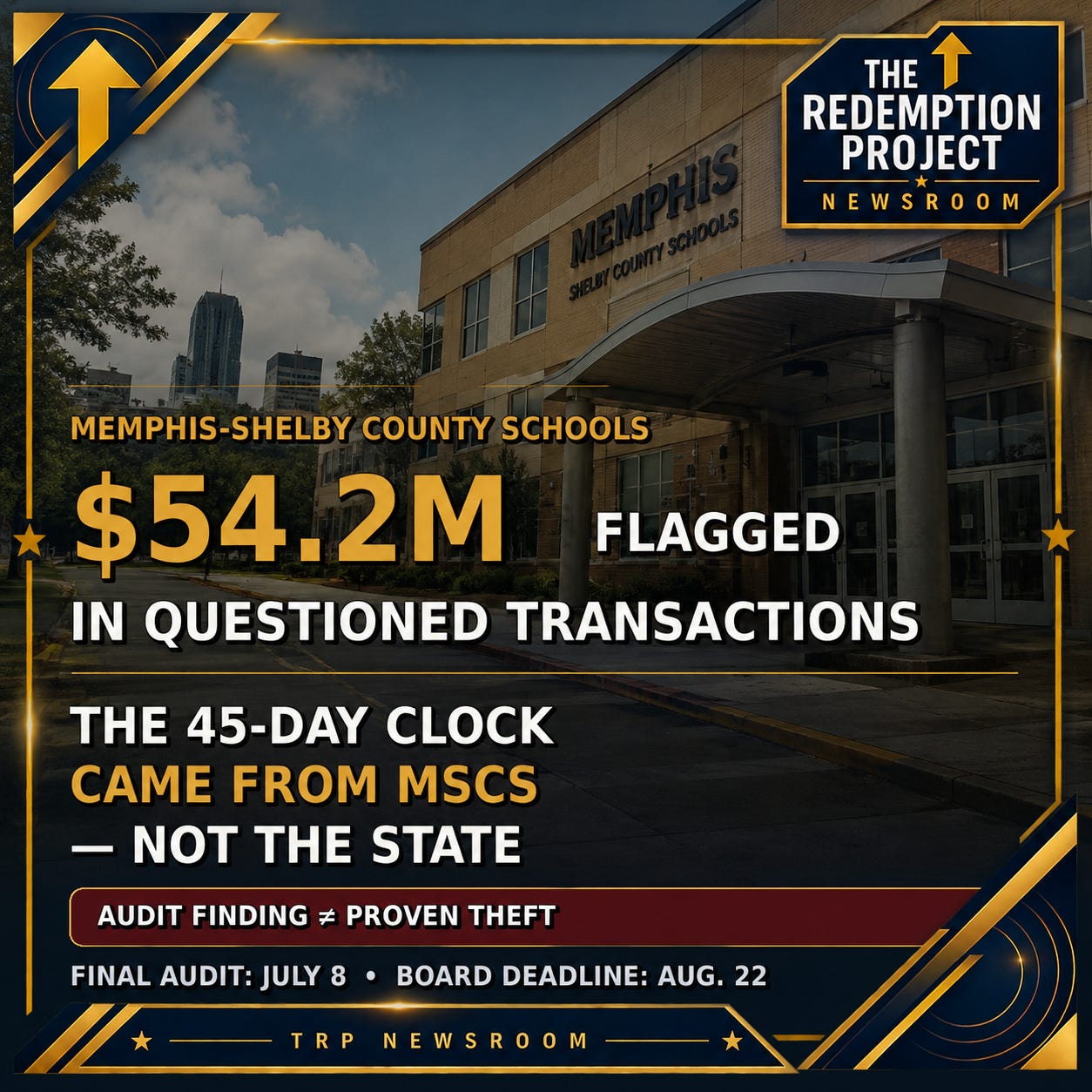
MEMPHIS, Tenn. — Tennessee’s final forensic review of Memphis-Shelby County Schools arrived with figures large enough to dominate the public debate: $54.2 million in transactions auditors said were consistent with evidence of potential fraud, waste or abuse; another $65.1 million associated with possible policy or procedural noncompliance; and 185 observations producing 133 recommendations.
Memphis-Shelby County Schools has not ignored those findings. The district maintains a public Operational Modernization & Excellence Plan and a live dashboard tracking work on procurement, contracts, payroll, human-resources files, compliance and digital systems.
What remains difficult to identify publicly is something narrower: the formal response to the July 8 final audit required by the district’s own school board.
A 45-day deadline widely associated with the audit was real. But it did not come from Tennessee’s new educational-oversight law, and the Comptroller’s July 8 announcement does not impose it.
The clock came from MSCS itself.
The school board created the 45-day requirement in March
On March 31, before the final forensic report was released, the Shelby County Board of Education adopted a resolution establishing what it called a framework for collaborative audit remediation and operational excellence. Contemporary reporting confirms the board approved the measure alongside Superintendent Roderick Richmond’s permanent contract.
The resolution says that after receiving the preliminary and final audit reports, the superintendent must analyze the findings and provide the board with written high-level summaries within 30 and 45 days, respectively.
The final report was released July 8.
Forty-five days later was Aug. 22.
That makes Aug. 22 a defensible deadline for at least one specific document: Richmond’s written high-level summary of the final audit to the school board.
TRP has not located that document on the district’s public audit-updates page or identified a publicly posted board filing that clearly says it satisfies that requirement.
But describing Aug. 22 as a simple deadline for the district’s complete corrective-action plan goes farther than the resolution supports.
The resolution contains more than one 45-day clock
The board created a sequence.
After the written summary of the final report, the resolution gives the board and superintendent another 45 days to jointly review it and identify three to five priority audit issues presenting the greatest operational, legal or fiscal risk.
The next provision calls for the superintendent to submit a corrective-action plan addressing each agreed-upon priority. That plan must include root causes, measurable corrective measures, deadlines and milestones, responsible departments and individuals, performance indicators, preventive controls, required resources and any needed policy changes.
The difficulty is the timing language.
The corrective-action provision also uses the phrase “forty-five (45) days of the final report,” even though the immediately preceding provision potentially gives the board and superintendent 45 days after the final-report summary to select the priorities that the corrective plan is supposed to address.
Those provisions do not create a clean basis for saying the entire corrective-action process unquestionably expired Aug. 22.
They do create a straightforward question for MSCS:
Which document satisfied each step of the board’s resolution, and when was each step completed?
The state takeover law created a different process
Tennessee’s new educational-oversight law should not be substituted for the district’s resolution.
Public Chapter 1057 created an Educational Oversight Board for qualifying districts and requires an initial comprehensive needs assessment no later than Oct. 1 or 90 days after the oversight board’s first meeting, whichever comes first. Based on that assessment, the board develops a transformation plan containing performance and operational goals and benchmarks.
That is a separate accountability system.
The state law does not establish the March 31 school board’s 45-day final-audit summary requirement.
The distinction matters because the district and state are simultaneously fighting in federal court over the oversight board’s authority. The latest publicly indexed federal docket reviewed by TRP shows the litigation continuing through August with an amended complaint and renewed dismissal motions.
The forensic-audit response should not disappear inside that governance dispute.
MSCS does have a public reform dashboard
It would be inaccurate to suggest Memphis has published no remediation plan.
MSCS’s Operational Modernization & Excellence Plan currently presents a public “Governance Dashboard — Compliance & Reform Tracking.” Among other measures, it tracks a central contract repository, HR-file compliance, payroll documentation, procurement procedures, compliance consulting and systems integration.
The dashboard shows several measures in progress and some payroll controls marked complete. Other categories, particularly portions of digital transformation and systems integration, remain at zero or not started.
That is useful accountability information.
It also predates the final audit.
MSCS launched the reform dashboard in April after preliminary audit findings were released, roughly three months before the Comptroller published the final report July 8.
The district’s broader transparency page now houses that dashboard along with a Local Accountability and Transformation Plan, finance and procurement reviews, contract reviews and the separate audit-updates page.
What TRP has not located is a public crosswalk showing what changed after the final audit: which of its 133 recommendations were accepted, which were already addressed, which remain open, which fall within the three to five priorities required by the board resolution and which the district disputes.
That is different from saying no reform work exists.
What the audit actually found
The review by CliftonLarsonAllen examined district operations during fiscal years 2022 through 2024 and identified serious weaknesses in procurement, contracting, governance, internal controls, financial oversight and recordkeeping.
The largest questioned matter involved approximately $48.4 million paid under a custodial-services contract. Auditors said an evaluation committee had recommended multiple vendors, but the district ultimately awarded the work to a single vendor without documentation explaining the change. The report said records indicated that a former chief of business operations influenced the award outside the established procurement process, and the contract was later terminated for poor performance.
After that termination, MSCS referred separate whistleblower allegations concerning the procurement to the FBI. CLA said it could not independently verify those allegations or determine what happened to the referral.
Auditors also identified approximately $3.1 million in payments to Mid-South Renovations where evidence indicated a conflict involving the former director of facilities and maintenance. The report identified $400,000 in work the district determined was performed negligently and $250,000 paid for work the district determined was never completed.
Other findings involved Allworld Project Management, possible Open Meetings Act violations, internal-control and cybersecurity weaknesses and approximately $880,000 in remaining Herbert STEM Center funds held by SchoolSeed, which auditors said declined to provide requested bank statements.
Those are audit findings, not criminal convictions.
The $54.2 million figure should not be rewritten as money proved stolen, and the $54.2 million and $65.1 million categories should not be casually added together without confirming whether the underlying transactions overlap.
The board’s own standard is measurable
The March 31 resolution provides a useful test for whatever MSCS identifies as its formal corrective-action plan.
For each of the three to five agreed priorities, the board required the plan to identify the underlying problem and root cause, measurable corrective steps, realistic completion dates and interim milestones, responsible leaders, performance indicators, controls designed to prevent recurrence, required resources and policy changes.
That is considerably more specific than saying the district is improving procurement or strengthening internal controls.
The district’s public dashboard may contain many of those elements.
The missing step is showing how the dashboard, the final audit and the board-mandated response connect.
The 133 recommendations still need a public disposition
The board resolution does not appear to require a corrective-action plan containing 133 separate lines.
It calls for selection of three to five priority audit issues.
That does not make the remaining recommendations irrelevant.
A transparent final-audit record could identify each recommendation as accepted, already completed, incorporated into another project, scheduled for future work, rejected with an explanation or outside the selected priority plan.
That kind of crosswalk would let taxpayers distinguish between work underway and findings actually closed.
It also would prevent the district and state from using different scorecards when describing progress.
The question is no longer whether a deadline existed
A deadline did exist.
The stronger question is what the deadline actually required.
The Comptroller released the final audit July 8. The school board had already ordered Richmond to provide it with a written high-level summary within 45 days. That local requirement points directly to Aug. 22.
The same resolution then established additional steps for selecting priority issues and producing a corrective-action plan, using timing language that does not fit neatly into a simple “everything was due Aug. 22” description.
Meanwhile, MSCS has publicly documented substantial remediation work through its Operational Modernization & Excellence dashboard.
Those facts can coexist.
The fastest way to clear up the remaining question is for the district to publish the document it considers its 45-day final-audit summary, identify the date it was provided to the board and explain the timetable it is using for the remaining corrective-action requirements.
The audit documented years of weak controls.
The public should not need another audit to reconstruct how the response to that audit was handled.
Behind the Reporting: What the 45-Day Deadline Actually Says
Paid subscribers get the deadline audit, numerical ledger, public-dashboard review, records strategy and primary-source library behind this report.
