
Systems Explained: How TDOT’s interstate studies shape Tennessee’s future before roads are built
By The Redemption Project Newsroom
Civic / Government Desk
Is this your thoughts about TDOT? You’re not alone.
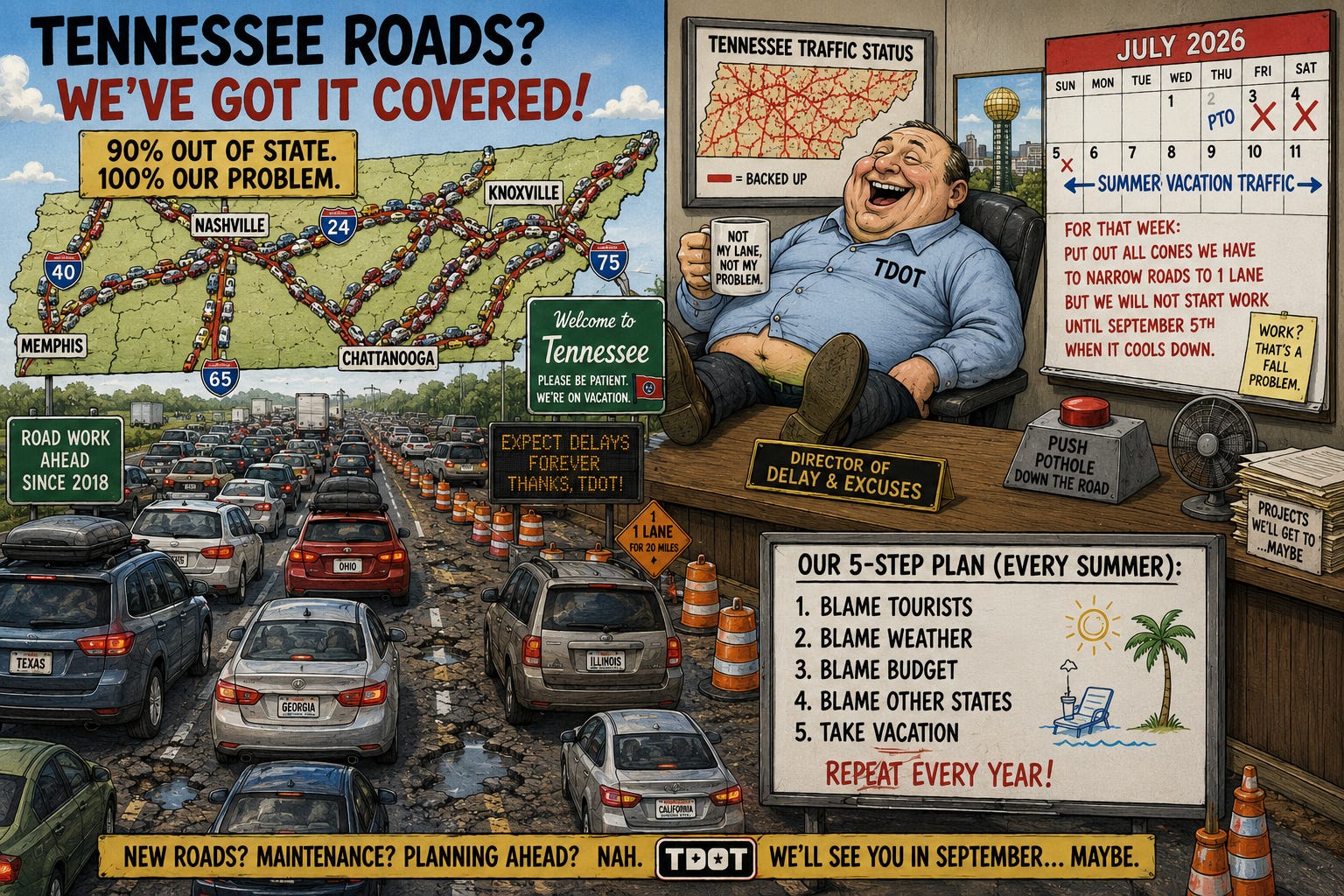
TDOT’s public meetings on the I-40/I-75 corridor west of Knoxville are not just about traffic.
They are about how major road projects become real.
Before a bypass is built, before a new lane is added, before a bridge is replaced and before property is acquired, the state begins with studies, alternatives, public input and decisions about which options should move forward.
That is where Tennessee is now on the I-40/I-75 West Knoxville Corridor.
The Tennessee Department of Transportation is studying about 17 miles of I-40/I-75 west of Knoxville, from the I-40/I-75 interchange in Loudon County to the I-640 interchange west of downtown Knoxville. The study area includes Anderson, Knox and Loudon counties.
TDOT says the study is looking at congestion relief, safety improvements and long-term corridor strategy. The options include a no-build alternative, choice lanes, collector-distributor roads, express bus service, interstate widening and a possible I-75 bypass.
Public comments are open through July 22.
That deadline matters because the project is still in an early planning stage. The state has not selected a final construction plan. Instead, TDOT is using a process called a Planning and Environmental Linkages study, or PEL study, to decide which ideas should remain on the table and which should be removed before later environmental review.
In plain language, a PEL study helps the state narrow the choices before a project becomes more formal, more expensive and harder to change.
That is why public input matters now.
People are not commenting on finished blueprints. They are commenting before the state decides which alternatives deserve to survive.
The West Knoxville corridor is a useful example of how the system works.
First, TDOT identifies a transportation problem. In this case, the problem is congestion, safety and reliability on one of East Tennessee’s most important interstate corridors.
The I-40/I-75 corridor carries local commuters, freight traffic, interstate travelers, emergency vehicles, tourists, suburban growth and regional connections to places such as Oak Ridge, Farragut, Hardin Valley, West Knoxville and Loudon County.
Second, TDOT studies possible solutions.
That can include widening existing interstate lanes, changing interchanges, adding collector-distributor roads, improving transit options, creating managed lanes or studying a new route.
Third, TDOT asks for public input.
That is the stage Knoxville-area residents are seeing now. Public meetings and written comments give residents, business owners, local officials and property owners a chance to raise questions before the list of alternatives becomes smaller.
Fourth, TDOT decides which alternatives should advance into the next phase.
The next phase is usually more formal environmental review under the National Environmental Policy Act, known as NEPA. That process examines environmental, community, traffic, property, safety and other impacts before a major federally connected project can move toward construction.
The important point is that a road project does not begin when bulldozers arrive.
It begins when a transportation problem is defined, alternatives are screened and the public record starts to form.
That is why early planning can shape a region for decades.
A bypass does not simply move traffic. It can change where homes are built, where businesses open, which farms or neighborhoods face pressure and which areas become more attractive for development.
A widened interstate can relieve congestion, but it can also bring construction disruption, noise, stormwater questions and right-of-way impacts.
A new interchange can improve access, but it can also reshape land values and development patterns around it.
A choice lane can provide a more reliable trip for drivers who pay to use it, but it also raises questions about pricing, public-private partnerships, data collection, transit access and who receives the benefit of reliability.
That is the system behind the debate.
TDOT defines choice lanes as new, optional lanes that use pricing to manage demand and provide reliable travel times. Existing general-purpose lanes remain free. Drivers who choose to use the new lanes pay a fee.
Supporters say choice lanes can help address congestion, improve travel-time reliability and provide another way to finance highway capacity. Critics and concerned residents often ask whether reliable travel becomes tied to ability to pay, who sets prices, whether prices can rise during heavy demand and whether private partners will operate or maintain the lanes.
Those questions are not limited to Knoxville.
Tennessee is already moving through a broader transportation shift.
In Middle Tennessee, TDOT is advancing the I-24 Southeast Choice Lanes project between Nashville and Murfreesboro. That project is designed to add optional priced managed lanes through a public-private partnership.
In Nashville, TDOT has studied downtown interstate corridors, including portions of I-65, I-24, I-40, I-440 and the downtown inner loop.
In Chattanooga, TDOT has studied widening along I-24 near Moccasin Bend.
In West Tennessee, Tennessee and Arkansas are moving toward replacing the I-55 bridge over the Mississippi River, a major freight and interstate connection now named Kings’ Crossing.
Together, those projects show that Tennessee is not only deciding where to add pavement.
The state is deciding how to manage growth, congestion, freight movement, user-fee lanes, private-sector partnerships, bridge resilience, public input and neighborhood impacts.
That is why roads are not just roads.
They are policy decisions poured into concrete.
The public often sees the road after the decision is mostly made. By then, the map has lines, the project has a name and the process has moved closer to engineering, funding and right-of-way.
The systems question is whether citizens understand the process early enough to shape it.
For the West Knoxville corridor, residents still have time to ask questions before the July 22 comment deadline.
They can ask what exact bypass alignments are being studied. They can ask how many homes, farms, churches, businesses or neighborhoods could be affected. They can ask how each alternative would affect Karns, Powell, Solway, Hardin Valley, Anderson County, Oak Ridge access, Farragut, Loudon County and West Knoxville.
They can ask how much traffic a bypass would actually remove from the existing I-40/I-75 corridor.
They can ask whether choice lanes would be publicly or privately operated, who would set prices, whether prices would be capped, whether buses or emergency vehicles would have access and whether revenue would remain in East Tennessee.
They can ask how TDOT will study noise, air quality, stormwater, emergency access, construction impacts, neighborhood separation and future land development.
They can ask how the project fits with local land-use plans and whether relieving traffic in one place could push growth pressure somewhere else.
Those are not anti-road questions.
They are public-government questions.
Tennessee’s transportation system is built through a long process that most people only notice when construction starts. But the most important decisions often happen earlier, when alternatives are being studied and the public is being asked to respond.
The I-40/I-75 West Knoxville Corridor study is one example.
It is also a reminder.
Traffic relief is real. Congestion has costs. Freight needs reliable movement. Emergency routes matter. Families need to get to work, school, hospitals and home.
But every major road project carries tradeoffs.
The purpose of public input is to make those tradeoffs visible before they become permanent.
The comment period for the I-40/I-75 West Knoxville Corridor study closes July 22.
The Civic / Government Desk at The Redemption Project Newsroom covers government, elections, public policy, legislation, public agencies, local decision-making and the civic systems that shape daily life. The desk focuses on clear, fact-grounded reporting that explains what officials are doing, how public decisions are made, who is affected, what remains unclear and why the issue matters to citizens.


