


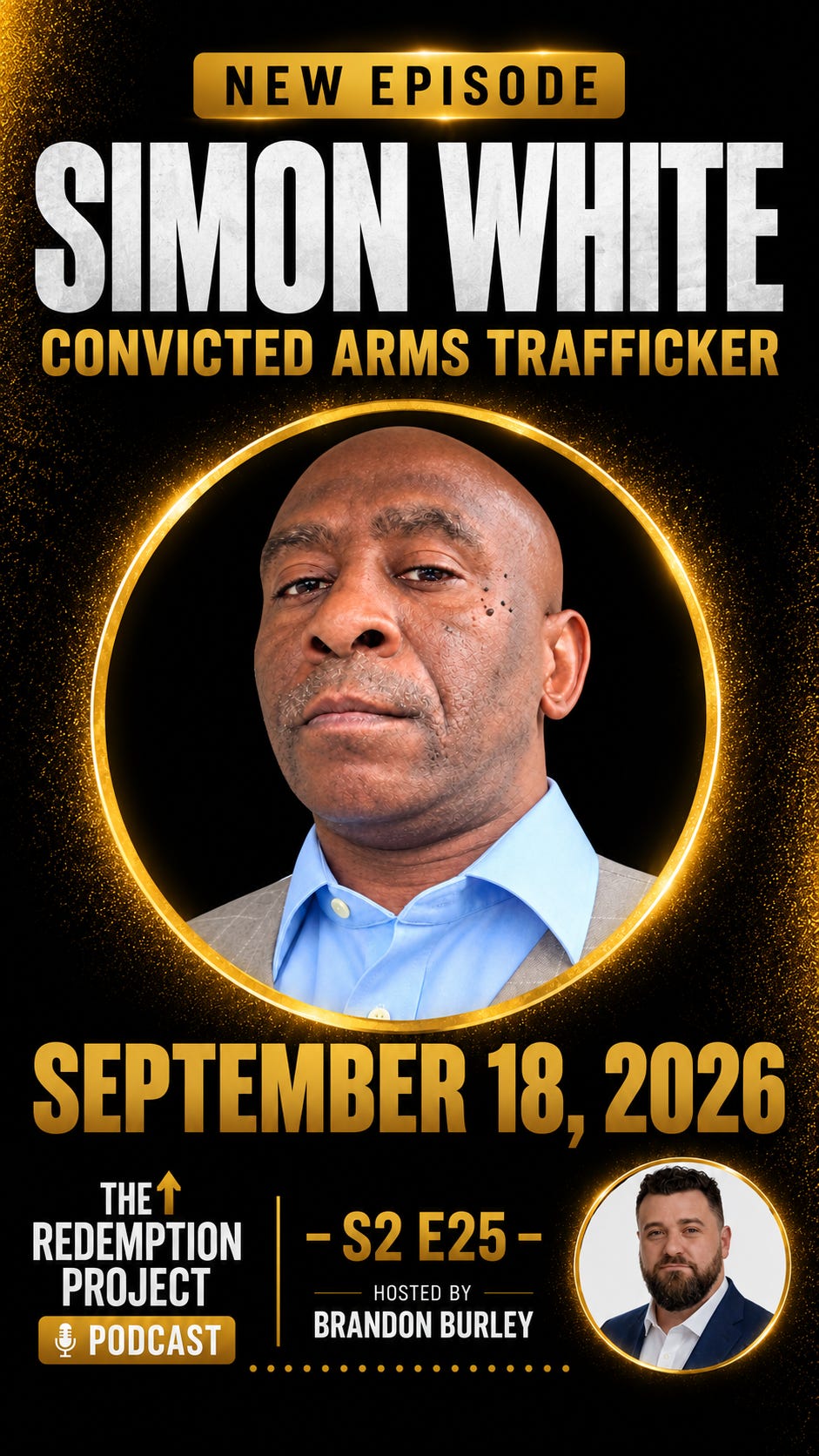
Simon White’s story does not begin in prison.
It begins in Dillon, South Carolina.
From there, his life moved to Harlem, then Philadelphia, then Florida, then back to Philadelphia. Along the way, there were early warnings, bad decisions, addiction, pressure, family responsibilities, job loss and a world that started pulling him deeper than he realized.
In this episode of The Redemption Project, Brandon Burley talks with Simon about a troubled past and why that past does not have to dictate the future.
Simon does not tell his story like a man trying to polish it.
He tells it plainly.
He talks about growing up around Harlem, drinking, drugging and doing the kind of petty things young men often think they can get away with. He remembers a friend warning him early that drugs and alcohol would take something from him. That friend went on to play professional baseball. Simon went a different direction.
At one point, cocaine nearly killed him. A doctor warned him that if he kept using it, he might not see his next birthday.
Simon says he made a change for a while.
But addiction, as he explains it, is not only about the substance.
It is about the way a person is thinking.
Simon’s story is not just about drugs.
It is about the mindset that kept moving from one thing to the next.
When Simon moved to Philadelphia, he worked in a psychiatric hospital. He was married, helping raise children and carrying more responsibility than he and his wife were ready to handle. Then he lost his job.
That is where he says the real trouble started.
Looking for money and pulled by relationships in the street, Simon began buying firearms and selling them illegally. At first, he hesitated. He knew selling guns could get him locked up. But after losing his job and feeling broke, the hesitation faded.
He bought a cheap gun.
He removed the serial number.
He sold it.
Then he bought more.
What began as one decision became a pattern.
Simon describes driving around to gun shops, buying cheap firearms, removing serial numbers and selling them into the street. He talks about gun dealers who should have known something was wrong, especially when buyers came in repeatedly with cash in small bills. He describes learning that multiple handgun sales triggered reporting requirements, while long guns could be handled differently at the time.
The story is disturbing because Simon does not hide the mechanics.
He explains how easy it became.
How fast it became.
How money changed the way he thought.
How the same addictive mind that had once chased drugs started chasing something else.
That is one of the central lessons of this episode:
Addiction can move.
It can shift from one object to another.
The substance may change, but the thinking can stay the same.
Simon’s first contact with ATF came after he bought a Tech-9 while still having an unresolved case in New York. He says agents stopped him outside a gun shop, took the gun and told him he was considered a fugitive from justice because of that old case.
That encounter eventually led Simon into contact with ATF Agent Robert J. Wescott. Simon describes working with law enforcement for a period of time, setting up drug buys and testifying against people. But after a family situation involving his brother-in-law, resentment built.
Later, after he lost his job and began selling guns, Wescott called him and asked whether he was selling firearms.
Simon says he snapped.
Instead of stopping, he went further.
He describes buying AK-style rifles and handguns, selling them into North Philadelphia and leaving with bags of drug money. He also remembers Wescott asking him why someone did not simply kill him and take the guns.
At the time, Simon did not have an answer.
Looking back, the danger is obvious.
Eventually, the downfall came.
Simon moved to Reading after his wife’s job relocated. He says he sold some firearms there and then shifted into selling marijuana because it felt lucrative and less risky. But ATF and law enforcement were still watching.
He was arrested.
Then ATF arrested him.
Simon says he ultimately did four years in federal prison and six months in state prison. He also reflects on what shocked him about sentencing: the gun case exposed him to roughly five years, while the marijuana case could have exposed him to far more time.
But the deeper part of the episode is not the legal math.
It is what prison made Simon see.
Simon talks about men in prison who had no remorse. He talks about how many men were angry not because of what they had done, but because they got caught. He remembers the constant talk about rats and snitches.
Then he remembers something another incarcerated man told him:
God does not always put you where you want to be.
God puts you where you need to be.
That became one of the spiritual turning points of the story.
Simon’s faith journey was not a straight line. He had church in his background. He had taken children to church. But after a church leader he knew went to prison, Simon pulled back.
In prison, he asked for a Quran.
A man offered him a Bible instead.
Simon started reading it.
He was baptized.
Later, he converted to Islam while incarcerated. But even then, Christian voices kept showing up. A guard asked him why he was dealing with certain groups. Another guard at Camp Hill sat beside him and asked whether anyone had ever talked to him about Jesus Christ.
Simon remembers thinking:
Why do people keep asking me about Jesus?
He describes it as if Jesus was chasing him down.
That is the spiritual center of this episode.
Simon had been running through addiction, illegal guns, resentment, prison, religious searching and guilt. But something kept following him. Something kept interrupting him. Something kept asking him to look deeper than the charge, deeper than the sentence, deeper than the story he had been telling himself.
Then the weight of the guns started to become personal.
Simon talks about conscience.
He says that if a person has a heart and a conscience, selling guns brings depression, anxiety and frustration. He remembers law enforcement telling him that someone he sold a gun to had used it in a murder the same day.
At the time, he had tried to think like a gun shop owner:
I have nothing to do with what that person does.
But deep down, he knew he had put something into the street that could be used to harm someone.
That knowledge does not leave a man easily.
Later, after prison, Simon saw a man who had been shot. He remembers the look of terror on the man’s face. He says gun violence is not like the movies. It is not clean. It is not distant. It is horror.
Then gun violence reached his own family.
His nephew turned 21 on a Friday.
He was killed the next evening.
He was 21 for less than 24 hours.
That is where the available transcript ends, but the meaning of the episode is already clear.
This is not a story about a man asking people to forget what he did.
It is not a story that minimizes harm.
It is not a story that treats prison as either the whole answer or no answer at all.
It is a story about consequences.
It is a story about conscience.
It is a story about the damage done when guns, addiction, money and street life come together.
It is also a story about the God who keeps pursuing a man even when that man is confused, angry, guilty, resistant and lost.
Simon White’s story is hard.
But that is why it matters.
Because redemption does not begin when a man pretends the past was not real.
Redemption begins when he finally stops running from the truth.
I am a retired detective and criminal justice / government educator based in Tennessee. I founded The Redemption Project, as a place to focus on civics, rebuild non-partisan trust, and provide educational and emotional grace while learning about the news. I also have a column in Knox TN Today. My reporting and commentary have also appeared in other outlets including; Governing, The Arizona Capitol Times, South Florida Sun Sentinel, Police1, among other state and regional outlets.