

Security ≠ freedom. Safety ≠ privacy.
When Everything Becomes Searchable Safety, Privacy and Freedom in the Digital Era


The Redemption Project Newsroom
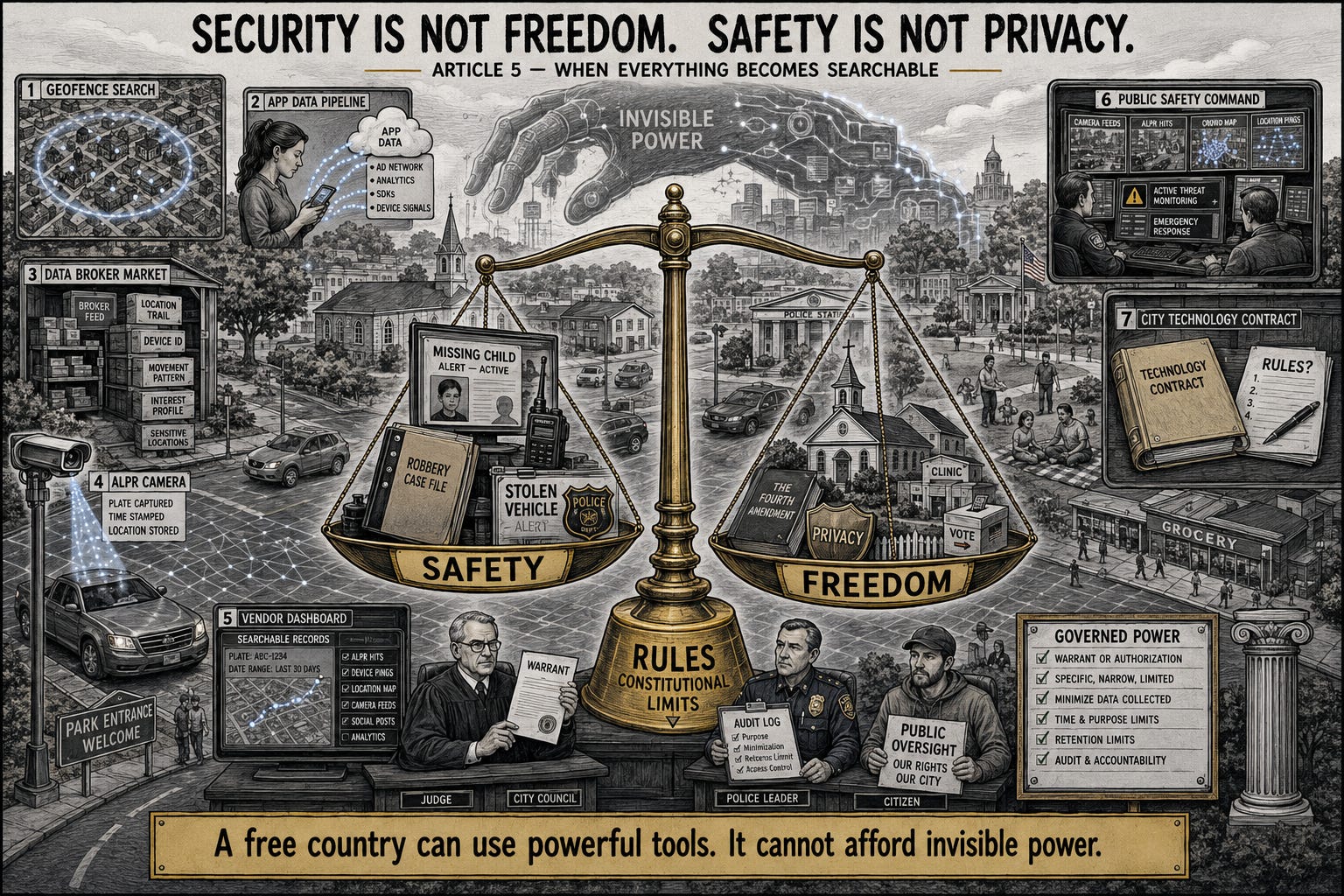
Safety is not the same thing as privacy.
Security is not the same thing as freedom.
A healthy republic needs all four. The danger comes when government, vendors or citizens start treating one as proof of the others.
That is the tension underneath the modern digital public-safety debate. Police agencies want tools that help solve serious crimes, recover stolen vehicles, find missing people, identify suspects and act quickly when time matters. Citizens want to live in communities where violent crime is investigated, victims are protected and dangerous people are held accountable.
Those are legitimate public interests.
But public safety tools are no longer limited to what an officer can see, hear, follow, remember or document in the moment. Increasingly, public safety tools work by making ordinary life searchable after the fact.
That changes the question.
The question is not whether technology can help police. It can.
The question is whether the rules are strong enough for a world where movement, habits, visits, associations and routines can be stored, searched, shared and reconstructed later.
That is not a small change in policing.
It is a change in power.
This series began with a geofence warrant, where police can begin with a place and a time, then ask which phones were nearby. It moved to a commercial data tool, where government access may come through a vendor contract instead of a warrant. It examined private apps and advertising systems that collect location signals long before government ever appears. It then turned to automated license plate readers, where public-road sightings can become searchable vehicle histories.
Different tools.
Same civic tension.
The more life becomes searchable, the more constitutional government has to ask what may be searched, by whom, under what standard, for what purpose and with what accountability.
That is where the old slogans fail.
“Public safety” does not answer every privacy question.
“Privacy” does not answer every public safety question.
A serious society has to hold both thoughts at the same time. Police need lawful tools to investigate real harm. Citizens need enforceable limits on government power, especially when the tools are quiet, technical and difficult for ordinary people to see.
The Constitution was written in a world of homes, papers, effects, warrants, officers and physical searches. The modern world adds phones, apps, databases, cameras, ad networks, data brokers, license plate readers, vendor platforms and real-time feeds.
The principle still matters.
Government power should be restrained when it reaches into the lives of the people
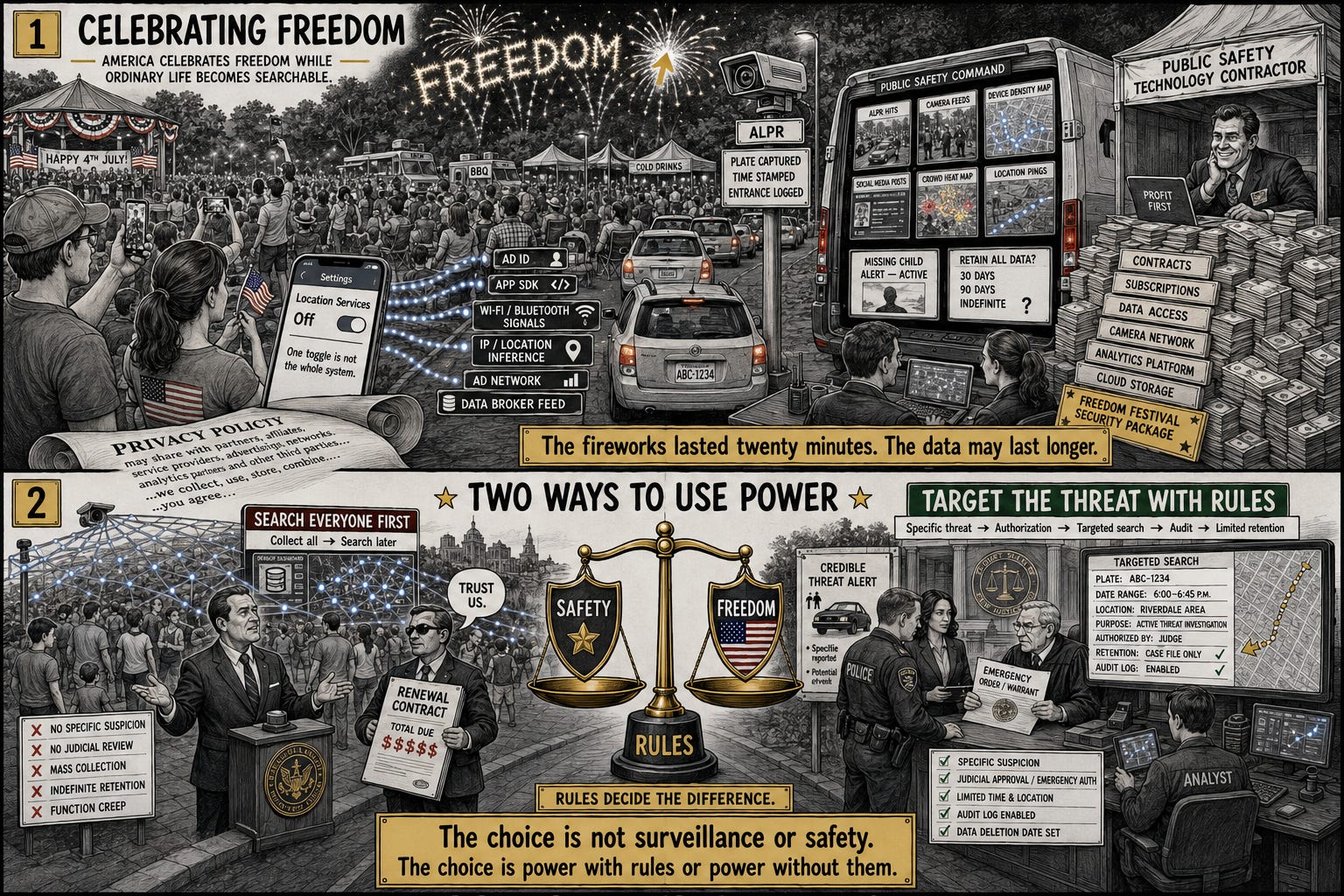
The hard part is that digital systems often do not feel like traditional searches. No officer kicks in a door. No drawer is opened. No person is stopped on the sidewalk.
A query is run.
A database responds.
A map appears.
A pattern emerges.
That does not make the power harmless.
It may make it easier to miss.
That is the danger of the digital era: power can become invisible at the exact moment it becomes more capable.
The public should not have to be technology lawyers to understand what is being collected, searched or shared. A person should not have to read a 40-page privacy policy, decode a police contract, understand ad-tech bidstreams, study Fourth Amendment doctrine and attend every city council meeting just to know whether ordinary movement is being turned into a searchable record.
That is not meaningful public consent.
It is civic fog.
Some will say these tools only matter to people who are doing something wrong. That sounds simple, but it is not how liberty works.
A free person does not need a criminal reason to care about privacy. People visit doctors, churches, schools, addiction treatment centers, gun stores, counselors, shelters, lawyers, political meetings, family members and friends. They travel for reasons that are legal, ordinary and deeply personal.
Privacy is not only about hiding wrongdoing.
It is about preserving space for ordinary life.
That does not mean police can never use location data, camera networks or digital records. They can, and sometimes they should. A missing child matters. A stolen vehicle matters. A homicide investigation matters. A pattern of violent crime matters. Digital evidence can be the difference between a case going cold and a case moving forward.
But the fact that a tool can help does not answer whether it should be used without limits.
Useful power still needs rules.
The strongest public safety systems are not the ones that ask citizens to stop asking questions. They are the ones that can show where the boundaries are.
Who can search the data?
What crimes justify access?
Is a warrant required?
Is a subpoena enough?
Is a vendor contract being used instead of legal process?
How long is the data kept?
Can outside agencies search it?
Are sensitive locations protected?
Are searches audited?
Are misuse findings public?
Can a defendant learn whether the tool was used in a case?
Can a city explain the system before the scandal?
Those are not anti-police questions.
They are constitutional government questions.
They protect the public. They also protect officers, agencies and prosecutions. A case built with lawful evidence is stronger than a case damaged by an unlawful search, hidden tool, weak policy or vendor system nobody fully understood.
Accountability is not the enemy of good police work.
It is part of good police work.
The mistake is treating safety and liberty as if one must defeat the other. That is the false choice.
A community can want police to solve violent crimes and still require warrants for certain historical location searches. A city can use license plate readers for stolen vehicles and missing-person alerts while limiting retention, outside sharing and reverse searches. A state can allow emergency access in narrow circumstances while prohibiting routine warrantless purchases of sensitive commercial data. Congress can protect public safety while closing a data-broker loophole that lets agencies buy what they would otherwise need legal process to obtain.
Those are not contradictions.
They are the work of self-government.
The issue is not whether every digital public-safety tool is bad. The issue is whether the public rules match the power of the tool.
That is the standard.
The rule should be stronger when the search reaches backward in time.
The rule should be stronger when the search begins with a place instead of a suspect.
The rule should be stronger when the data reveals patterns of life.
The rule should be stronger when sensitive locations are involved.
The rule should be stronger when one local search can reach across jurisdictions.
The rule should be stronger when the government buys access from a private vendor instead of asking a judge.
The rule should be stronger when ordinary people could not reasonably understand that their movements were being collected, packaged and sold.
That is not anti-technology.
It is proportionality.
The more revealing the tool, the stronger the guardrail should be.
Local governments have a special responsibility here because many of these decisions happen quietly. A city signs a contract. A police department joins a network. A vendor offers a dashboard. A retention period is set by default. A sharing permission is turned on. A pilot program becomes normal before the public ever understands what changed.
That is how surveillance infrastructure grows: not always through one dramatic law, but through many small decisions that each sound practical in isolation.
A camera here.
A database there.
A vendor platform added later.
A sharing agreement after that.
Then one day the public learns that ordinary movement has become searchable in ways nobody clearly debated.
That is not how trust is built.
If a city wants to use powerful digital tools, it should be able to say so plainly. It should explain what the tool does, what data it collects, how long the data is kept, who can search it, what legal standard applies, what outside agencies can access, how audits work and what happens when the system is misused.
If the tool is worth using, it is worth governing in public.
The private sector also belongs in this conversation. Government did not build the entire tracking economy by itself. Apps, ad networks, analytics firms and data brokers helped build the shelf. Government agencies may become buyers, but the inventory often begins with private collection.
That matters because privacy cannot be protected only at the police station door. If commercial systems are allowed to turn daily life into location products, the market will keep producing data for anyone with money and access.
Citizens can reduce their exposure. They can limit app permissions, turn off precise location, delete unused apps, reset advertising identifiers and avoid giving location access to services that do not need it.
Those steps matter.
But individual settings are not enough to solve a structural problem.
A privacy setting cannot replace law.
A phone toggle cannot replace oversight.
A city contract cannot replace the Constitution.
This is why the debate has to rise above slogans.
More safety does not automatically mean more freedom.
More security does not automatically mean less liberty either.
The difference is governance.
Security can protect freedom when it is lawful, accountable and limited. Security can crowd out freedom when it becomes invisible, permanent and searchable by default.
That is the line.
The country does not need weaker public safety. It needs clearer rules for powerful public-safety tools.
It needs courts willing to apply old constitutional principles to new systems.
It needs lawmakers willing to close gaps before the market normalizes them.
It needs city councils willing to ask hard questions before signing contracts.
It needs police leaders willing to build trust through transparency instead of asking for trust as a substitute for transparency.
It needs citizens willing to care before the tool is aimed at them personally.
Because once ordinary life becomes searchable, the question is no longer only whether the government is watching in the moment.
The question is whether the record is waiting.
Waiting for the right query.
Waiting for the right case.
Waiting for the right official.
Waiting for the wrong reason.
A free country can use powerful tools.
It cannot afford invisible power.
Safety is not privacy.
Security is not freedom.
And if we want all four, we will need rules strong enough for the digital world we have already built.
I am a retired detective and criminal justice / government educator based in Tennessee. I am a commentary write for Tennessee Lookout and a weekly columnist with Knox TN Today. My work examines public policy, public safety systems and civic responsibility. My reporting and commentary have also appeared in Governing, The Arizona Capitol Times, South Florida Sun Sentinel, Police1, among other state and regional outlets.

 | A guest post by
|
 | A guest post by
|