



Martha Stewart went to federal prison at the height of her fame. She came out wearing a handmade poncho from another inmate and went back to work. Her story is not about erasing a conviction. It is about what can still be built after one.
By Brandon L. Burley
The Redemption Project | Redemption Story of the Week
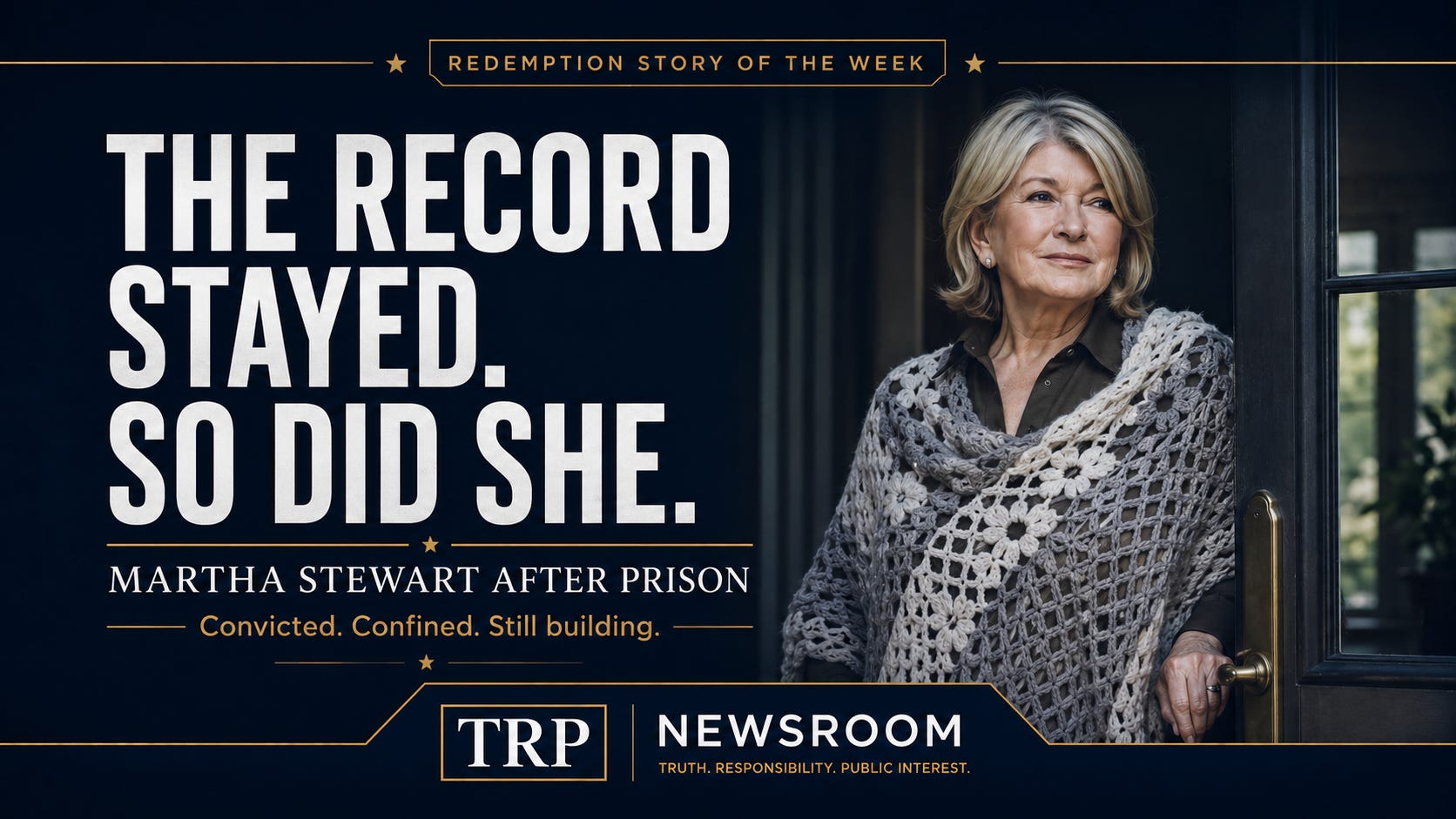
When Martha Stewart walked out of federal prison on March 4, 2005, she was wearing a gray-and-white crocheted poncho.
It became an instant fashion story.
But the more interesting part was who made it.
The poncho had been crocheted by a fellow inmate at the federal prison camp in Alderson, West Virginia, where Stewart had spent five months.
Martha Stewart had entered prison as one of the most famous businesswomen in America.
She left wearing something made for her by a woman most Americans would never know.
That may tell us more about what happened inside than the photographs did.
Start with the record
Stewart’s criminal case is often shortened to “Martha Stewart went to prison for insider trading.”
That is not quite what happened.
A federal jury convicted her in 2004 of one count of conspiracy, two counts of making false statements and one count of obstructing an agency proceeding during the government’s investigation of her 2001 sale of ImClone Systems stock. A securities-fraud charge was dismissed by the judge before the case went to the jury.
She received five months in federal prison, followed by five months of home confinement and two years of supervised release.
Two years later, Stewart settled a separate Securities and Exchange Commission civil insider-trading case, agreeing to disgorgement, interest and penalties totaling about $195,000.

Redemption should never require rewriting the record.
Neither should accountability.
A second chance is not an acquittal.
Prison took away something Martha was famous for
Before prison, Martha Stewart had built an empire around control.
The table was set correctly.
The garden was planned.
The recipe worked.
The photograph looked right.
The business carried her name.
Then the federal government told her when to wake up, where to sleep and when she could go home.
In an excerpt from The Martha Rules, Stewart later acknowledged how accustomed she had been to controlling both her life and her company. Prison forced her to spend time with women whose circumstances were very different from hers. She wrote that she emerged with a greater appreciation for “the complexity of every single person’s situation.”
That is not a dramatic confession.
It is still worth noticing.
Because something else happened at Alderson.
Women began asking Martha Stewart questions about business.
One group of Muslim inmates invited her to speak about entrepreneurship. Stewart gave them a seminar about developing ideas, advertising and building businesses.
She later wrote that The Martha Rules began there.
Think about the reversal.
The woman whose business career had just been shattered by a criminal conviction was sitting inside a federal prison helping other incarcerated women imagine businesses of their own.
The place that interrupted her career became one of the places where she began writing the next chapter of it.
Do not manufacture humility
There is an important complication.
Martha Stewart has never consistently described her prosecution as something she deserved.
At the time of her conviction, she maintained that she had done nothing wrong and said she would continue fighting to clear her name.
Two decades later, she was still sharply critical of the prosecutors.
In the 2024 Netflix documentary Martha, Stewart argued that her fame made her a prosecutorial trophy and spoke bitterly about the people who brought the case.
So I would not describe Martha Stewart’s story as:
She committed a crime, became humble, confessed everything and emerged transformed.
The evidence does not support that.
Her redemption story is different.
She was convicted.
She served the sentence.
She experienced the loss of control, status and freedom that came with it.
She encountered women she probably never would have met otherwise.
And then she had to decide what her life would become after the number attached to her inmate file stopped being the only number people wanted to talk about.
She went back to work
Stewart did not hide after prison.
Three days after her release, she was back at the offices of Martha Stewart Living Omnimedia speaking to employees and the press.
Later that year came a new daytime television show, a version of The Apprentice and The Martha Rules, a business book built around 10 principles for starting, growing and managing a company.
The title is almost perfectly Martha.
Even after prison, she had rules.
But the woman writing them had now experienced something the earlier Martha Stewart brand could never have manufactured for television.
Failure.
Public humiliation.
A prison number.
A cell.
Women living with criminal records considerably less famous than hers.
And the question every formerly incarcerated person eventually confronts:
What happens when the sentence ends but the story follows you home?
For Stewart, the answer was work.
Not one comeback announcement.
Years of it.
Television.
Books.
Products.
Cooking.
Gardening.
Business partnerships.
An unexpected friendship and television partnership with Snoop Dogg that introduced her to another generation.
In 2023, at 81, she became the oldest person then featured on the cover of Sports Illustrated’s swimsuit issue. And in August 2026, approaching 85, she was still discussing new business ventures and showing little interest in retirement.
The conviction remained.
So did she.

That is where the redemption is
Martha Stewart’s story does not give us an easy sermon.
There is no documented moment when she stood before the country and confessed everything critics wanted her to confess.
There is no clean before-and-after conversion.
There is something else.
A woman built an identity around excellence and control.
Then she lost control.
A jury convicted her.
A judge sentenced her.
A prison confined her.
The public laughed.
And afterward, she discovered that losing one version of her life did not require surrendering the rest of it.
That lesson extends far beyond celebrity.
Millions of people come home from prisons and jails without Martha Stewart’s money, connections or name recognition.
Their barriers are harder.
Their second chances are often narrower.
But the principle is the same:
Punishment is supposed to have an ending.
Accountability requires acknowledging what happened.
It does not require a person to remain permanently frozen at the worst entry in the record.
A criminal record is part of the record. It does not have to become the whole résumé.
The poncho makes more sense now
Twenty-one years later, I keep coming back to that poncho.
Martha Stewart could have walked out of prison wearing almost anything.
Instead, one of the most photographed women in America emerged wearing something another incarcerated woman had made by hand.
Stewart kept it.
She has spoken about it years later.
Maybe we should resist turning that into more symbolism than it can carry.
But there is something fitting about it.
The woman famous for teaching America how to make things came home carrying something someone else had made for her.
Her career resumed.
Her reputation evolved.
The conviction stayed in every biography.
And life continued.
That may be the redemption story.
Not that prison magically transformed Martha Stewart into someone else.
Not that success afterward erased what came before.
But that consequence and possibility were allowed to occupy the same life.
Second chances do not erase the first chapter.
They prove there was still room to write another one.
Advertisement · Explore Project Forge Books
For readers who want to examine justice, evidence and accountability more closely, our reader update includes an Exploring Criminal Justice teaching prompt and a way to request the sampler from Silas.
Read the preview and request a sample →
I am a retired detective and criminal justice / government educator based in Tennessee. I am a commentary write for Tennessee Lookout and a weekly columnist with Knox TN Today. My work examines public policy, public safety systems and civic responsibility. My reporting and commentary have also appeared in Governing, The Arizona Capitol Times, South Florida Sun Sentinel, Police1, among other state and regional outlets.
