

by Brandon Burley of Burley Books and The Redemption Project Podcast
Kevin Costner’s story is not one of a Hollywood skeptic suddenly finding religion. Faith was there before the fame. What changed late in his career was his willingness to speak about it plainly.
By Brandon L. Burley
The Redemption Project | Redemption Story of the Week
Kevin Costner remembers one of his first performances.
He was about 4 years old.
The stage was not Hollywood.
It was church.
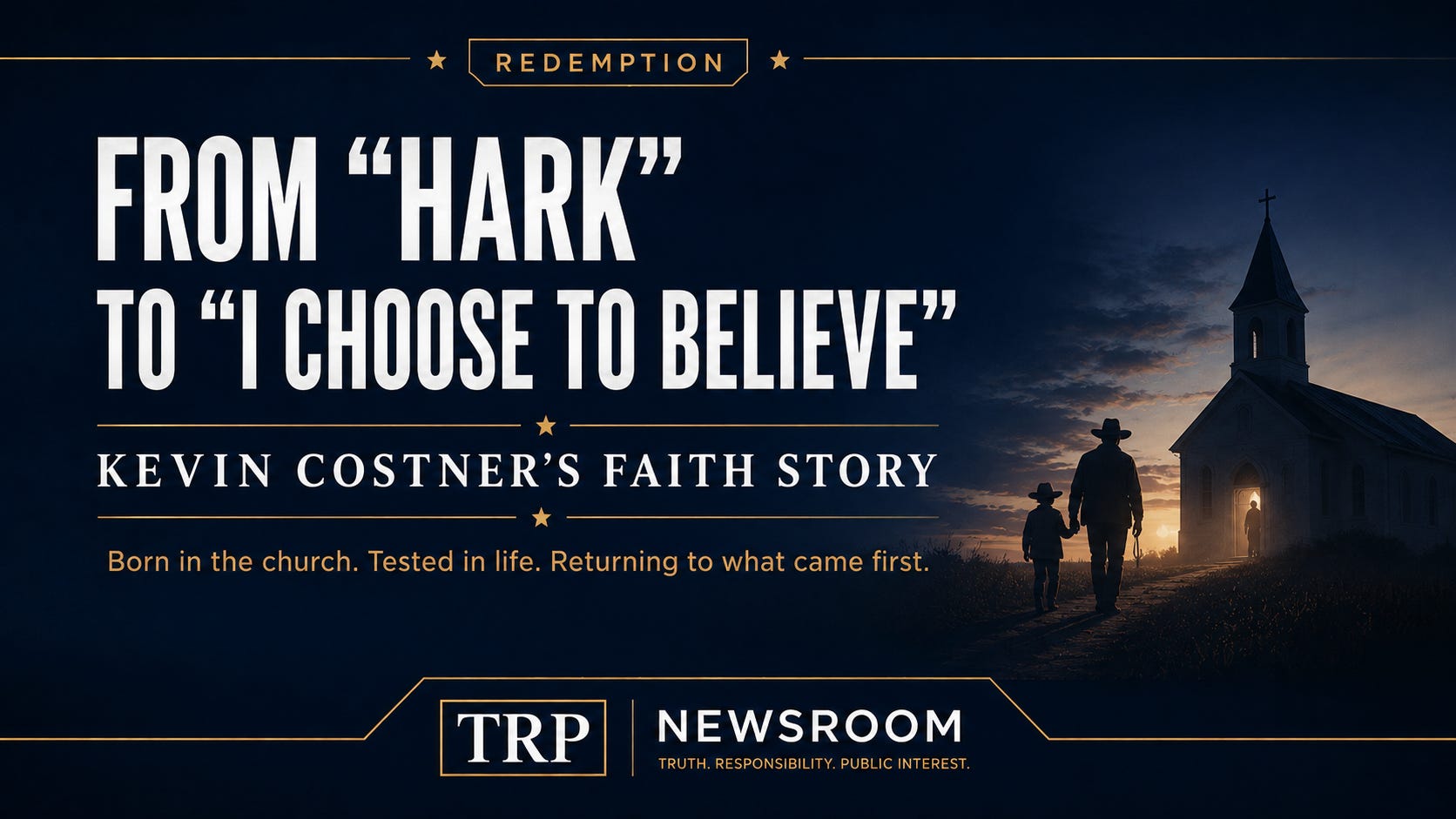
Costner had been cast as a shepherd in a Nativity play. His part consisted of one word:
“Hark.”
More than six decades later, after two Academy Awards, blockbuster films, television success, career disappointments, comebacks and a lifetime spent telling stories, Costner returned to the same one.
The birth of Christ.
In December 2025, ABC aired Kevin Costner Presents: The First Christmas, with Costner hosting a dramatized exploration of Mary, Joseph and the birth of Jesus. The network described the special as an examination of the hardships, trials and triumphs surrounding Christ’s birth.
This time, Costner had considerably more than one word.
And what he said about his own faith may have been more revealing than the program itself.
“I choose to believe,” he told the Deseret News.
That sentence gives us the real redemption story.
Because this is not a conversion story.
It is a story about returning publicly to something that was there long before anyone knew his name.
Faith before fame
The easiest version of this story would be to describe an aging Hollywood star discovering Christianity late in life.
That would be cleaner.
It would also be wrong.
Costner has said he was raised in church and that faith had been part of his life from childhood. In 2024, while discussing Horizon: An American Saga, he said he grew up Baptist and that church had “always been part of my life.”
That matters.
We do not need to manufacture a conversion in order to find redemption.
Sometimes the deeper story is continuity.
Before Dances with Wolves.
Before Field of Dreams.
Before The Untouchables.
Before Yellowstone.
There was a little boy standing in a church Nativity play.
And apparently, that story never completely left him.
He did not present faith as certainty
What makes Costner’s recent comments more interesting is what he did not say.
He did not present himself as a theologian.
He did not claim to possess answers for every objection.
He acknowledged that religion can be attacked easily and that a believer may encounter questions he does not know how to answer.
Then he made the distinction:
“You choose to believe. I choose to believe.”
There is something unusually unpolished about that confession.
Not certainty about everything.
Not intellectual surrender either.
Faith.
Costner was effectively saying that his inability to answer every challenge does not erase what he believes.
That is considerably different from treating belief as a performance.
Faith does not require pretending every question has stopped being a question.
Sometimes it means deciding what remains true while the questions are still there.
The Westerns were already telling us something
A year before The First Christmas, Costner was talking publicly about faith in another context.
The American West.
While promoting Horizon, the sprawling Western project he had spent decades trying to make, Costner argued that religion could not honestly be removed from the story of westward migration because faith helped sustain many people walking into lives filled with uncertainty.
“Faith is what guided people out there to the unknown,” he said.
That comment did not turn Horizon into a Christian film.
It revealed something about the storyteller.
Costner has spent much of his career interested in people who commit themselves to things they cannot fully control.
Land.
Family.
Duty.
Community.
Justice.
Home.
A dream that makes little sense to everyone else.
We should be careful not to retroactively baptize every Kevin Costner movie.
But it is fair to notice the pattern.
His characters frequently inhabit worlds where choices have weight.
And Costner himself appears drawn to stories that allow that weight to remain.
Then came the Nativity
By 2025, Costner was 70.
He did not need another television credit to establish his career.
Yet he attached his name to a two-hour network special about the birth of Jesus Christ.
ABC’s description was straightforward: Costner would guide viewers through the journey of Mary and Joseph and the circumstances surrounding Jesus’ birth.
Costner said he wanted the project to reach more than believers.
He invited people who were skeptical or simply curious to come along and examine what he called the story behind the Christmas tradition.
That posture matters.
He was not demanding belief.
He was asking for attention.
There is a difference.
And Costner himself described the project less as a declaration aimed at others than an opportunity to slow down and reconsider a story he already believed.
He said Christmas can become crowded with decorations, customs and competing messages until people lose sight of what the holiday is actually about.
The special, he said, was an opportunity to stop and reflect.
For someone whose entire professional life has revolved around stories, perhaps that is fitting.
Eventually he returned to the story beneath the traditions.
This is not redemption through collapse
There is a temptation in this series to expect every redemption story to contain a wreck.
Addiction.
Prison.
Public disgrace.
Bankruptcy.
A dramatic conversion.
A life separated cleanly into before and after.
Costner does not give us that story.
And we should not force one onto him.
Redemption can include rescue from catastrophe.
Christianity certainly contains stories like that.
But Christianity also contains another idea:
Return.
Remember.
Come back to what is true.
Recognize that accomplishments cannot occupy the place of God simply because they are impressive.
Costner’s story, at least from what he has chosen to say publicly, belongs closer to that category.
The church was there first.
The career became enormous.
Then, late in that career, he was willing to talk publicly about what had remained underneath it.
The story did not begin when he became famous enough to discuss faith.
The faith was there before anybody was listening.

Reverence is not rebellion
I would also resist another easy narrative.
This is not a story about Kevin Costner courageously defeating an anti-Christian Hollywood.
We do not have evidence for that.
Costner himself did not frame The First Christmas that way.
He acknowledged skepticism toward religion, but his answer was not cultural warfare.
It was invitation.
Believe.
Do not believe.
Be curious.
Come look at the story.
That restraint is more interesting than defiance.
Because reverence does not have to become combat.
A Christian does not honor Christ more by turning every declaration of faith into a fight with someone who disagrees.
Sometimes witness is quieter.
This is what I believe.
This is why it matters to me.
You are welcome to look.
That was much closer to Costner’s posture.
The little shepherd and the old storyteller
There is an image in this story I cannot get past.
A 4-year-old boy stands in church dressed as a shepherd.
He gets one line.
“Hark.”
Listen.
Pay attention.
Something important is happening.
Then comes nearly an entire lifetime.
Success.
Failure.
Marriage.
Divorce.
Children.
Awards.
Films that became classics.
Films that did not.
Projects people told him would never work.
A television Western that made him newly famous to another generation.
And finally, at 70, the storyteller sits down to tell the Nativity again.
This time he understands considerably more about how uncertain a human life can become.
He also understands that belief does not remove uncertainty.
His answer is simpler.
“I choose to believe.”
That may be where the redemption is.
Not in a scandal erased.
Not in a ruined reputation restored.
Not in a dramatic reinvention.
In remembering what came first.
Some stories get larger as we get smaller
Kevin Costner has spent his life telling big stories.
The American frontier.
Baseball.
War.
Crime.
Land.
Family dynasties.
Men trying to hold onto things they believe matter.
But the story he chose to revisit late in his career begins differently.
A young woman.
A young man.
An occupied land.
A child.
No empire recognizing what has happened.
No red carpet.
No applause.
For Christians, the significance lies precisely there.
God enters history without needing the world’s permission to matter.
That is a difficult story for a culture built around visibility, status and achievement.
Perhaps especially for Hollywood.
Perhaps especially for anyone who has been successful.
Because Christianity ultimately makes an uncomfortable claim about every résumé:
It is not the biggest story.
Costner has spent decades being the name above the title.
In The First Christmas, he chose to stand beside a story bigger than his name.
And maybe that is the quiet redemption here.
Not that Kevin Costner finally found something to believe in.
According to him, belief had been there all along.
The meaningful change is that, after a lifetime of telling other people’s stories, he became willing to tell us something about his own.
A shepherd at 4.
A storyteller at 70.
One word at the beginning:
Hark.
And one sentence near the other end:
I choose to believe.
Sometimes redemption is not discovering an entirely new road.
Sometimes it is realizing the road has been leading you home the whole time.
I am a retired detective and criminal justice / government educator based in Tennessee. I am a commentary write for Tennessee Lookout and a weekly columnist with Knox TN Today. My work examines public policy, public safety systems and civic responsibility. My reporting and commentary have also appeared in Governing, The Arizona Capitol Times, South Florida Sun Sentinel, Police1, among other state and regional outlets.