


Frankie Muniz did not lose everything after childhood fame. He deliberately walked away from part of it, chased other dreams and eventually found something he now says sits above all of them: faith in Jesus Christ.
By Brandon L. Burley
The Redemption Project | Redemption Story of the Week
For a generation of television viewers, Frankie Muniz will probably always be Malcolm.
He was 13 when Malcolm in the Middle premiered in 2000. The role made him one of the most recognizable child actors in America, earned him Emmy and Golden Globe nominations and helped turn a teenager into a multimillion-dollar Hollywood star. By the early 2000s, he was commanding millions for films such as Agent Cody Banks.
Then something unusual happened.
He left.
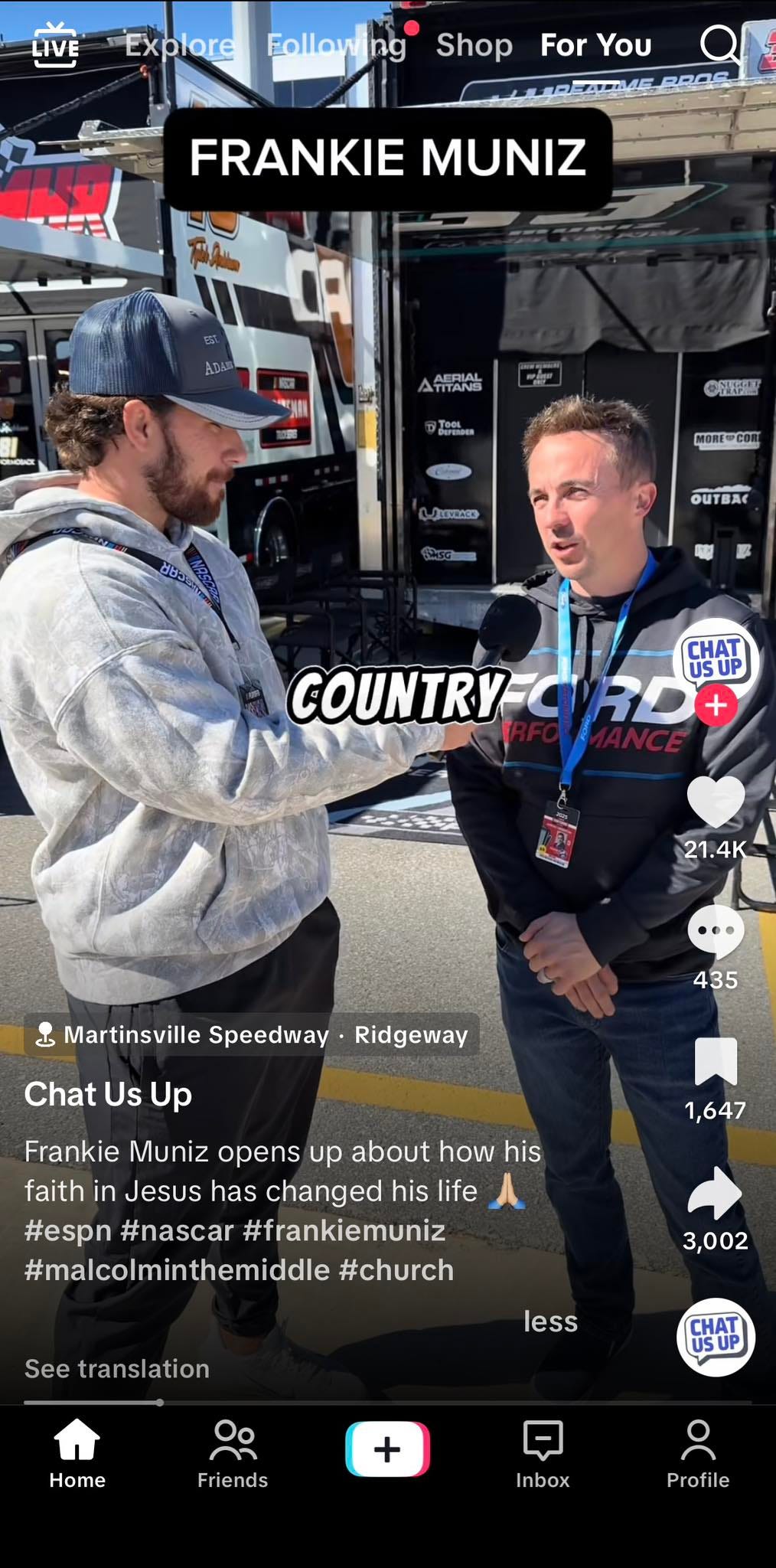
Not because drugs destroyed him.
Not because the money disappeared.
Not because Hollywood stopped calling.
Muniz has said he moved from Los Angeles to Arizona in 2008 because he wanted a different life. Looking back, he has gone so far as to say the move “saved my life” — not from substance abuse, but from a Hollywood environment in which he had never felt completely comfortable.
That distinction matters.
Because the easiest Frankie Muniz redemption story would be the familiar one:
Child star becomes famous.
Fame destroys him.
Everything falls apart.
Then Jesus puts the pieces back together.
It is also not his story.
He did not have the stereotypical child-star collapse
Muniz has spoken openly about how unusual his Hollywood years were.
In 2023, he said he had never consumed alcohol or used drugs, despite growing up in an industry where the public often assumes former child stars eventually did both. He specifically said his abstinence was not originally religious.
His life after Malcolm was not empty either.
He raced cars.
Played drums in a band.
Ran businesses.
Continued acting occasionally.
Built a family.
Then returned more seriously to racing, eventually working his way into NASCAR.
There were hard years and frightening moments.
Muniz suffered injuries in racing and has said he has experienced nine concussions. For years, stories also followed him claiming that a series of “mini-strokes” had left him unable to remember much of his acting career.
Muniz now says that story got away from the truth.
The neurological episodes originally described to him as transient ischemic attacks were later diagnosed as migraine auras. And while he describes himself as having a bad memory and acknowledges that concussions probably have not helped, he has repeatedly rejected the idea that he has amnesia or does not remember being Malcolm.
That correction belongs in the redemption story too.
We do not have to break a person more than reality did in order to make his redemption more powerful.
The turning point happened on a road in New Mexico
Faith entered Muniz’s story much more quietly.
In 2025, after publicly declaring his Christian faith, Muniz described an experience from roughly six years earlier.
He was driving across the country.
Things were going badly.
He remembered being close to tears somewhere in New Mexico when the only radio station he could get clearly was the Christian station K-LOVE. Two worship songs played back to back at what he later described as the right moment.
He kept listening.
Then something that began with a radio station became something more deliberate.
Muniz said he started attending church every Sunday and becoming more involved in his faith. Christian music became part of how he handled anxiety and stress, and he described faith as having become a significant part of his life.
That is not the kind of conversion story Hollywood usually writes.
There was no ruined mansion.
No overdose.
No public arrest.
No dramatic fall from celebrity grace.
A man was driving through New Mexico having a terrible day.
The radio came on.
He listened.
Then he kept listening.
Sometimes redemption enters loudly.
Sometimes it enters through the only station you can pick up.
Years later, he said it plainly
Whatever began privately eventually became public.
On Sept. 21, 2025, Muniz wrote on social media:
“I am proud to say I live for Jesus Christ.”
The sentence received enormous attention precisely because many people still knew him primarily as Malcolm.
But the more interesting part came afterward.
When asked about the declaration, Muniz did not present himself as someone who had suddenly figured everything out.
He described faith as relatively new in his life.
Something he was still growing into.
That makes the story more credible.
Christian redemption is not supposed to mean that one profession disappears, every difficulty ends and the believer suddenly becomes the finished version of himself.
It means the center changes.
Racing did not replace Hollywood
There is another correction worth making.
Muniz has not simply traded red carpets for racetracks.
In 2026, he is a full-time NASCAR Craftsman Truck Series driver. NASCAR lists him driving the No. 33 Ford for Team Reaume. He has also continued competing in sports-car racing.
But he also returned to the role that made him famous.
While filming Malcolm in the Middle: Life’s Still Unfair, Muniz said something unexpected happened: for the first time, he finished a project and felt happy calling himself an actor. The experience gave him a new appreciation for something he had done since childhood.
That may tell us something important about redemption.
It does not always require rejecting the old life.
Sometimes it allows you to return to part of it without needing it to tell you who you are.
The thing that once defined you can become something you do instead of everything you are.
Muniz can be Malcolm.
He can be a NASCAR driver.
He can be a father.
He can pursue difficult goals and still care how he finishes.
But his own public declaration now puts another identity above the résumé:
He lives for Jesus Christ.

Racing may be the better picture anyway
There is something fitting about where Muniz spends much of his life now.
Racing has not handed him easy success.
His acting career began when he was a child, and major success came quickly. Muniz has said racing has been almost the opposite — harder than he imagined and something he has had to fight to prove he belongs in.
In 2025, he produced a top-10 finish at Daytona but also endured mechanical problems, disappointing results and a broken wrist that kept him out for weeks. He returned for another full season in 2026 because, as he described it, he still had unfinished business.
That is a different kind of life from child stardom.
There is no script guaranteeing the next lap.
No director yelling cut so the scene can be tried again.
Sometimes the car is not fast enough.
Sometimes something breaks.
Sometimes you do everything correctly and still finish 25th.
And then you come back.
There may be more redemption in that picture than in the polished version of the story we started with.
Redemption does not require losing everything first
Frankie Muniz did not have to become the ruined-child-star stereotype before his life could mean something.
He did not lose all his money.
He did not descend into addiction.
His memory was not erased.
His acting career was not taken from him.
And racing has not replaced everything that came before.
The better story is quieter.
A child became famous before he was old enough to fully understand fame.
An adult eventually chose distance from the place that had defined him.
He tried other lives.
He chased a difficult dream.
Somewhere along a road through New Mexico, during a moment when very little seemed to be going right, he heard something that made him listen.
Then he kept listening.
Years later, he was willing to say publicly where that road had taken him:
Jesus Christ.
There is a temptation in redemption stories to make the darkness darker so the light looks brighter.
We do not need to do that.
Grace does not need an exaggerated past to make the present meaningful.
Sometimes redemption means being pulled from destruction.
Sometimes it means discovering, while your life still looks successful from the outside, that success was never large enough to carry the weight you placed on it.
Frankie Muniz spent much of his childhood being known by millions of people.
The more important part of his story may be what he now says he discovered later:
Being known was never the same thing as knowing what you were living for.
Malcolm made Frankie Muniz famous.
The rest of his life has been learning what fame could never tell him.
And today, when asked where that road has led, he gives the answer himself.
He lives for Jesus Christ.
I am a retired detective and criminal justice / government educator based in Tennessee. I am a commentary write for Tennessee Lookout and a weekly columnist with Knox TN Today. My work examines public policy, public safety systems and civic responsibility. My reporting and commentary have also appeared in Governing, The Arizona Capitol Times, South Florida Sun Sentinel, Police1, among other state and regional outlets.