



The Redemption Project Newsroom
A license plate is visible in public.
A searchable history of when and where a vehicle was seen raises a different question.
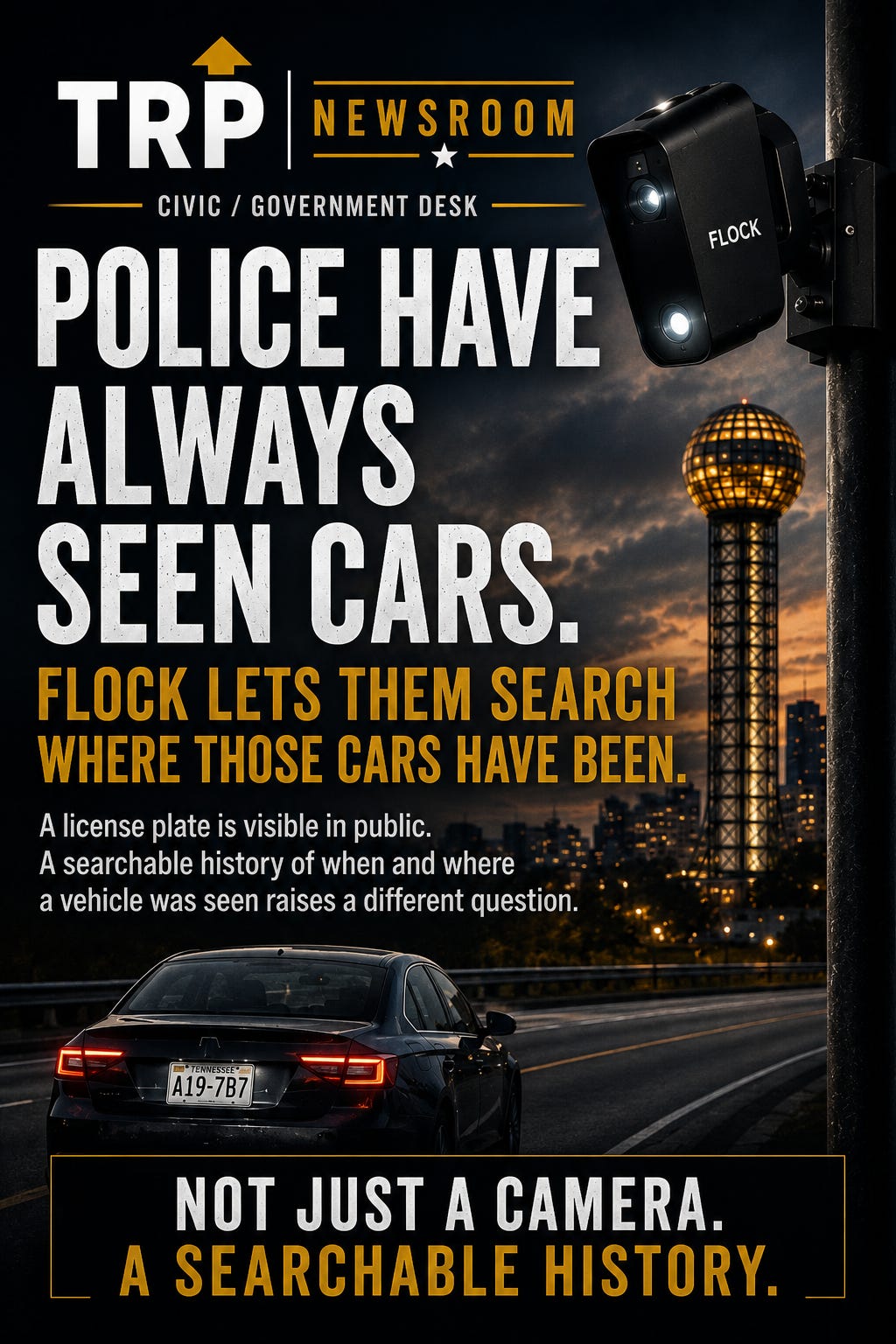
A police officer sitting beside a roadway has always been able to see a passing car, read its license plate and remember where it was headed.
That observation was limited by ordinary human constraints. The officer had to be there. The officer had to notice the vehicle. Unless something caused the information to be written down, the moment eventually disappeared.
Flock Safety’s automated license plate readers change that equation.
The camera does not simply see the vehicle. It creates a searchable record of the observation: the plate, the time, the location and visible characteristics of the vehicle. Those characteristics may include make, model, color, body type, damage, decals, roof racks or even the absence of a readable plate. Flock describes its product as searchable vehicle evidence, not ordinary video footage.
That distinction matters.
Police have always been able to observe vehicles traveling on public roads. What is new is that the observation no longer has to disappear when the officer looks away.
What a Flock camera does
This article focuses on Flock’s license plate reader system, commonly associated with its Falcon cameras. Flock also sells video cameras, gunshot-detection equipment, drones and other public-safety products. Those systems raise additional questions, but they should not be casually blended together.
A license plate reader is not the same as a general-purpose video camera.
When a vehicle passes a Flock license plate reader, the system captures an image and converts portions of that image into searchable data. An authorized user can search by a complete or partial plate number, but searches are not limited to a known full plate. Flock advertises search capabilities tied to vehicle type, color, make, model, time window, location and distinguishing features.
The system can also compare passing vehicles against law-enforcement hot lists. If a plate associated with a stolen vehicle, wanted person or missing or endangered person passes a camera, an alert can be sent to officers.
That alert is an investigative lead.
Officers still need to verify the plate, the alert status and the surrounding circumstances before taking enforcement action.
For investigators, the attraction is easy to understand.
A detective investigating a robbery may begin with a vague description: a dark SUV with a damaged rear bumper that entered the area shortly before the crime and left minutes later. Traditionally, the detective might spend hours collecting footage from homes, businesses and traffic systems. A searchable license plate reader network can narrow that work considerably.
It can help locate a stolen car, identify vehicles that repeatedly appeared near a series of crimes, find a missing person or corroborate whether a suspect vehicle was near a particular location.
Those are real investigative benefits. Pretending otherwise does not strengthen the privacy argument. It weakens it.
The better question is not whether the technology can help solve crimes.
It can.
The better question is what additional power is created when those observations are stored, searchable and shared.
This is not just another traffic camera
A traffic-management camera usually watches a roadway or intersection so transportation officials can monitor congestion, crashes or road conditions. A real-time crime center may pull nearby camera feeds because a shooting, robbery or other event is happening now.
