



Y-12 has restored enriched-uranium purification and is planning new weapons-component manufacturing capacity. At the same time, the $10.35 billion Uranium Processing Facility will not reach full operations until 2034.
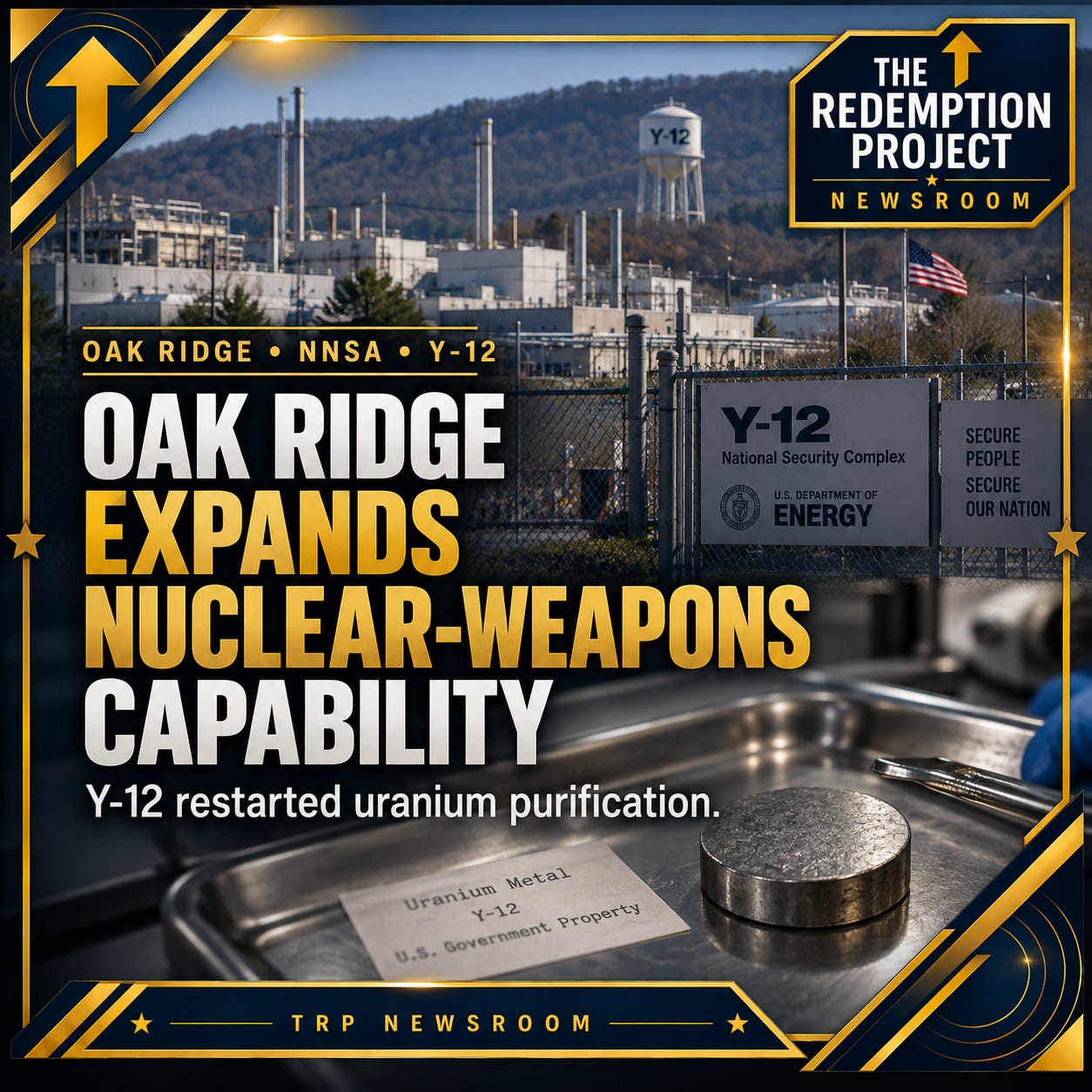
OAK RIDGE, Tenn. — The federal government is adding nuclear-weapons production capability in Oak Ridge while spending billions of dollars to finish a uranium-processing plant that is now expected to reach full operations eight years later than once planned.
That is the story taking shape at the Y-12 National Security Complex.
In March, the National Nuclear Security Administration announced that Y-12 had restored enriched-uranium metal purification and produced its first purified uranium metal “button” using a new production electrorefining process.
NNSA said the material produced through that process will support national-security missions including nuclear-weapons production and uranium supplied for U.S. Navy aircraft carriers and submarines.
The agency called it the first startup of a new nuclear-processing capability at Y-12 in more than 20 years.
Four months later, NNSA completed its environmental review for another proposed expansion: a new East End Campus at Y-12 that the agency says would provide a “robust radiation case manufacturing capability” for national stockpile requirements.
Radiation cases are part of the nuclear-weapons production system. NNSA’s own stockpile planning documents identify radiation cases among the components covered by its Production Modernization program and describe Secondary Capability Modernization as the effort to restore and increase manufacturing capabilities for the secondary stage of nuclear weapons.
There is an important distinction here.
These records establish that the federal government is restoring, modernizing and, in some areas, increasing Y-12’s ability to produce materials and components used in nuclear weapons.
They do not establish how many additional completed nuclear weapons those capabilities will produce.
Capability is not the same thing as output.
And neither is the same thing as the size of the nuclear stockpile.
That distinction matters because the government is undertaking this expansion while the largest uranium-processing construction project at Y-12 remains years behind the schedule the government once expected.
Y-12 is not just another federal laboratory
For Oak Ridge residents, the names of the federal installations can sometimes blur together.
Oak Ridge National Laboratory performs scientific research.
Y-12 has a different mission.
NNSA describes Y-12 as the nation’s only source of enriched-uranium nuclear-weapons components. The site also processes and stores enriched uranium, performs precision manufacturing and supplies enriched uranium for the U.S. nuclear Navy.
That means changes in manufacturing capability at Y-12 connect East Tennessee directly to the physical production system behind the U.S. nuclear arsenal.
The system is larger than Oak Ridge.
Other facilities manufacture plutonium pits, explosives and non-nuclear components. Pantex in Texas performs nuclear-weapons assembly and dismantlement.
Y-12 occupies a specific place in that chain.
It handles materials and components the government says are necessary to maintain and modernize nuclear weapons.
The March electrorefining milestone is one example.
A uranium capability that had disappeared is back
Electrorefining uses an electrochemical process to purify uranium metal.
Y-12 had been developing the replacement technology for years. In 2020, the site produced a production-quality uranium button using a demonstration system as it worked toward deploying the process in an operating production environment.
In September 2025, NNSA authorized startup of the production electrorefining project.
Then came the March 2026 milestone: the first purified enriched-uranium button produced through that operational system.
NNSA said the project allows related processing to move out of a legacy facility and described the new process as safer and more efficient than the process it replaced.
This is more than a laboratory demonstration.
The government says the capability is now operating.
And NNSA explicitly identifies nuclear-weapons production as one of the missions the resulting uranium will support.
That does not tell us which weapon will receive a particular piece of uranium or how many weapons will ultimately be manufactured.
It tells us what the production system can now do.
The East End Campus would add another piece
The East End Campus is at a different stage.
It is proposed, not completed.
NNSA issued its environmental assessment and a finding of no significant impact in July for the campus, which would occupy roughly 40 acres on the east side of Y-12.
The proposal includes multiple buildings and structures built in phases over an estimated 10 years. Federal planning documents describe manufacturing, analytical chemistry, alloying, machining, inspection, depleted-uranium support, material storage and other capabilities.
The stated purpose is unusually direct.
NNSA says the project would provide radiation-case manufacturing capability needed for stockpile requirements.
Older NNSA planning documents help explain what that means.
The agency has said its Production Modernization program covers components critical to nuclear-weapons performance, including primaries, secondaries and radiation cases. Secondary Capability Modernization, meanwhile, is intended to restore and increase manufacturing capabilities for the secondary stage of nuclear weapons.
The East End Campus environmental decision therefore does not establish that a new factory is already operating.
It establishes something narrower: NNSA has completed the environmental review necessary to move forward with a proposed campus whose stated mission includes increased weapons-component manufacturing capability.
That is still consequential.
The money is moving in the same direction
The federal budget provides another window into the scale of the modernization.
NNSA’s fiscal 2026 request sought about $1.107 billion for programmatic Secondary Capability Modernization, compared with about $770.4 million enacted for fiscal 2025.
That is an increase of about 43.7%.
Those numbers require care.
The $1.107 billion was a budget request. It should not be described as money already spent.
And the Secondary Capability Modernization program extends beyond a single building at Y-12.
But NNSA describes the program itself as one that restores and increases manufacturing capabilities for the secondary stage of nuclear weapons. Its planning documents have specifically identified emerging risks at Y-12, future mission demand, depleted-uranium operations and new capabilities for future weapon-system components among the reasons for increased investment.
There is another Y-12 funding shift worth watching.
An OMB apportionment record reproduced by OpenOMB says congressional defense committees approved a change allowing money previously intended for the Lithium Processing Facility and Uranium Processing Facility to be redirected at Y-12.
The record says $381.6 million may be allocated to Secondary Capability Modernization, along with $75 million for maintenance and repair and $55 million for recapitalization.
Again, the language matters.
“May be allocated” is not the same as “was spent.”
The record establishes authority to redirect the money. It does not, by itself, establish final obligations or expenditures.
But taken with the budget request and the new facilities and processes, it shows where federal attention is moving.
At the same time, the flagship project is years late
Then there is the Uranium Processing Facility.
UPF was supposed to help move critical uranium-processing work out of Building 9212, a facility constructed in 1945.
In March 2018, the project carried a $6.5 billion cost estimate and was expected to be fully operational in 2026.
It did not make that schedule.
In December 2024, the Department of Energy approved a new project baseline of $10.35 billion, with project completion expected in 2032 and full operations in 2034, according to the Government Accountability Office.
That is a $3.85 billion increase over the 2018 estimate and an eight-year delay in reaching full operations.
GAO did not attribute the problems to one thing.
Federal reviews identified poor contractor performance, COVID-19 effects, limited workforce availability, increased procurement costs and budget problems connected to late notice of projected cost increases.
GAO said poor contractor performance included about $770 million in increased subcontractor costs. Labor availability and procurement pressures added more than $330 million through July 2022.
That would be a major federal construction story by itself.
But the delay creates another problem underneath it.
Building 9212 has to keep working.
The replacement is late, so the old building stays
GAO says Building 9212 predates modern safety codes and does not meet modern nuclear-safety standards for earthquakes or high-wind events.
Some NNSA officials acknowledged increasing risks associated with continuing to rely on the aging building.
The Y-12 operating contractor identified about $463 million in additional funding needs from 2026 through 2035 to support continued safe operations there.
That estimate includes operations, maintenance, infrastructure work, protective equipment and deferred maintenance.
The government has also developed another hedge against disruption: produce some weapons components before they are needed and store them.
GAO says NNSA plans to use that approach to reduce the risk that a Building 9212 interruption could affect future weapons missions.
Think about what that means.
While the federal government builds the future Y-12, it must spend hundreds of millions of additional dollars keeping part of the old Y-12 functioning long enough for the transition to happen.
And GAO found that NNSA did not yet have a comprehensive plan, agreed upon by the relevant stakeholders, for keeping Building 9212 safely operating through that extended period.
GAO recommended that the agency establish one.
NNSA agreed.
The agency had already directed its contractor to evaluate whether the building, supporting infrastructure and required processing equipment could support safe mission operations through fiscal 2035 and potentially later. GAO called that a constructive first step toward a comprehensive plan.
So the record is not that NNSA has done nothing about the risk.
The record is that the original schedule failed, the old building must remain in service longer because of that failure, additional money will be required, and GAO concluded the planning for that extended operation was not yet comprehensive when it completed its review.
Y-12 is already delivering weapons components
This modernization is also not happening in isolation from current production.
In July, NNSA announced that Y-12 had completed the canned subassemblies planned for the B61-13 nuclear gravity bomb during the fiscal year three months ahead of schedule.
That should not be described as Y-12 building complete bombs.
It does not.
Nuclear-weapons production is distributed across the federal nuclear-security enterprise.
But the announcement reinforces the larger point: Y-12 is not being rebuilt for some hypothetical mission decades from now.
It is producing components for existing weapons programs while the government simultaneously replaces old infrastructure and adds new manufacturing capability.
What the record does — and does not — prove
There are several ways to overstate this story.
One would be to say Oak Ridge is simply “building more nukes.”
The records reviewed by The Redemption Project do not support that conclusion by themselves.
A factory can gain capacity without the total stockpile increasing. Components can be manufactured to replace aging components in weapons already in the stockpile. New warhead programs can replace older systems. Production can also be accelerated to meet schedules without establishing a permanent increase in deployed weapons.
To answer how many additional completed nuclear weapons these Y-12 investments will ultimately support would require examining the individual stockpile programs, production requirements and schedules governing those weapons.
That is a different layer of reporting.
But understating what is happening would also distort the record.
NNSA itself says Secondary Capability Modernization restores and increases manufacturing capabilities for nuclear-weapons secondaries.
It has restarted enriched-uranium purification at Y-12.
It has completed environmental review of a campus intended to provide radiation-case manufacturing capacity.
It is seeking substantial additional funding for secondary-production modernization.
And it is doing all of that while the $10.35 billion facility intended to replace one of Y-12’s most important aging buildings remains years away from full operations.
Those facts belong together.
Shop the TRP store and Save 10%
The Oak Ridge story is bigger than one construction project
For years, the Uranium Processing Facility has provided the most visible measure of Y-12 modernization: cranes, concrete, construction milestones, cost estimates and completion dates.
But UPF is no longer enough to explain what is happening at the site.
The government is building around the delay.
Some capabilities are being restored before UPF reaches full operations. Other manufacturing capacity is being proposed elsewhere at Y-12. Aging buildings are being sustained longer. Federal money is being moved toward secondary-production capability. Weapons components continue to leave the production system while the replacement infrastructure is still being built.
That is a more complicated story than a delayed federal project.
It is an industrial transition taking place inside one of the most important nuclear-weapons manufacturing sites in the United States.
There are policy arguments to be had about that transition.
Supporters of nuclear modernization argue the country needs a reliable manufacturing base to maintain an aging stockpile, replace obsolete infrastructure and respond to changing national-security requirements.
Critics can legitimately question the cost of the buildup, the weapons programs driving it, the environmental consequences, the safety risks of extending old facilities and the broader direction of U.S. nuclear policy.
Those arguments matter.
First, though, the public needs to understand what is actually being built.
The evidence available today supports a narrower conclusion than “Oak Ridge is building more nuclear weapons,” but a more significant one than “Y-12 is getting new buildings.”
The federal government is rebuilding and expanding the production system in Oak Ridge that makes key nuclear-weapons materials and components.
At the same time, the plant meant to solve one of Y-12’s most serious aging-infrastructure problems will not reach full operations until 2034.
The question now is not whether Y-12 is being modernized.
It is whether the government can build the new production system fast enough — and safely sustain the old one long enough — to meet the nuclear mission it has already set.
I am a retired detective and criminal justice / government educator based in Tennessee. I founded The Redemption Project, as a place to focus on civics, rebuild non-partisan trust, and provide educational and emotional grace while learning about the news. I also have a column in Knox TN Today. My reporting and commentary have also appeared in other outlets including; Governing, The Arizona Capitol Times, South Florida Sun Sentinel, Police1, among other state and regional outlets.

Behind the Reporting
The Redemption Project reviewed National Nuclear Security Administration announcements and planning documents, Department of Energy environmental records, NNSA budget documents, a Government Accountability Office investigation of the Uranium Processing Facility and an OMB apportionment record reproduced by OpenOMB.
The records support several different types of conclusions, and TRP did not treat them as interchangeable.
Electrorefining: NNSA’s March 18 announcement establishes that Y-12 produced


