

NATO’s Ankara summit is about more than spending. It is about whether the alliance still trusts itself.


By The Redemption Project Newsroom
International Desk
NATO leaders are gathering in Ankara for a summit officially focused on defense spending, weapons production and continued support for Ukraine.
The deeper question is trust.
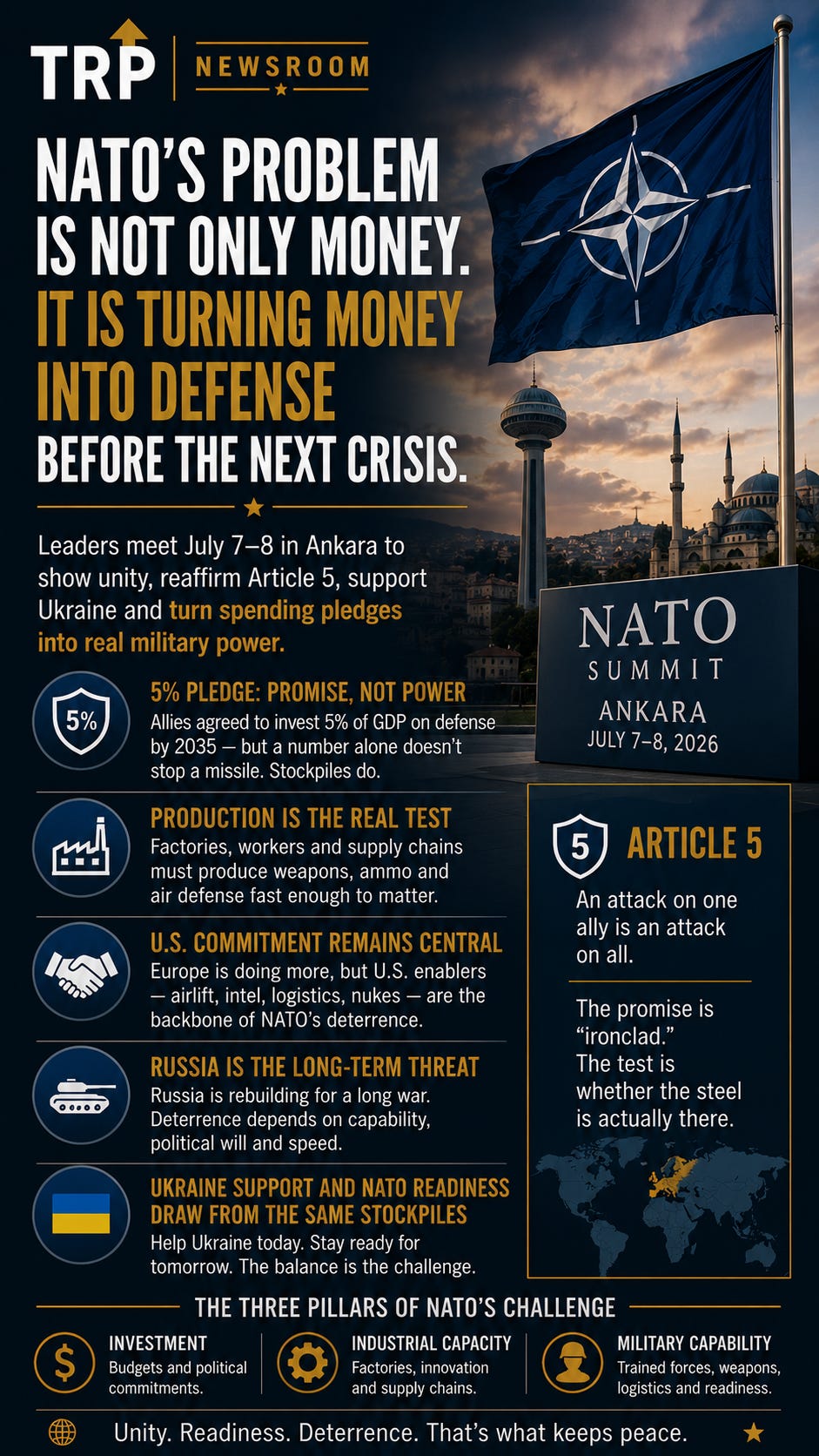
The July 7–8 summit in Turkey comes as the alliance tries to show unity, reaffirm its collective-defense promise, manage tensions with President Donald Trump, support Ukraine, address Russia’s long-term threat and navigate friction over Iran.
Reuters reported that NATO leaders, including Trump, are expected to affirm an “ironclad commitment” to collective defense under Article 5 in summit text approved by NATO ambassadors.
That language matters.
Article 5 is the core of NATO. It says an armed attack against one ally is considered an attack against all. NATO describes collective defense as its most fundamental principle.
But Article 5 is not only a legal clause.
It is a political promise that works only if allies believe it — and if adversaries believe it.
That is why the Ankara summit is about more than whether leaders can agree on a declaration. It is about whether NATO can still act like one alliance when its members increasingly disagree about who pays, who leads, who produces, who fights and which crisis matters most.
NATO says the summit will focus on three main areas: defense investment, defense industrial production and continued support for Ukraine.
Those are not separate issues.
They are the parts of one larger problem: NATO has promised more defense spending. Now it has to turn that money into usable military power before Russia, or another crisis, tests the alliance.
At the 2025 Hague Summit, NATO allies agreed to invest 5% of gross domestic product annually on defense and defense-related spending by 2035. That includes at least 3.5% for core defense requirements and NATO capability targets, with up to 1.5% for broader security-related investments such as critical infrastructure, cyber defense, civil preparedness, innovation and defense industrial capacity.
The number is politically important.
But money does not automatically become deterrence.
A spending pledge does not stop a missile. A stockpile might.
Defense spending is what governments budget. Defense production is what factories, supply chains and workers can build. Defense capability is what armed forces can actually use: trained units, weapons, ammunition, maintenance, logistics, command systems and readiness.
Those are not the same thing.
A government can spend more and still fail to solve the urgent problem if the money goes into slow procurement, payroll, pensions, politically protected industries or long-term prestige projects instead of the capabilities NATO needs most.
That is why the production question may be the most important part of Ankara.
Modern war consumes artillery shells, air-defense interceptors, drones, counter-drone systems, missiles, armored vehicles, spare parts, repair capacity, fuel and trained people. Ukraine has shown that a war of attrition can burn through stockpiles faster than peacetime defense industries are built to replace them.
NATO can vote for money in a day. It cannot build factories, ammunition stockpiles and trained formations in a day.
Reuters reported that NATO members are expected to announce tens of billions of dollars in defense-related contracts at the summit. But Reuters also reported that officials remain frustrated by slow increases in production and long delivery times for some orders.
That is the execution problem.
NATO’s challenge is no longer only getting allies to promise more money. It is converting political promises into deployable combat power, industrial capacity, stockpiles, air defense, ammunition, drones, logistics and credible readiness.
The United States sits at the center of that question.
Reuters reported that NATO officials are working to keep the United States committed to collective defense while Trump continues to pressure Europe to spend more and take greater responsibility for its own conventional defense.
That pressure is not new, but it has become more urgent.
The U.S. remains NATO’s strongest military power, especially in strategic enablers such as airlift, aerial refueling, intelligence, surveillance, reconnaissance, missile defense, long-range strike, command-and-control, logistics, high-end naval power and nuclear deterrence.
The question for NATO is not only whether America remains in the treaty.
It is whether allies and adversaries believe American power will arrive when NATO’s defense plans require it.
The Associated Press reported that NATO’s top commander, U.S. Gen. Alex Grynkewich, said European allies have filled most gaps created after the United States told NATO it would no longer provide certain assets in a crisis, including an aircraft carrier and support ships, aerial refueling planes and fighter jets. Some shortfalls remain.
That is a sign of Europe doing more.
It is also a sign of the larger shift underway.
The old NATO bargain often relied on America as the backbone while Europe contributed forces, geography and political support. The emerging bargain asks Europe to grow more of the conventional backbone itself while the United States focuses more attention and resources on global competition, especially in the Indo-Pacific.
That shift requires more than money.
Europe needs more deployable forces, air defense, long-range fires, artillery ammunition, drones, counter-drone systems, logistics, military mobility, intelligence, command-and-control, maintenance, repair capacity and industrial surge capacity.
It also requires political durability.
Defense spending competes with health care, pensions, housing, migration pressures, energy costs, debt and domestic politics. A summit declaration can set a target. National parliaments have to fund it year after year.
A spending target is a promise. A budget is a choice. A delivered capability is the result.
Russia is the reason the timeline matters.
NATO’s 2025 Hague declaration described Russia as a long-term threat to Euro-Atlantic security. Reuters reported that the Ankara summit text is expected to describe Russia as a persistent threat.
Russia has taken heavy losses in Ukraine, but the war has also pushed Moscow into a wartime production model. NATO does not have to assume Russia can match the alliance overall to worry about deterrence. A damaged Russian military can still be dangerous if it rebuilds faster than Europe rearms or creates a narrow, local test of NATO readiness along the eastern flank.
Deterrence depends on three things: capability, political will and speed.
If Russia doubts any of those, deterrence weakens.
Ukraine support is part of the same calculation.
Reuters reported that the summit declaration is expected to pledge €70 billion, or about $80 billion, in military support to Ukraine for 2026, with a commitment to provide at least equivalent levels in 2027. Until the declaration is formally released, that remains reported summit language rather than final adopted NATO text.
NATO says allied security is tied to Ukraine’s security and that support must be made sustainable for the long term.
The strategic tension is that Ukraine support and NATO readiness draw from the same factories, stockpiles and political patience.
Sending weapons to Ukraine helps degrade Russia and defend Europe forward. But if production does not keep pace, it can also drain stockpiles NATO may need for its own defense.
That is the production trap.
The summit is also taking place after Iran-related tensions among allies. Reuters reported that NATO leaders are trying to smooth over friction with Trump linked partly to Iran and other issues. Reuters also reported that the summit text is expected to warn that Iran must not develop a nuclear weapon and must respect freedom of navigation in the Strait of Hormuz.
That matters because NATO is built around Euro-Atlantic defense, but its members do not always share the same priorities in the Middle East. A crisis involving Iran can expose differences over U.S. action, regional escalation, maritime security, energy and Turkey’s role.
Turkey’s role as host adds another layer.
Turkey is strategically central to NATO’s southern flank, the Black Sea region and Middle East security. It is also an ally that has often pursued independent policies, including disputes with other members over Russian weapons systems and alliance enlargement.
That makes Ankara a fitting location for a unity summit.
NATO’s strength is that it brings together countries with different geography, politics and threat perceptions under one collective-defense system. NATO’s weakness is that those differences do not disappear when leaders sit at the same table.
For American voters, this is not an abstract foreign-policy story.
NATO affects whether U.S. troops are committed to Europe, how much American taxpayers spend on European defense, whether Europe buys U.S. weapons or builds more of its own, whether Russia is deterred before a wider war begins, whether Ukraine can keep fighting without direct NATO combat, and whether U.S. forces can focus more on China and the Indo-Pacific.
NATO is not only about Europe’s security.
It is about how much of the world’s disorder America is expected to carry.
The Ankara summit may produce strong language. It may reaffirm Article 5. It may announce Ukraine support and defense contracts. It may show that European allies are spending more and trying to carry more of the load.
Those things matter.
But the harder test will come after the summit.
Did allies fund the promises? Did contracts produce weapons fast enough? Did stockpiles grow? Did Europe replace enough U.S. conventional support to make NATO plans credible? Did Ukraine receive enough support without hollowing out allied readiness? Did Russia believe the alliance had both the will and the means to respond?
A summit declaration can say “ironclad.”
Deterrence asks whether the steel is actually there.
 | A guest post by
|