
License plates are public. Movement histories are different.
When Everything Becomes Searchable Safety, Privacy and Freedom in the Digital Era
The Redemption Project Newsroom
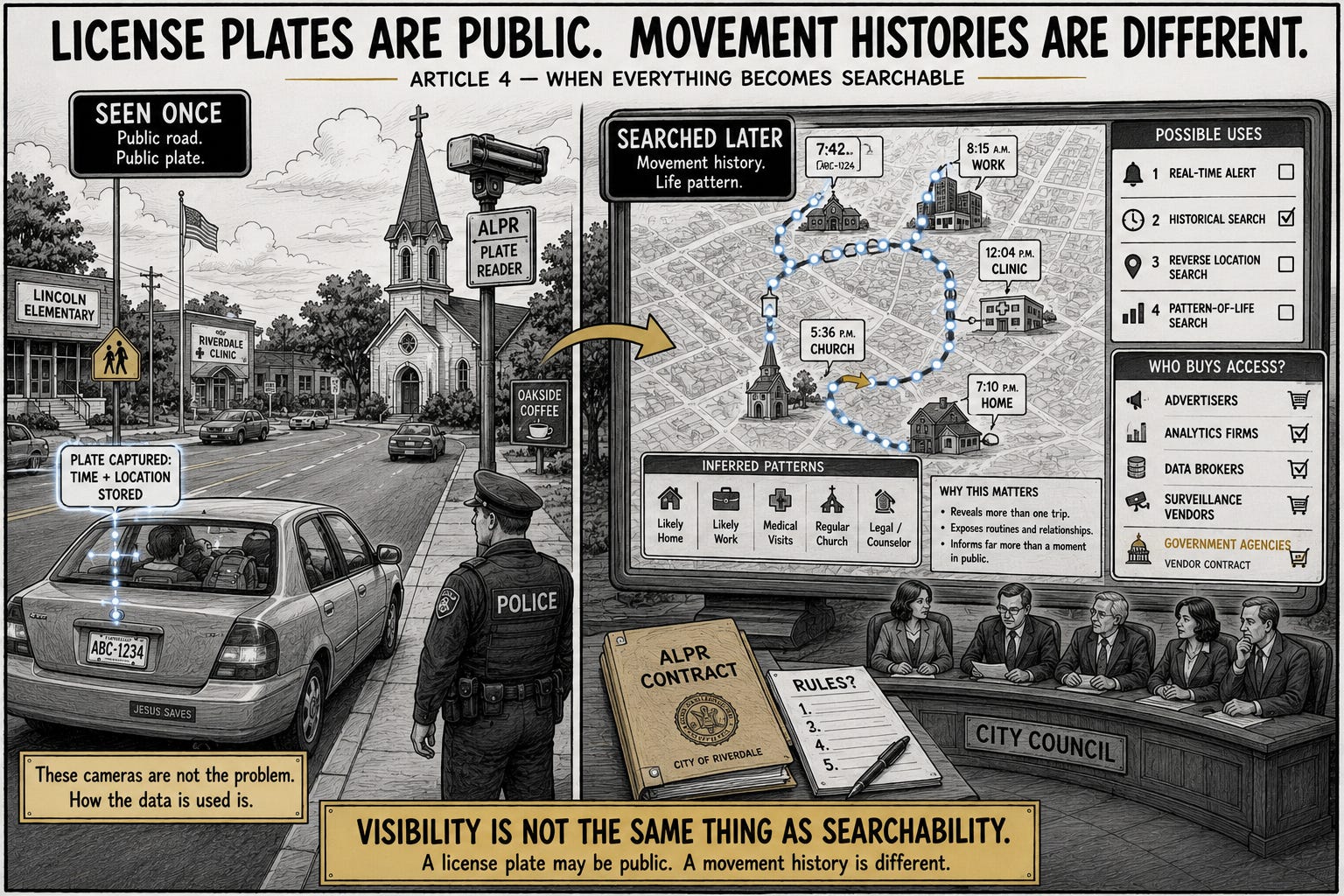
For generations, Americans have understood that driving on a public road is not private in the same way as being inside a home.
A police officer can see a license plate. A passerby can see a car. A witness can remember that a vehicle was parked near a store, a church, a school or a crime scene.
That part is not new.
What is new is the scale.
Flock Safety and other automated license plate reader systems do not merely let police see a plate in public. They allow cameras to capture vehicle information, store it, search it later and connect sightings across time and place.
That raises a harder question than whether a license plate can be seen from the street.
The question is whether ordinary driving should become part of a searchable movement history.
This is the fourth article in a series about what happens when ordinary life becomes searchable. The first articles looked at geofence warrants, commercial location data and the private apps that help create the location-data market. Automated license plate readers raise the same civic question on public roads.
What happens when movement that was once visible in passing becomes stored, searchable and shareable after the fact?
Automated license plate readers, often called ALPRs or LPRs, are cameras that capture license plate numbers, vehicle images, time stamps and locations as cars pass by. Some systems also record vehicle characteristics such as make, model, color or unique features.
Police agencies use the systems to help find stolen cars, locate wanted vehicles, identify suspects, recover missing people and move quickly in serious investigations. Those are real public safety uses. A camera hit tied to a stolen vehicle, an Amber Alert or a violent crime can matter.
But useful does not mean unlimited.
That is the line public officials keep having to confront as Flock cameras expand across cities, neighborhoods, businesses, homeowners associations and police departments.
The old assumption was simple: if you drive on a public road, people can see you. The new question is different: if thousands or millions of public sightings are stored in a database, searched later and shared across agencies, is that still ordinary observation?
That is where the constitutional issue begins.
A license plate is exposed to public view. But a searchable record of where a vehicle appeared yesterday, last week or over several weeks may reveal something more powerful than a single officer could observe from a patrol car.
It may reveal routines.
It may reveal patterns.
It may reveal where someone sleeps, works, worships, seeks medical care, attends political events, visits family, meets a lawyer or spends time when they think they are simply living an ordinary life.
That does not mean every ALPR search violates the Fourth Amendment. Courts have not gone that far.
It does mean the public debate should stop pretending the only question is whether a plate is visible.
Visibility is not the same thing as searchability.
The U.S. Supreme Court has not directly decided whether widespread ALPR systems such as Flock create a Fourth Amendment search when police access historical vehicle-location data. Lower courts have begun wrestling with the issue, and so far the results have often favored limited government use.
In Norfolk, Virginia, a federal judge rejected a Fourth Amendment challenge to the city’s use of Flock cameras, concluding that the system did not capture enough of a person’s movements to violate a reasonable expectation of privacy. Civil liberties groups have continued to argue that broad ALPR networks can become a form of mass surveillance when they are dense enough, searchable enough and retained long enough.
In a separate federal case in Kansas, a court rejected a Fourth Amendment challenge involving warrantless use of Flock data. But even there, the court recognized the concern that aggregation and searchability could eventually reach a constitutional line if police gain access to information that would otherwise be unknowable.
That is the key point.
The legal issue is not only the camera. It is the database.
A single police officer seeing a license plate in public is one kind of government observation. A network that can search vehicle sightings across time and jurisdictions is something else.
The same distinction has appeared in other digital privacy cases. In Carpenter v. United States, the Supreme Court held that police generally need a warrant to obtain historical cell-site location information from a cellphone provider. In United States v. Jones, the Court addressed warrantless GPS tracking, with several justices warning about the danger of long-term monitoring.
Those cases did not decide the Flock question. But they explain why the Flock question exists.
Technology changes what government can know.
The Constitution does not become irrelevant simply because the information was gathered in public.
That is where local governments have to be honest. When a city buys ALPR cameras, it is not only buying a crime-fighting tool. It may also be building a searchable map of public movement.
A city should not buy a searchable movement database and call it just another camera.
The harder question is what rules come with it.
Not all ALPR uses are the same.
A real-time hot-list alert may tell police that a stolen vehicle, wanted plate or missing-person vehicle just passed a camera. That use is targeted and immediate.
A targeted historical search asks where a known plate appeared during a defined period.
A reverse location search asks which vehicles were near a specific place at a specific time.
A pattern-of-life search uses repeated sightings to infer someone’s routine.
Those are different uses with different levels of risk.
They should not be treated as if they are the same.
The higher a search moves up that ladder, the stronger the constitutional and civic concern becomes. A stolen-car alert is not the same as asking which vehicles were near a church, clinic, protest, gun store, immigration office, addiction treatment center or political meeting.
That is why retention matters. Data kept for 24 or 48 hours creates one kind of power. Data kept for 30 days creates more. Data shared across regions, states or agencies creates more still.
Access matters too. A system should not be searchable by anyone with a login and curiosity. Searches should be tied to documented investigative purposes, case numbers, training, audit logs and consequences for misuse.
Sharing matters because license plate data does not stay local simply because the camera is local. If outside agencies can access a city’s ALPR data, residents deserve to know who those agencies are, what they can search, what legal standard applies and whether local officials can stop improper access.
That concern is no longer theoretical.
Public reporting has shown communities across the country reconsidering, limiting, pausing or canceling Flock contracts over privacy, immigration-enforcement, abortion-related, data-sharing and oversight concerns. Flock has also paused certain federal pilot programs after an Illinois audit found Customs and Border Protection accessed Illinois license plate data, raising concerns under state law.
In Shaker Heights, Ohio, officials amended a Flock contract after public records showed outside agencies had used data for immigration-related investigations. The revised agreement requires a court-issued search warrant and written notice before data is disclosed to outside entities.
In other places, local officials have paused systems, turned cameras off, covered cameras, rejected contracts or demanded tighter rules after residents questioned how vehicle data was being used and shared.
That public pushback does not mean Flock is useless. It does not mean police departments are wrong to want tools that help solve crimes. It does not mean every ALPR search is abusive.
It means citizens are asking a basic question before the network becomes too normal to question:
Who can search where we have been?
Flock and other vendors often emphasize that ALPR systems do not use facial recognition, do not track people by name and may use default retention limits. Those safeguards matter.
But safeguards built by a vendor are not a substitute for public rules.
A city council should not treat privacy as a feature setting. It is a governance question.
If a community uses ALPRs, residents should know the answers to several questions before the cameras become part of daily life.
Who owns the data?
Who can search it?
How long is it kept?
Can outside agencies access it?
Are searches limited to serious crimes or specific public safety purposes?
Are reverse searches allowed?
Are searches near sensitive locations restricted?
Is a warrant required for historical searches?
Are audit logs reviewed by someone with authority?
What happens when an officer or outside agency misuses the system?
Those questions are not anti-police. They are pro-accountability.
Good rules protect the public. They also protect good police work. A legitimate case is stronger when the tool used to build it is governed by clear policy, documented purpose and constitutional guardrails.
The mistake in this debate is pretending there are only two choices: let police use the technology however the platform allows, or ban every camera.
There are more responsible options.
A city could allow real-time alerts for stolen vehicles, missing persons and serious crimes while requiring a warrant or court order for certain historical searches. It could limit retention. It could restrict outside sharing. It could prohibit access for noncriminal immigration enforcement or out-of-state investigations that violate local or state policy. It could restrict searches involving sensitive locations. It could require annual transparency reports showing how often the system was used, what kinds of cases it supported, how many outside agencies accessed data and whether misuse occurred.
None of that prevents police from doing their job.
It defines the job before the tool expands beyond it.
That is especially important because Flock sits at the private-public line. In some places, cameras are purchased or used by police departments. In others, private neighborhoods, businesses, schools or property owners may install cameras and share access with law enforcement. The company provides the platform, the cameras and the search tools, while public agencies use the results.
That raises a public accountability question beyond the usual Fourth Amendment analysis.
When does private surveillance infrastructure become government surveillance power?
The answer will depend on ownership, access, control, direction, sharing and use. But citizens do not need to wait for the Supreme Court to decide every question before asking local officials to set clear rules.
Courts decide constitutional floors.
Communities can set higher standards.
That is where the public debate should be. Not in panic. Not in blind trust. In rules.
Police should be able to explain when they search ALPR data, why they search it, how far back they search, who can see the results and what prevents misuse. Vendors should be able to explain how data is stored, shared, audited and deleted. Local officials should be able to explain why the benefits are worth the risks and what limits protect ordinary residents.
If the answer is only “trust us,” the answer is not enough.
Public safety matters. Stolen vehicles matter. Missing people matter. Violent crime matters. Communities have a legitimate interest in using technology to respond faster and investigate better.
But free movement matters too.
A person should not have to assume that every routine drive is becoming part of a searchable government-accessible file. Going to work, church, school, a doctor, a counselor, a political meeting, a gun store, a shelter, a lawyer’s office or a friend’s house should not automatically become a data point waiting for the right query.
That is the real issue with Flock and ALPRs.
Not whether a plate can be seen in public.
Whether public movement can be stored, searched and reconstructed later.
The country does not need to choose between public safety and constitutional liberty as if one must erase the other. It needs rules strong enough for the tools being used.
A license plate may be public.
A life pattern is different.
I am a retired detective and criminal justice / government educator based in Tennessee. I am a commentary write for Tennessee Lookout and a weekly columnist with Knox TN Today. My work examines public policy, public safety systems and civic responsibility. My reporting and commentary have also appeared in Governing, The Arizona Capitol Times, South Florida Sun Sentinel, Police1, among other state and regional outlets.
Notes:
A federal judge rejected the Fourth Amendment challenge to Norfolk’s use of Flock cameras in Schmidt v. City of Norfolk, while civil liberties groups describe the case as ongoing around ALPR privacy expectations. In United States v. Martin, a Kansas federal court rejected a suppression challenge involving warrantless use of Flock data. AP reported Flock paused federal pilot programs after an Illinois audit found CBP accessed Illinois license plate data, and Axios reported Shaker Heights amended its Flock contract to require a court-issued warrant and written notice before outside disclosure.


