



Commissioners entered Monday’s workshop seeking answers about data retention, access, sharing, audits, cybersecurity and misuse. They left facing a more fundamental dispute over how the Sheriff’s Office bought the technology, whether a valid agreement governs it and whether the existing camera network should remain at all.
By Brandon L. Burley
The Redemption Project Newsroom | Systems Explained / Accountability
KNOXVILLE, Tenn. — Knox County commissioners went into Monday’s Flock Safety workshop asking who can search license plate data, how long the information is kept, who can receive it and what happens when somebody misuses the system. They left with an even more basic question: Was the system itself properly authorized?
The question emerged after an Aug. 12 letter from Knox County Mayor Glenn Jacobs challenged the validity of the Knox County Sheriff’s Office’s longstanding agreement with Flock. A day after the workshop, Mayor-elect Betsy Henderson said she believes the cameras should be removed.
Commissioners are now preparing for an Aug. 31 vote on legislation that could ultimately require the existing Flock network to come down and keep the Sheriff’s Office’s Advanced Research & Communications Center, or ARC, closed until the incoming sheriff returns with a new plan.
The privacy questions did not disappear during Monday’s workshop. Procurement and oversight questions joined them, changing what Knox County is being asked to decide.
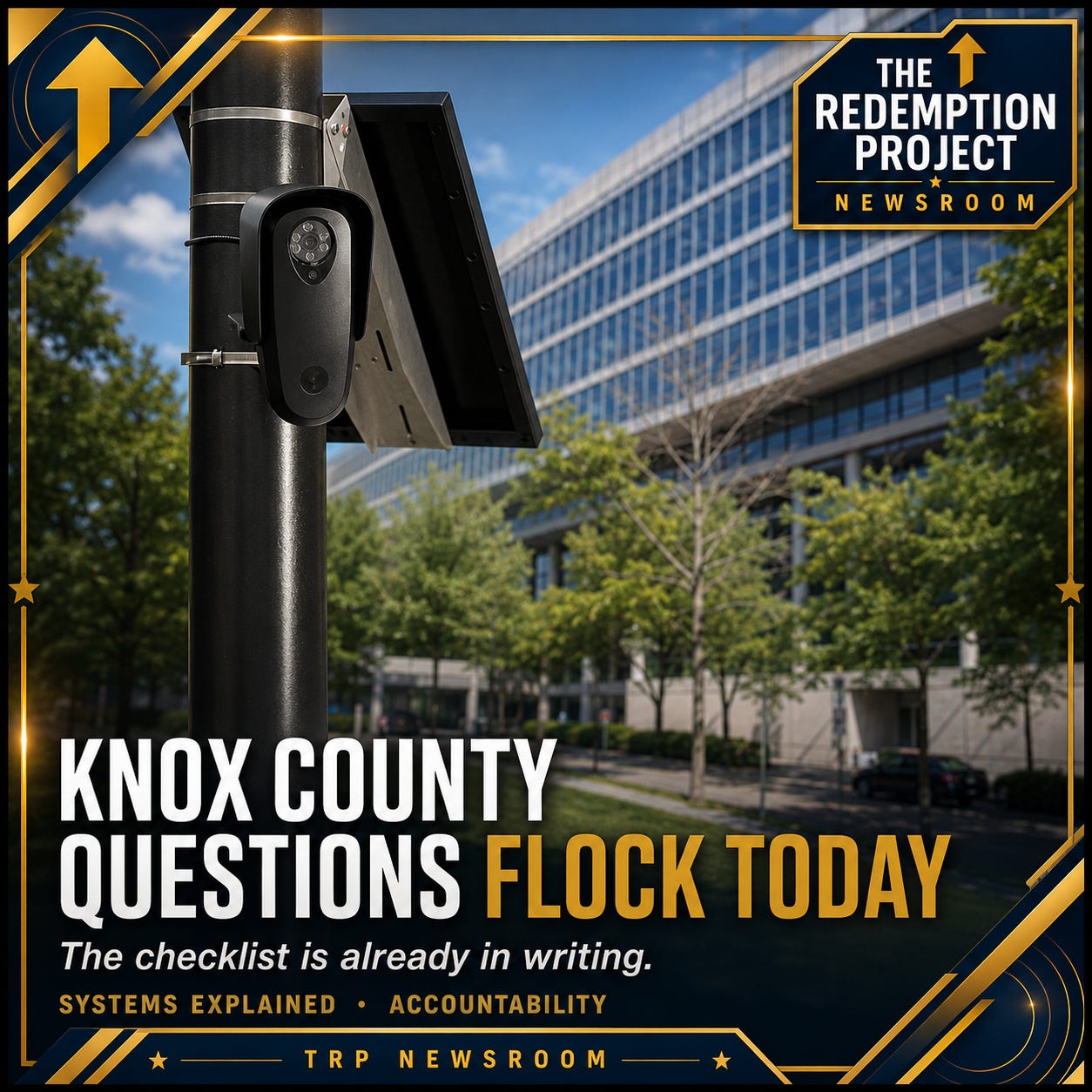
The county already had a checklist
Before Flock executives and Sheriff’s Office representatives met with commissioners, the county had already established its standard for reviewing the system.
Resolution R-26-7-905, adopted unanimously in July, requested a comprehensive review of ARC and its associated automated license plate readers before the center becomes operational. It asks what information the cameras collect, how long it is retained, who can search it, who else can receive it, how access is controlled and whether searches are audited.
Commissioners also asked about cybersecurity, erroneous information, vendor access, misuse and discipline, training, costs, contracts and the written policies governing the operation. The resolution requested policies, standard operating procedures, training requirements, audit protocols and governance documents, and asked that ARC not become operational until commissioners had completed the review and had a reasonable opportunity to consider the information publicly.
The resolution acknowledged the legitimate law-enforcement uses of license plate readers while also calling for protection of constitutional liberties. Monday’s workshop added another question to that checklist: What agreement authorized the system being reviewed?
Jacobs says the original agreement is not valid
Jacobs’ letter traces the Flock relationship to 2020, when the Sheriff’s Office entered into an agreement for five cameras and installation costing $13,750. According to the mayor, subsequent equipment and services purchased under that agreement eventually totaled approximately $274,720.
That figure does not include a separate $800,000 purchase made through Omnia, a cooperative purchasing organization. Jacobs argues that purchases under the earlier agreement eventually crossed the $100,000 threshold at which County Commission approval was required.
Jacobs concluded that he does not believe the 2020 agreement is valid and said he believes no current service agreement is in place. He also questioned what contractual terms governed the cameras after the original agreement, which he says should have expired in 2024.
That is the mayor’s legal position, not a court ruling. But it creates a significant governance question while the existing camera network remains operational: What agreement currently controls Knox County’s relationship with Flock?
Purchases just below a review threshold drew scrutiny
Commissioner Larsen Jay raised another issue during Monday’s workshop, saying records showed multiple Flock purchases of $24,990. The amount matters because Sheriff’s Office purchases of $25,000 or more trigger additional mayoral review.
Jay also said he identified pairs of $12,500 purchases that would have crossed the threshold if considered together. A Sheriff’s Office representative acknowledged during the workshop that he understood commissioners’ concern about how the transactions appeared.
The records do not establish why the purchases were structured that way, and they do not prove someone deliberately attempted to avoid oversight. Repeated transactions landing immediately below an oversight threshold nevertheless warrant an explanation.
The issue also goes beyond accounting. Procurement review is one of the places elected officials can ask what government is buying, what powers a technology creates, how much it will ultimately cost and what safeguards accompany it.
There are already 143 cameras
The controversy intensified over the Sheriff’s Office’s plan to install roughly 270 additional cameras using state grant money. Those new installations have been paused, but Knox County is not debating a surveillance network that exists only on paper.
Information presented at Monday’s workshop put the current KCSO network at 143 active Flock cameras.
That makes questions about retention, access, sharing and auditing immediate rather than theoretical. The existing system is already creating searchable records showing that vehicles were observed at particular places and times.
The county therefore is not simply asking whether it should build a Flock network. It is deciding what to do with one it already has.
The incoming mayor wants the cameras removed
The dispute crossed into the incoming county administration Tuesday when Henderson said she supports removing the cameras. She told WVLT that supporting law enforcement must be balanced with protecting individual rights and said the situation had become more disturbing as she learned more.
That creates an unusual transition. The outgoing mayor disputes the validity of the underlying Flock agreement and does not want it renewed. The incoming mayor wants the cameras removed. Commissioners are considering legislation that could dismantle the current network.
Sheriff-elect Brent Gibson could therefore inherit either an operating 143-camera system or the responsibility of deciding whether to build a new surveillance program through a different public process.
The original privacy questions still need answers
The procurement dispute should not swallow the issues that prompted the July resolution.
Tennessee law generally allows governmental ALPR data to be retained for no more than 90 days unless information is preserved as part of an ongoing investigation. That is the legal ceiling, not necessarily Knox County’s actual retention period.
The Sheriff’s Office system has previously been described as retaining information for 30 days. Flock announced Aug. 13 that it was changing its recommended default from 30 days to seven and creating an “Evidence Mode” for preserving specific records associated with investigations.
Existing customers, however, do not automatically move to seven days. The local question remains how long Knox County keeps its data, whether that period is fixed in written policy, who can change it and what is required to preserve information beyond the ordinary retention period.
The same distinction applies to federal sharing. Flock says ICE does not have automatic nationwide access to customer data and says federal sharing is disabled by default. But the company also allows local customers to authorize direct sharing relationships with federal agencies.
That means the useful question is not simply whether Flock gives ICE Knox County data. It is which outside agencies KCSO has authorized to access or receive its information, who can change those relationships and whether the restrictions exist in written policy rather than only in software settings.

A search log is not the same thing as oversight
Flock says searches are associated with individual users and logged, and the company has announced additional safeguards it plans to require of law-enforcement customers by the end of 2026, including stronger misuse detection and required case codes.
Those vendor controls do not eliminate the need for local policy.
Knox County still needs to know who reviews KCSO search logs, how often they are examined, whether every search is tied to a case or legitimate law-enforcement purpose, who audits supervisors and administrators and what happens when misuse is discovered.
A search log provides a record. Accountability requires someone to examine it and act when that record shows a problem.
Vendor access presents a similar issue. Flock’s current terms say customers retain ownership of their data while granting Flock a license, limited to specified purposes but perpetual and irrevocable, to use the information in providing its services and supporting or improving its products.
That makes ownership an important contractual protection, but it does not fully answer who can technically access Knox County information for support, maintenance or other purposes, whether that access is logged or what happens to the information when the relationship ends.
