


The Redemption Project Newsroom
A Washington resident asked the city of Stanwood for one hour of images captured by its Flock license plate readers.
The request covered every vehicle photographed during a specific period in March 2025.
Stanwood and the nearby city of Sedro-Woolley went to court rather than release the records.
Their argument was not simply that the images were sensitive.
The cities argued that the images were not government records at all because Flock Safety stored them on the company’s servers. Unless a city employee searched for an image and downloaded it, they said, the record remained in the vendor’s possession.
A Skagit County Superior Court judge rejected that argument in November 2025.
The cameras had been purchased by the cities. The images were created for the cities and used for a governmental purpose. Storing them with a private company did not place them beyond Washington’s public-records law.
The ruling answered one important question.
Government cannot necessarily outsource a public record and then claim the record does not exist.
It raised another.
Should a public-records request allow someone to obtain the time, location and image of every vehicle that passed a police camera?
Less than five months later, Washington lawmakers supplied a different statewide answer.
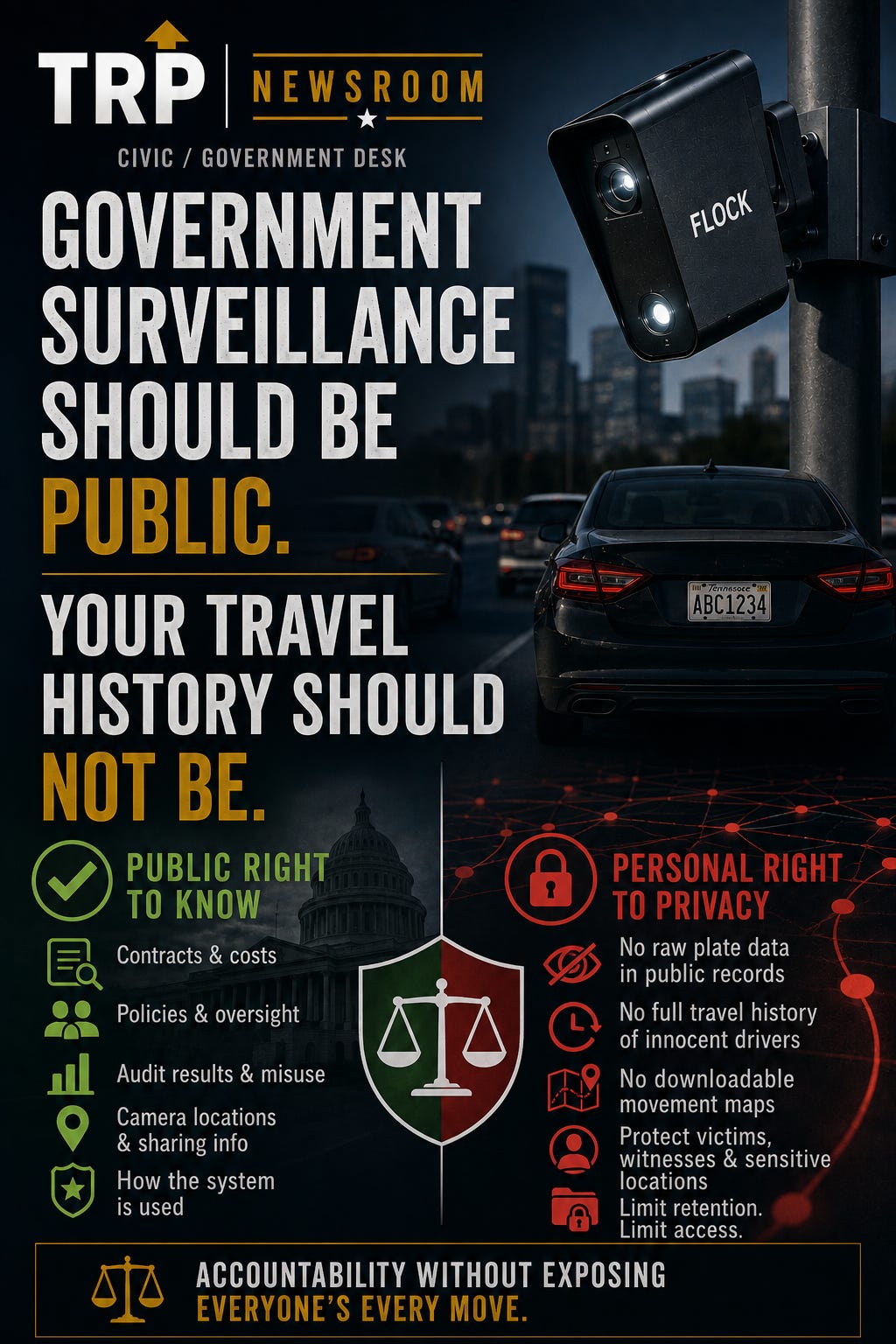
A new law signed March 30, 2026, exempts automated license plate reader data from public disclosure while requiring agencies to preserve audit trails and eventually publish policies, camera locations, sharing information, audit results and statistics showing how the systems are used.
That distinction sits at the center of the fifth article in this series.
The public has a legitimate right to know how government surveillance operates.
That does not necessarily mean the public should receive a searchable history of where every driver went.
The first question is whether the record belongs to government
Public-records disputes often begin with two separate questions.
First: Is the material a government record?
Second: If it is, must the government disclose it?
Those questions are not the same.
A police report may be a public record while portions remain withheld to protect a victim, witness, juvenile or active investigation. A personnel file may be a government record while medical information and other protected details are redacted.
Calling something a public record does not mean posting every unedited detail online.
It means the government cannot avoid accountability merely because the information is inconvenient, sensitive or stored by a contractor.
That vendor-custody issue extends well beyond Flock.
Government agencies increasingly use private companies to store emails, manage body-camera footage, operate cloud databases, process emergency communications and maintain digital evidence.
If government could avoid public-records laws simply by leaving information on a vendor’s server, transparency would depend less on what the government did than on where it saved the file.
The Washington trial court rejected that approach. It found that Flock images created and used for the cities’ governmental purposes were public records even though Flock retained them.
That principle matters.
So does the privacy problem created by releasing the images.
Secrecy would hide the evidence of misuse
The second article in this series examined officers who allegedly used license plate reader systems to monitor former spouses, dating partners and romantic rivals.
Many of those cases were established through audit records showing which officer searched which plate, when the search occurred and what reason the officer entered.
One Milwaukee victim discovered repeated searches through HaveIBeenFlocked.com, a privately operated project built from audit records obtained through public-records requests.
