



Americans spend billions on gift cards every year. The money cannot generally be counted as a sale when a retailer first receives it. But when customers never redeem some of those balances, accounting rules can allow part of the forgotten money to become revenue.
By Brandon L. Burley
Systems Explained
There is probably one somewhere.
In a junk drawer.
An old wallet.
A glove compartment.
Maybe buried three screens deep in an email inbox.
A gift card with $7.43 left on it.
To the person who forgot it, that money may as well be gone.
To the company that issued the card, it is still being accounted for.
When a customer first buys a retailer’s gift card, the company generally cannot count the money as a sale. It has the cash, but it still owes somebody the merchandise, meal or coffee that the card promises.
So the money begins as a liability.
Most of it eventually becomes ordinary sales revenue when customers redeem their cards.
Some of it does not.
The accounting term for the portion companies expect will never be redeemed is breakage.
And once you know where to look, publicly traded companies tell investors quite openly how much customer forgetfulness can be worth.
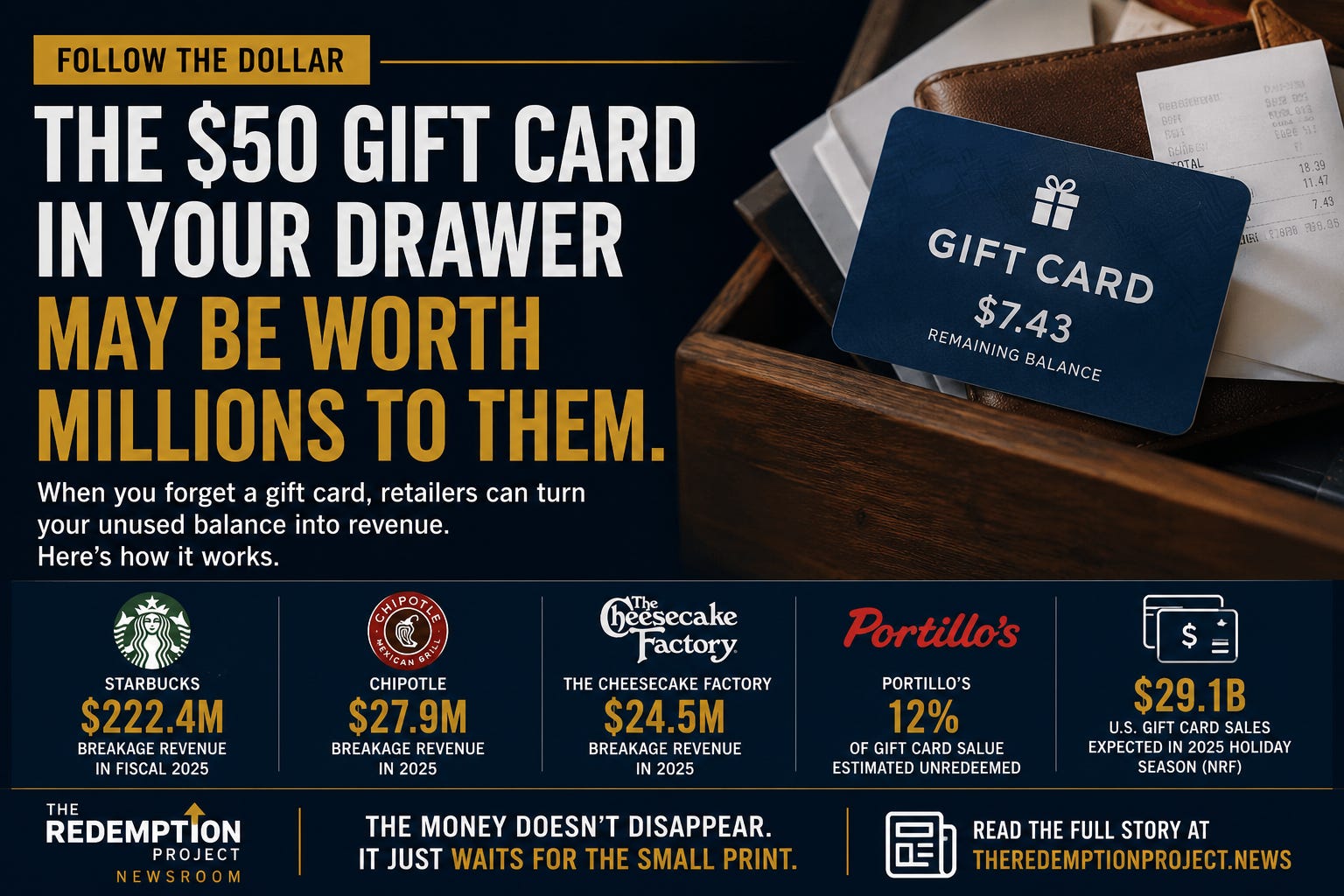
Starbucks reported approximately $222.4 million in breakage revenue from stored-value cards across its company-operated and licensed businesses in fiscal 2025.
Chipotle reported nearly $28 million.
The Cheesecake Factory reported $24.5 million.
Portillo’s estimates that 12% of eligible gift-card value will ultimately go unredeemed.
Those figures are revenue, not necessarily profit. They also do not suggest that any of these companies did something improper.
They show something more interesting.
The gift card in your drawer is part of a financial system most consumers never see.
And the money does not disappear simply because the card does.
The $50 becomes a promise
Suppose you give a restaurant $50 for a $50 gift card.
You have completed a purchase.
The restaurant has not.
It has your cash, but somebody can still walk through the door tomorrow and demand $50 worth of food.
Until that obligation is satisfied, the company generally records the outstanding amount as a liability rather than sales revenue.
Walmart describes that process directly in its annual filings. Customer gift-card purchases are not recognized as sales until the cards are used to buy merchandise. Until then, the amount remains deferred gift-card revenue.
Target reported approximately $1.2 billion in outstanding gift-card liabilities at the end of January 2026.
Starbucks operates one of the largest visible stored-value systems in American retail.
Its fiscal 2025 financial statements showed approximately $1.75 billion in deferred revenue associated with stored-value cards and its loyalty program at year-end.
During the year, Starbucks reported more than $15.2 billion flowing through card activations, reloads and loyalty-related activity, while similarly enormous amounts moved back out of those liabilities through customer redemption and breakage.
That exposes the first economic advantage of a gift card before breakage ever occurs.
The company gets the cash first.
The customer receives the goods later.
That does not mean every gift-card dollar sits untouched in a separate account, nor does every card program operate exactly the same way. General-purpose prepaid cards involving banks and payment networks can have different structures from restaurant or retailer cards.
But with a traditional retailer-issued gift card, the basic sequence is simple:
The cash arrives before the merchandise leaves.
Then people forget
Most gift-card balances eventually get spent.
Some do not.
A 2024 Bankrate survey found that 43% of U.S. adults had at least one unused gift card, voucher or store credit. Among those holding unused value, the average was $244.
The survey also found that 34% of Americans said they had lost money at some point because a gift card expired, was lost or belonged to a business that closed.
Meanwhile, the National Retail Federation expected consumers to spend approximately $29.1 billion on gift cards during the 2025 holiday season alone.
A small percentage of an enormous market is still an enormous amount of money.
Companies have years of their own redemption data. They know how quickly cards tend to be used, how long small balances remain outstanding and how often those balances never move again.
That allows them to estimate future nonredemption.
Breakage is where customer forgetfulness becomes a line item.

Starbucks recognized $222.4 million in one year
Starbucks provides one of the clearest examples.
The company says most stored-value cards are redeemed within a year. Based on historical redemption patterns, however, Starbucks estimates that some balances will never be used and recognizes qualifying breakage over time.
In fiscal 2025, Starbucks reported $200.4 million in breakage revenue through company-operated stores and another $22 million through licensed stores.
Combined: $222.4 million.
The previous year’s total was approximately $207.6 million.
That number requires an important distinction.
Starbucks did not charge customers a $222 million penalty.
It did not simply declare hundreds of millions in gift cards abandoned one morning and move the balances into revenue.
The company estimates expected nonredemption based on actual customer behavior and accounts for unclaimed-property obligations where applicable. Revenue is then recognized according to the accounting treatment for those expected unused balances.
The process is routine.
The scale is not.
Starbucks is not alone
Chipotle reported approximately $27.9 million in gift-card breakage revenue in 2025, compared with roughly $7.8 million in 2024 and $1.2 million in 2023.
The company says its estimate considers historical redemption patterns along with amounts it expects could ultimately be remitted to governments under unclaimed-property laws.
The Cheesecake Factory reported $24.5 million in breakage in 2025, compared with $7.3 million in each of the previous two years.
Approximately $17.3 million of the 2025 total resulted from an updated assessment of customer redemption patterns.
Its auditor considered gift-card breakage significant enough to warrant detailed testing because changing assumptions about future redemption can materially affect revenue.
Brinker International, the parent company of Chili’s, reported approximately $10 million in gift-card breakage during its 2025 fiscal year.
Its auditor identified the estimate as a critical audit matter because determining expected future redemption requires judgment and actuarial modeling.
Portillo’s makes the underlying assumption particularly easy to see.
The restaurant company increased its expected gift-card breakage rate from 11% to 12% in 2025.
In plain language, its historical data currently supports an expectation that roughly $12 of every $100 in eligible gift-card value will ultimately go unused.
Sportsman’s Warehouse uses a far lower estimate: approximately 4% where it has no obligation to remit abandoned balances to a state.
That range matters.
There is no universal rule that gift cards generate some fixed percentage of free money for companies.
Customers behave differently.
Businesses attract different kinds of customers.
State laws differ.
So do the cards.
How forgotten money becomes revenue
The mechanism is easier to understand than the accounting language surrounding it.
A company sells a gift card.
The company records an obligation.
Customers begin redeeming their cards.
Years of redemption history give the company evidence about how much eligible value is likely never to be used.
Accounting rules can then allow expected breakage to be recognized over time in proportion to customer redemption patterns.
The liability declines.
Revenue rises.
No additional customer necessarily walks through the door at the moment that breakage revenue is recognized.
That does not mean the company unlawfully took somebody’s money.
It means the economic value of nonredemption eventually needs an accounting destination.
Sometimes that destination is the company.
Sometimes the government gets there first.
The state can enter the money trail
Every state has rules governing abandoned financial property.
They are generally known as unclaimed-property or escheat laws.
The rules can cover dormant bank accounts, uncashed checks and, depending on the jurisdiction and type of card, unused gift-card balances.
Companies account for those legal obligations when estimating breakage.
That means the money trail can split.
A customer buys a gift card and spends it. The company recognizes the resulting sale.
A customer buys a card and never spends all of it. The company may eventually recognize qualifying breakage.
Or a balance becomes legally abandoned and must be transferred to a state as unclaimed property.
Same gift card.
Different destination.
Geography can help determine which one.
Tennessee illustrates why the distinction matters
Tennessee law can exempt certain gift cards and certificates from the state’s unclaimed-property requirements when they satisfy specified conditions.
According to Tennessee Department of Treasury guidance, qualifying cards generally must have value that does not expire, decrease only through redemption and meet other statutory requirements.
Cards that do not qualify for the exemption can become subject to a five-year dormancy period before being reportable as unclaimed property.
Tennessee also restricts expiration dates and certain fees on covered gift certificates. Federal Regulation E provides additional protections for covered gift cards, including restrictions on expiration and inactivity fees.
But consumer-protection law and accounting law answer different questions.
That distinction is the heart of this story.
A card being protected from expiration does not necessarily mean the issuing company must leave the entire unused balance recorded as a liability forever.
Accounting rules ask when a company may recognize expected nonredemption.
Unclaimed-property laws ask whether legally abandoned value must eventually be transferred to the state.
Consumer-protection laws govern what issuers can do to the cardholder.
One forgotten balance can therefore sit at the intersection of three different systems.
The plastic is simple.
The law underneath it is not.
Tennessee holds forgotten money, too
The state reported receiving approximately $252.9 million in cash unclaimed property during fiscal 2025 and returning about $124.9 million through 168,070 claims.
Those figures cover all forms of unclaimed property, not merely gift cards.
Still, they reveal the scale of another system built around money whose owners have lost track of it.
Tennessee generally does not pay interest to someone reclaiming abandoned property unless the property itself was interest-bearing when the state received it.
That raises another Follow the Dollar question:
What happens financially to hundreds of millions of dollars while the state is holding it for people who have not claimed it?
That deserves its own investigation.
For gift cards, the divide is already visible.
Some forgotten value can become company revenue.
Some may become state-held unclaimed property.
Some remains an outstanding liability.
The dollar never stopped existing.
Only the person holding the card stopped thinking about it.
Companies can benefit even when every penny gets spent
Breakage is only one piece of gift-card economics.
Imagine that every dollar on a card eventually gets redeemed.
The company still received cash before providing the merchandise.
The recipient still had to return to that company’s ecosystem to recover the full value.
The visit may produce additional spending beyond the balance remaining on the card.
And the card may bring the customer back more than once.
Starbucks says so directly.
Its annual report describes the Starbucks Card not only as a gifting and payment tool but as a product designed to increase the frequency of store visits by cardholders.
That is an important reminder about how gift cards should be understood.
They are gifts to the recipient.
They are also customer-acquisition and retention tools for the issuer.
There is another layer at the checkout rack.
Companies can pay fees associated with gift cards distributed through third-party retailers. Texas Roadhouse, for example, reports expenses connected with cards sold through outside retailers.
That establishes the existence of another commercial relationship inside the gift-card system, although it does not by itself tell us how much a particular grocery store, warehouse club or other retailer earns from selling someone else’s cards.
That is another money trail worth following.
The rack beside the register is the visible piece.
The contracts behind it are not.
None of this makes gift cards bad
That would be the easy conclusion.
It would also miss the point.
Gift cards are convenient. They solve the problem of choosing a gift for someone else. They are easy to send electronically. Recipients can select what they want. Businesses get customers who have a reason to walk through the door.
Most gift-card value gets redeemed.
The more useful question is whether consumers understand what changes when they convert cash into a gift card.
Cash is broadly spendable.
A retailer-issued gift card is a claim against one company.
The customer has traded flexibility for convenience.
If the claim is used, the transaction works exactly as intended.
If it is forgotten, another system takes over.
Follow the dollar
Return to that $50 restaurant gift card.
Someone gives the restaurant $50 today.
The restaurant records an obligation.
Months later, the recipient spends $43.17.
A balance of $6.83 remains.
Maybe the customer comes back next week.
Maybe the card sits in a drawer for five years.
Maybe state law eventually requires the abandoned value to be transferred.
Maybe the company’s historical data says balances like that are unlikely to be redeemed, allowing an appropriate portion to become breakage revenue.
Whatever happens, the $6.83 did not vanish.
It moved through a system.
Multiply that small forgotten balance across millions of consumers, and pocket change becomes corporate revenue, state-held property or billions of dollars in outstanding obligations.
Starbucks alone reported approximately $222.4 million in breakage revenue in one fiscal year.
That is what makes the old gift card worth looking at differently.
To you, it may be $7.43 forgotten in a drawer.
To somebody else, it is still a liability, a future sale, abandoned property or expected revenue.
The card may be forgotten. The money is not.
Advertisement · Make a more specific wish list
If TRP apparel belongs on your gift list, save the exact product link and your preferred size. The Jesus Saves 24/7 Retro Tee is one place to start. Check current pricing and destination-specific shipping before ordering.
I am a retired detective and criminal justice / government educator based in Tennessee. I am a commentary write for Tennessee Lookout and a weekly columnist with Knox TN Today. My work examines public policy, public safety systems and civic responsibility. My reporting and commentary have also appeared in Governing, The Arizona Capitol Times, South Florida Sun Sentinel, Police1, among other state and regional outlets.
