



The Redemption Project Newsroom
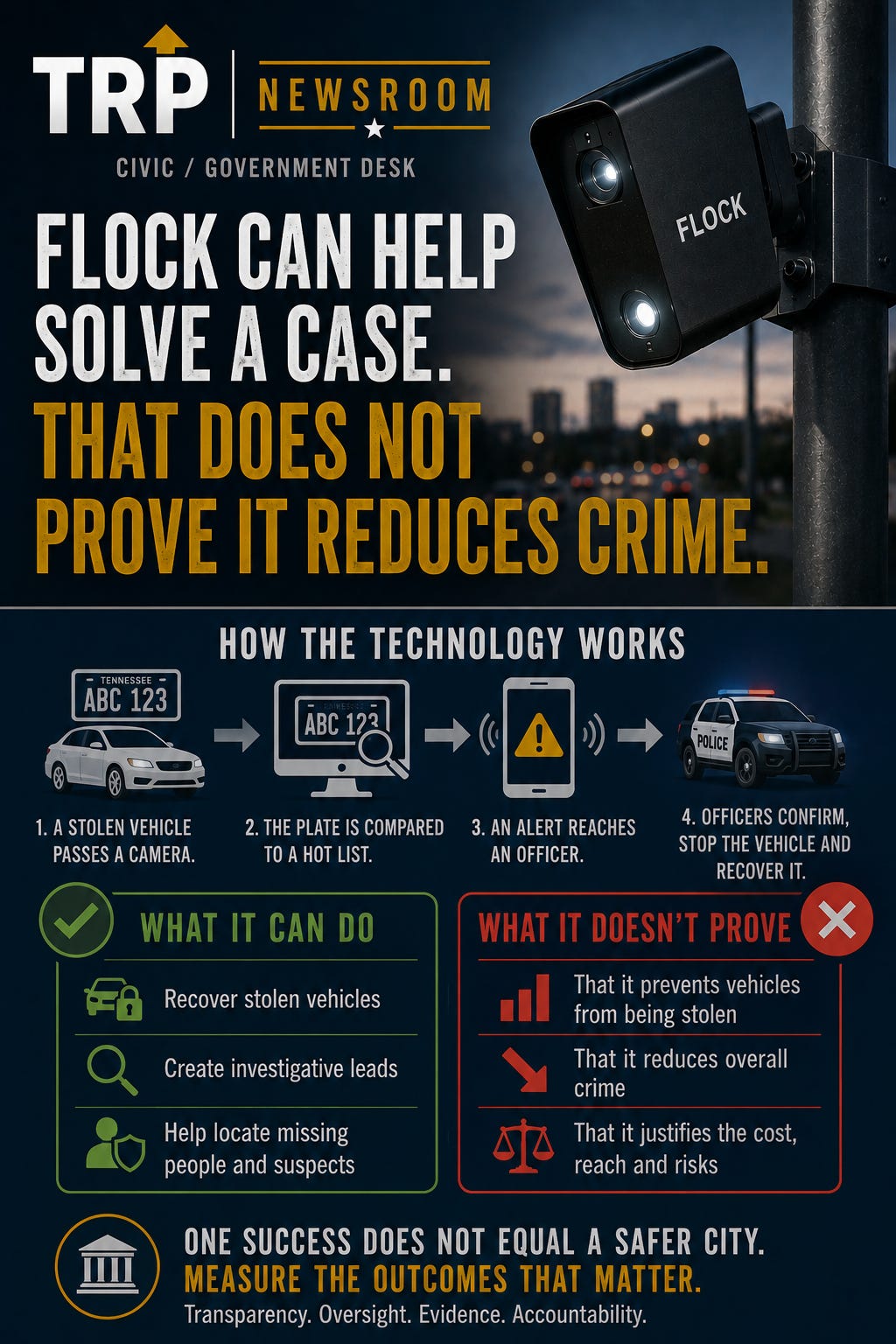
A stolen vehicle passes a roadside camera.
The license plate is compared with a law-enforcement hot list.
An alert reaches an officer, who confirms the plate, stops the vehicle and returns it to its owner.
In that case, the technology worked.
The vehicle was located. The owner recovered property. Police may have identified a suspect who otherwise would have remained unknown.
That is meaningful.
It also does not prove that the camera prevented a vehicle from being stolen.
Those two outcomes are often folded together when police departments, vendors and elected officials discuss automated license plate readers.
A camera may help police find a vehicle.
It may help investigators clear a case.
It may contribute to an arrest.
Whether installing a larger network causes crime to decline is a different question.
The evidence is considerably stronger for the first claim than the last.
That distinction sits at the center of the seventh article in this series.
Three claims that should not be treated as one
The first article in this series explained how Flock Safety’s automated license plate readers turn roadside observations into searchable records.
The system can produce several kinds of results.
It can generate activity: plate reads, searches and alerts.
It can produce investigative outputs: recovered vehicles, identified suspects, arrests and cases in which the data supplied a lead.
And it may contribute to broader public-safety outcomes: improved clearance rates, reduced theft or lower crime.
Those categories are connected.
They are not interchangeable.
A department may scan millions of plates and generate thousands of alerts without knowing how many alerts were accurate, how many produced stops or how many materially changed a case.
An officer may recover a stolen vehicle without preventing the next theft.
Investigators may use Flock while solving a homicide even though witness statements, phone records or physical evidence would have solved the case without it.
The narrow claim may still be true.
The system helped.
The broader claim — that the system caused the outcome — requires more evidence.
Flock says its technology assisted one in five cleared cases
Flock published its first annual Impact Census in May 2026.
The company surveyed nearly 700 law-enforcement customers across 43 states. Agencies that formally tracked Flock-related outcomes supplied counts. Agencies without formal tracking provided estimates of the percentage of cases in which Flock contributed.
Flock then matched responses with FBI crime and clearance data and weighted the findings according to agency size and crime volume.
The company estimates that its technology supported more than 1 million criminal investigations and incidents during 2025.
