

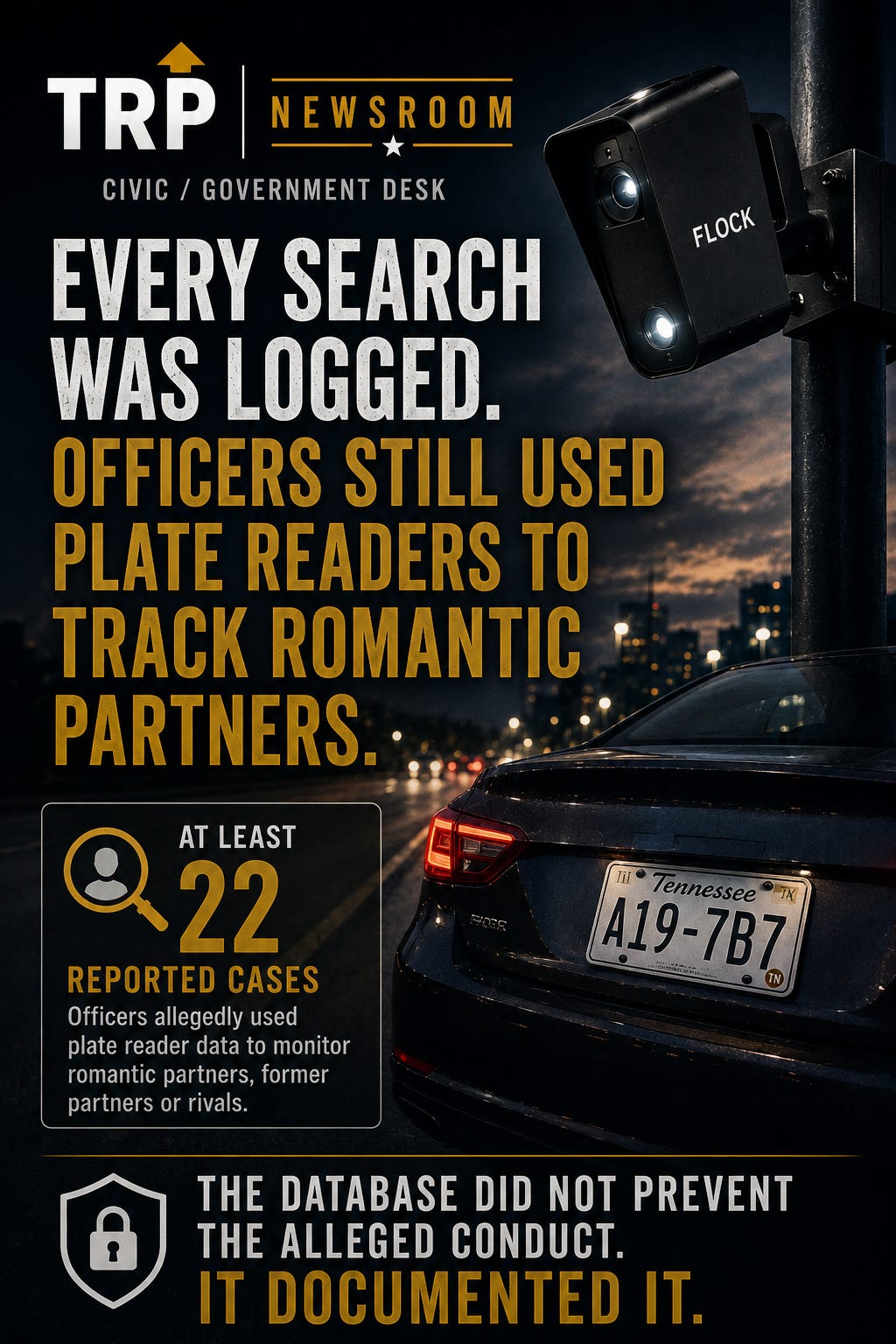
Every Search Was Logged. Officers Still Used Plate Readers to Track Romantic Partners


The Redemption Project Newsroom
The car had been checked for a GPS tracker.
Nothing was found.
But according to a 2024 arrest affidavit, a Shelby County sheriff’s deputy still appeared to know where his former wife was going.
At one point, she received a message asking, “Where are you going?”
Investigators eventually found another possible explanation.
An audit showed that Deputy Thadius Gordon had searched the same Tennessee license plate approximately 20 times in four days and more than 100 times overall using a law-enforcement database, according to Action News 5. Gordon was charged with stalking and harassment and relieved of duty with pay. His attorney disputed the allegations and said the full circumstances had not been presented.
The database did not prevent the alleged conduct.
It documented it.
That distinction sits at the center of the second article in this series.
As the first article explained, automated license plate readers can turn individual roadside observations into a searchable history of where and when a vehicle was seen.
That history can help locate stolen vehicles, identify a suspect car or find a missing person.
It also can be searched by someone who already knows the plate number for reasons that have nothing to do with a criminal investigation.
At least 22 reported cases
The Institute for Justice, a public-interest law firm challenging automated license plate reader networks in several cities, has identified at least 22 reported cases in which officers allegedly used license plate reader data to monitor current partners, former partners, suspected romantic rivals or other people in whom they had a romantic interest.
The organization’s article was updated July 13, 2026.
Most of the reported incidents occurred since 2024. Nearly all of the officers were criminally charged and lost their jobs through termination or resignation, according to the organization’s review.
Only a few of the cases were initially discovered through internal investigations.
Most reportedly came to light after the person being monitored complained about the officer’s behavior.
Twenty-two is a serious number.
It also needs to be described precisely.
The count is not limited to Flock Safety. It includes Flock and other automated license plate reader systems.
It is not a count of every kind of license plate reader misuse. It excludes cases involving searches for political, immigration or other personal purposes when no romantic interest was documented. It also excludes misconduct that was never reported publicly, never detected or resolved internally without a public record.
Twenty-two is therefore not the total.
It is the documented floor for one specific category of reported abuse.
The pattern is difficult to dismiss
The cases span officers, deputies, detectives, police chiefs and at least one elected sheriff.
The alleged search counts are not generally limited to one curious or mistaken lookup.

Continue reading this post for free, courtesy of The Redemption Project.
 | A guest post by
|
 | A guest post by
|