



The proposed Kingsport permit covers eight surface impoundments, a hazardous-waste landfill, groundwater monitoring and corrective action. The public comment period remains open through Sept. 22.
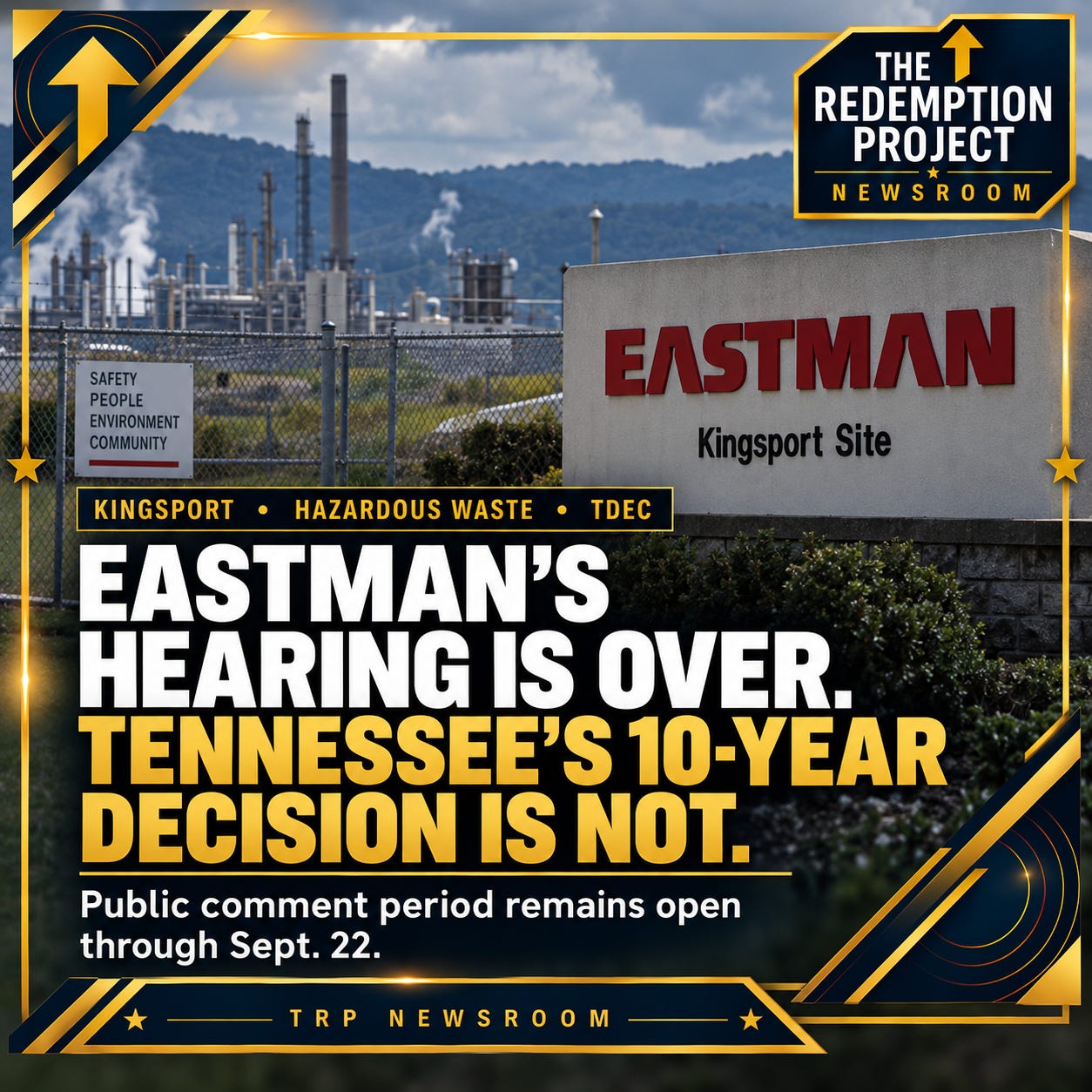
KINGSPORT, Tenn. — Tennessee held its public hearing this week on another 10-year hazardous-waste permit for Eastman Chemical Co.
But the hearing was not the decision.
The Tennessee Department of Environment and Conservation has tentatively decided to reissue the permit, which governs eight surface impoundments with a combined capacity of 130.3 million gallons, a hazardous-waste landfill, groundwater monitoring and continuing corrective-action requirements at Eastman’s Kingsport operations.
Written comments remain open through Sept. 22.
Only after that process ends will TDEC decide whether to issue or deny the permit and respond to significant comments raised during the proceeding.
That means the most important questions surrounding Eastman’s next decade of permitted hazardous-waste activity are still open.
They include what groundwater-monitoring and corrective-action obligations remain active, what recent permit modifications changed and whether those changes are incorporated into the proposed renewal.
The state’s own public-facing records also disagree over how the Eastman permit should be classified.
What Tennessee is considering
Eastman submitted its Part A and Part B renewal applications in March 2023.
Because the company filed a timely renewal application, TDEC says Eastman may continue operating under its existing permit while the state decides whether to issue or deny the new one.
The proposed permit covers eight surface impoundments used in connection with Eastman’s wastewater-treatment operations.
Together, those impoundments have a capacity of 130.3 million gallons.
The permit also covers a hazardous-waste landfill that may receive residues from Eastman incineration units and certain other hazardous and nonhazardous wastes, including technology-enhanced naturally occurring radioactive material, commonly known as TENORM.
The permit includes groundwater-monitoring requirements and corrective-action provisions for solid-waste-management units and areas of concern.
Those requirements matter.
But their existence alone does not establish that Eastman is currently violating its permit, that every regulated unit is contaminated or that a cleanup remains incomplete.
Those are separate factual questions.
The relevant issue as Tennessee considers another 10-year permit is what the current regulatory record actually shows.
The groundwater and corrective-action record
TDEC’s public materials establish that groundwater monitoring and corrective action are part of the permit.
They do not, by themselves, establish the present condition of every monitored area.
That requires the underlying records.
Current groundwater results could show ongoing contamination, stable conditions, completed remediation, continuing monitoring obligations or some combination of those conditions across different parts of the site.
The same distinction applies to corrective action.
A requirement to investigate and address releases is not the same thing as a finding that a particular release remains unresolved.
For the public, the meaningful questions are therefore more specific:
Which units remain subject to active corrective action?
What contaminants, if any, are currently being monitored?
What remedies have been completed?
What work remains?
And what conditions would trigger additional investigation or remediation during the next permit term?
Those answers are more important than simply knowing that the words “groundwater monitoring” and “corrective action” appear in the permit.
Recent permit changes still need explanation
The timing of recent permit modifications creates another question.
TDEC’s notices identify permit activity shortly before the Sept. 8 hearing, including a Class 1 modification notice dated Aug. 27 and other recent modifications.
The existence of those modifications is not evidence of wrongdoing.
Permit modifications are a normal part of hazardous-waste regulation.
But when a permit is being considered for another 10 years, changes made immediately before the renewal proceeding are relevant to understanding exactly what the state is being asked to continue authorizing.
The underlying modification documents are therefore important.
They should establish what changed, what units or operations were affected and whether the changes involved waste handling, monitoring, corrective action, capacity or administrative provisions.
They should also show whether those changes are reflected in the draft renewal now before TDEC.
Until those records are reviewed, it would be premature to characterize the significance of the recent modifications.
TDEC’s own pages classify the permit differently
There is also a discrepancy in Tennessee’s public-facing records.
TDEC’s detailed Eastman materials describe the proceeding as a hazardous-waste permit renewal involving continued operation of the surface impoundments and landfill.
Its statewide “Waste Notices & Hearings” table, however, labels the Eastman matter a “Hazardous Waste Post-Closure Permit.”
The state’s hearing calendar describes the Eastman proceeding as a hazardous-waste permit.
That same calendar identifies an Olin proceeding as a post-closure matter, while the waste-notices table describes Olin more generally as a hazardous-waste permit.
The records are therefore internally inconsistent.
One possible explanation is that labels were swapped or entered incorrectly on the state website.
TDEC has not yet established that explanation in the records reviewed by The Redemption Project.
So the defensible finding is narrower:
Two current TDEC pages classify the Eastman proceeding differently, and TRP has not yet established why.
The distinction matters because an operating hazardous-waste permit and a post-closure permit do not describe the same regulatory posture.


