



By The Redemption Project Newsroom
Civic / Government Desk
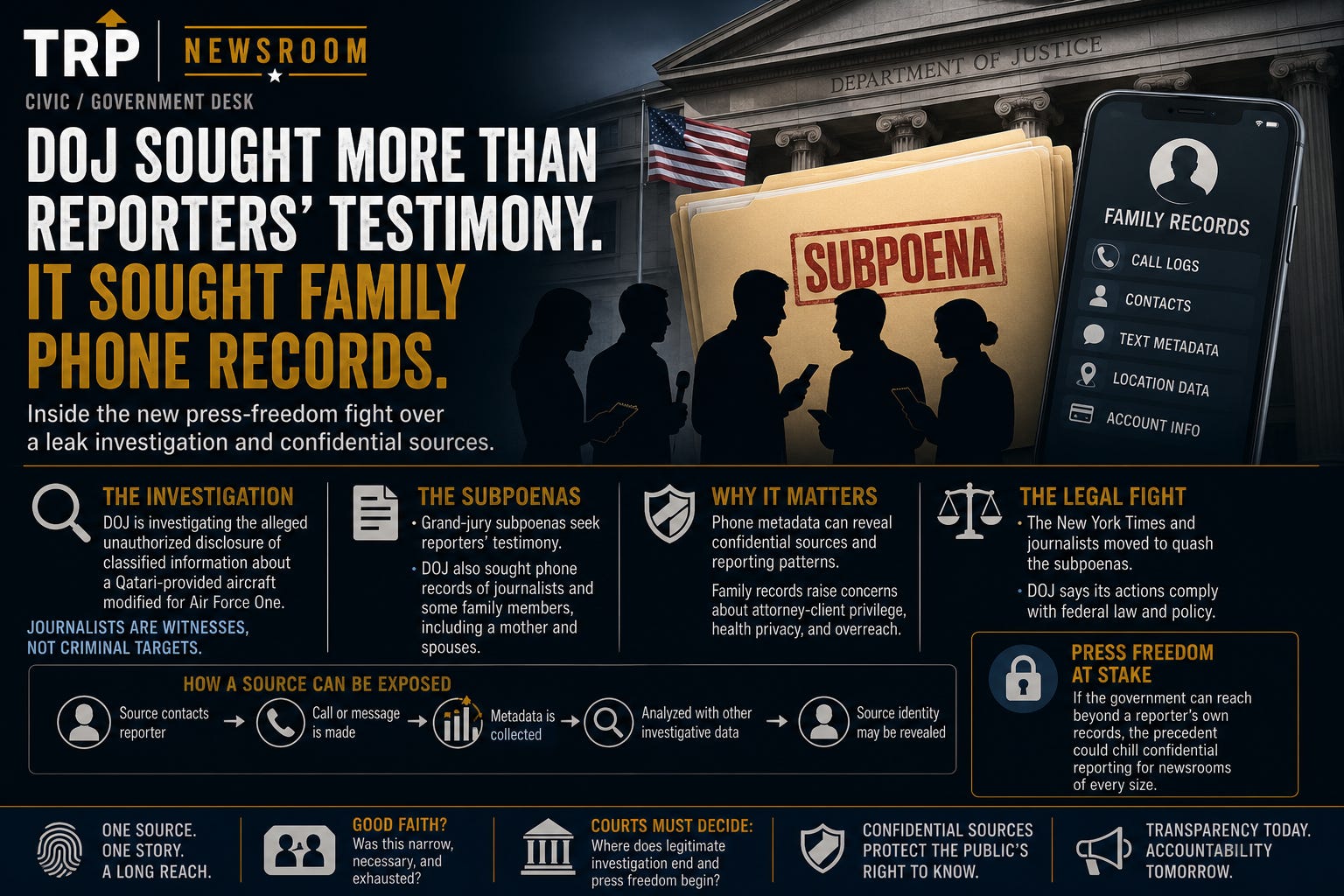
The Justice Department was investigating who spoke to journalists about the president’s aircraft.
To find the source, prosecutors did not seek only the reporters’ testimony.
They also sought phone records tied to some of the reporters’ relatives.
That is the escalation at the center of a new press-freedom dispute involving The New York Times, several of its journalists and a federal grand-jury investigation in Manhattan.
The underlying investigation concerns reporting about security limitations on a Qatari-provided aircraft modified for use as Air Force One. The Times reported that the aircraft lacked some defensive capabilities associated with the existing presidential fleet and that the Secret Service had advised President Donald Trump to use an older aircraft when departing a NATO summit in Turkey. (AP News)
The Justice Department says it is investigating the alleged unauthorized disclosure of classified information. It says the journalists are witnesses, not criminal targets. (AP News)
That distinction matters
Government employees do not have an unlimited right to disclose national-security information simply because a journalist is willing to publish it. If classified presidential-security information was unlawfully shared, the government has a legitimate interest in investigating.
But the government does not receive unlimited power to expose a newsroom’s confidential relationships simply by calling the investigation national security.
That is the harder question now before the court.
Four Times journalists — Julian E. Barnes, Eric Lipton, Tyler Pager and Eric Schmitt — were identified by NPR as receiving federal grand-jury subpoenas tied to the Air Force One reporting. The subpoenas sought to compel testimony before a grand jury in Manhattan regarding an alleged violation of federal criminal law. (Georgia Public Broadcasting)
Later filings revealed another layer: DOJ also issued subpoenas seeking phone records associated with several Times journalists and some of their relatives. AP reported that the records subpoenas were in addition to the grand-jury subpoenas and that U.S. District Judge Arun Subramanian had frozen enforcement of the phone-records subpoenas while the Times challenged them. (AP News)
Those records do not necessarily mean recordings of calls or the contents of text messages. Phone-record subpoenas commonly seek metadata: numbers contacted, dates, times, call duration, subscriber information and account details.
That may sound less intrusive than call content.
It can still reveal a source.
Phone metadata can show who communicated with whom, how often and when. Investigators can compare those patterns with government phone logs, work schedules, access records or travel information. A confidential source can be identified without the government ever hearing the conversation.
That is why the family records matter.


