



Crime labs, toxicology units, clinical laboratories and wastewater researchers are looking at different specimens for different purposes. That can make an emerging drug visible in one dataset while absent from another.
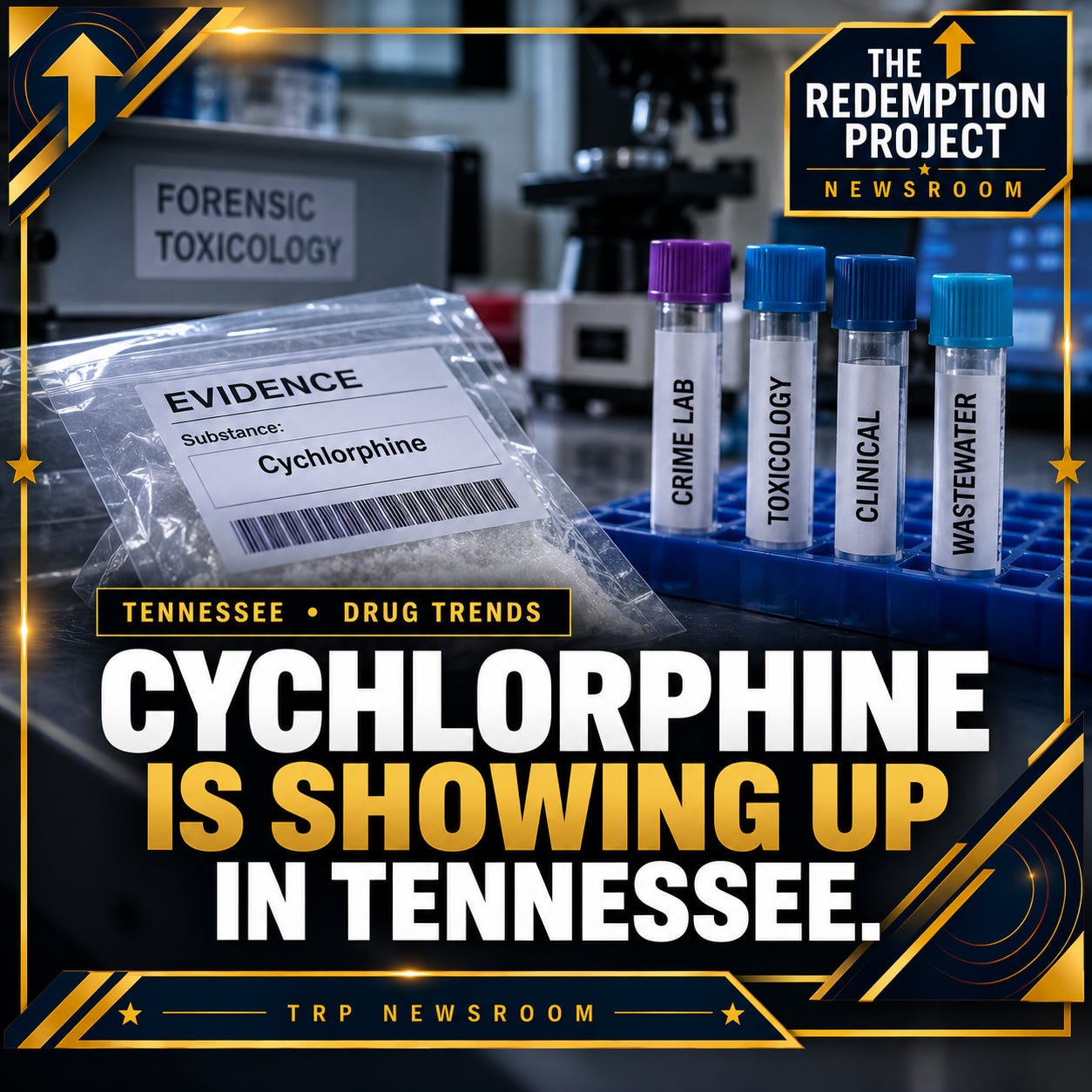
KNOXVILLE, Tenn. — In February, one Tennessee Bureau of Investigation laboratory could identify cychlorphine in drugs seized by police.
Another TBI unit did not yet have a method to test blood for it.
That was not a contradiction.
The laboratories were testing different specimens, for different purposes, using different methods.
That distinction is becoming increasingly important as cychlorphine, also known as N-propionitrile chlorphine, appears in the illicit drug supply and in overdose investigations.
A drug can be identified in powder seized by police before a toxicology laboratory is prepared to routinely identify it in blood. A clinical laboratory may not include it on its testing menu even while a forensic laboratory can confirm it in drug evidence. Researchers may detect it in wastewater before conventional public-health statistics fully capture its presence.
There is no single system that sees an emerging drug all at once.
And that complicates what the public can know about cychlorphine in real time.
Tennessee saw the divide early
In a Feb. 12 response to The Redemption Project, TBI said its Forensic Chemistry Unit had identified cychlorphine in drugs submitted by law enforcement.
TBI reported 11 positive seized-drug submissions during 2025 and nine more by the time of its February response. According to the agency, all had come from East Tennessee law-enforcement agencies.
But TBI told TRP something else at the same time: Its Toxicology Unit did not then have a method for testing blood for the compound.
Those units were answering different questions.
Forensic chemists examining a powder seized by police are trying to determine what the material contains.
Toxicologists examining blood from a person are working with a biological specimen, often at much lower concentrations, under different analytical and validation requirements.
The February response is also now seven months old.
TRP has asked TBI for an updated assessment but has not yet established whether its blood-testing capability has changed. The newsroom therefore is not treating TBI’s February limitation as a statement about its current September capability.
Ohio shows what another system can see
Ohio’s Bureau of Criminal Investigation described a different experience in a September response to TRP.
BCI said its general controlled-substance workflow was capable of identifying cychlorphine without the agency first having to create a cychlorphine-specific screening process.
According to BCI, its laboratories use gas chromatography-mass spectrometry, compare results against spectral libraries and confirm findings with a reference standard when reporting requirements are met.
BCI told TRP it had recorded 37 cychlorphine laboratory cases through Aug. 31, along with several cases involving related orphine compounds.
The agency said nine cychlorphine submissions were associated with overdose investigations based on information supplied by the submitting agencies.
But Ohio BCI does not test blood from overdose victims.
It tests seized drugs.
So nine drug submissions associated with overdose investigations are not nine toxicologically confirmed cychlorphine overdoses.
They are nine seized-drug laboratory submissions connected, according to the submitting agencies, to overdose investigations.
That denominator matters.
Finding a signal is not the same as routinely reporting it
Barry Logan, a forensic toxicologist with NMS Labs and the Center for Forensic Science Research and Education, told TRP that sophisticated laboratories can sometimes recognize a previously unknown substance relatively quickly.
High-resolution mass spectrometry, structure elucidation and retrospective analysis can help researchers determine that something new is present, Logan said.
Turning that discovery into routine testing takes longer.
According to Logan, obtaining a reference standard can take weeks. Laboratories then have to determine whether the drug appears often enough or presents enough risk to justify developing and validating a routine method.
He estimated that the process from early recognition to routine validated testing can take roughly two months to six months or longer, depending on the substance.
There is a financial calculation, too.
Logan estimated that adding a drug and metabolite to an appropriate existing method might cost approximately $40,000 to $60,000. More difficult chemistry could push the cost to $60,000 to $80,000, he said, while particularly challenging compounds could require more than $150,000 in analytical investment.
The important distinction is between recognizing an unknown signal and having a validated method capable of defensibly reporting that drug in a clinical or forensic case.
Clinical laboratories make another decision
Millennium Health showed how that difference reaches patient testing.
The clinical laboratory told TRP on Sept. 9 that it is not currently testing for cychlorphine, although it is strongly considering adding the drug.
The company said it watches multiple surveillance sources when deciding which emerging substances warrant addition to its testing menu.
That does not conflict with Ohio BCI’s ability to identify cychlorphine.
The laboratories are performing different jobs.
A state crime laboratory examining powder from an evidence submission and a clinical laboratory deciding which substances to routinely test for in patient specimens are not measuring the same thing.
Even “zero” requires context
Connecticut’s state forensic laboratory offered another example.
The laboratory told TRP on Sept. 9 that it had no reportable cychlorphine cases. But officials also said cychlorphine is represented in its analytical libraries and the laboratory can identify it.
And when TRP asked whether zero cases at that laboratory meant Connecticut had no cases, the answer was no.
Cases could have gone elsewhere.
“No cases in this laboratory” is therefore not the same statement as “no cases in this state.”
Denver adds another layer.
Its crime laboratory told TRP it had presumptively identified the broader orphine class in an estimated 20 to 30 seized-drug samples. Fentanyl was present in all but one, according to the laboratory.
Denver did not describe those as 20 to 30 confirmed cychlorphine cases.
“Orphine” is a broader category.
And a presumptive identification is not the same as a confirmed result.


