



CPD says Drone as First Responder operations began in February, although its Aug. 26 announcement says training and test flights began in late April. Six months of flight records can now show when the drones launched, why they launched, what authority governed the flight and what happened to the video afterward.
By The Redemption Project Newsroom
CHATTANOOGA, Tenn. — Chattanooga police publicly rolled out a new Drone as First Responder program Wednesday, demonstrating aircraft that can rise from fire-station docks, fly remotely toward a 911 call and give officers a live view before the first patrol car reaches the scene.
The program itself apparently had been operating for months. The Chattanooga Police Department’s current DFR page says operations began in February 2026 and had already been helping the department respond to calls, while its Aug. 26 announcement says officer training and DFR test flights began in late April and describes the pilot as “now fully operational.”
That timeline needs clarification, but it does not mean the city secretly created the program. City Council publicly authorized CPD in July 2025 to seek a federal grant specifically for overtime associated with beta testing Drone as First Responder operations, and CPD issued a written unmanned-aircraft policy incorporating DFR in December.
What the department’s own materials now suggest is more specific: operational use began in February, the department says training and testing began later, and the major public demonstration followed in August.
That leaves Chattanooga with something more useful than a debate over how police drones might operate.
It has months of records showing how they actually did.
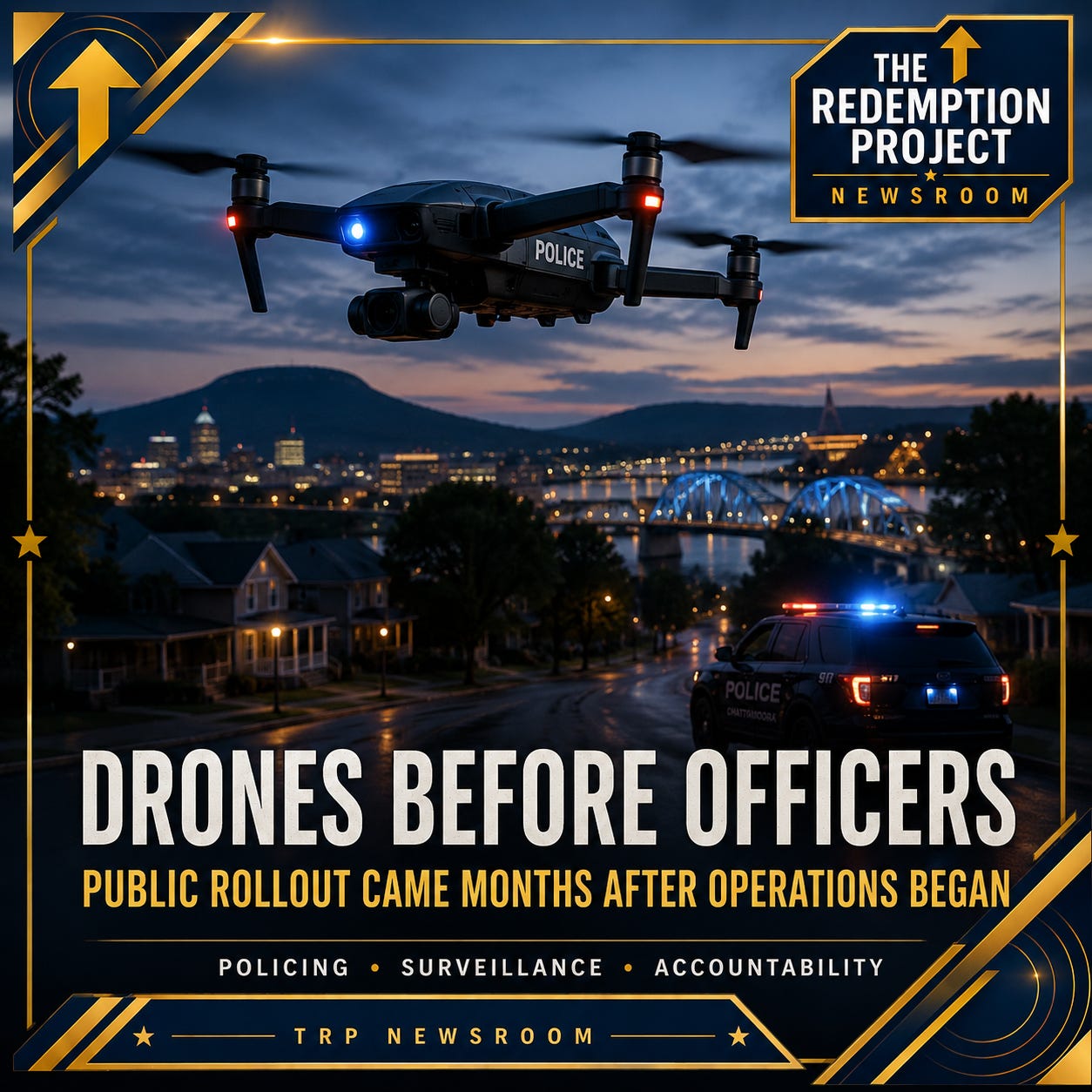
These are not officer-carried drones launched after police arrive
CPD’s DFR pilot uses two BRINC Responder aircraft positioned at Chattanooga Fire Stations 4 and 9.
When a 911 call or what CPD calls a “police-generated call for service” occurs, a trained officer inside the department’s Real Time Intelligence Center can remotely launch an aircraft. CPD says the drone transmits live video to responding officers, operators and incident commanders and can remain overhead until the incident stabilizes.
BRINC says its Responder platform provides roughly 42 minutes of flight time, thermal imaging, 40-times total zoom and cellular teleoperation. CPD says its aircraft are not equipped with facial recognition, do not routinely patrol and are not used for random or general surveillance. The department also says the camera remains pointed toward the horizon while traveling to and from calls before switching to an overwatch view at the scene.
Those are meaningful safeguards.
They do not answer every question about what the aircraft are allowed to do, either under police policy or federal aviation rules.
FAA confirmed the regulatory framework — not Chattanooga’s specific flight envelope
CPD says its FAA authorization allows the drones to operate as far as three miles from their docks.
The Federal Aviation Administration has not yet independently confirmed that Chattanooga-specific permission to The Redemption Project.
FAA Public Affairs Specialist Rick Breitenfeldt told TRP that law-enforcement and other public-safety drone programs can generally operate through one of two regulatory paths: as public aircraft under an FAA Certificate of Waiver or Authorization, commonly called a COA, or as civil aircraft under Part 107.
Whichever route applies, Breitenfeldt said public-safety operators still must comply with applicable FAA regulations and every operational condition contained in their particular authorization. He also described Drone as First Responder as a recognized public-safety use that can give officers aerial awareness before ground personnel arrive and while responders are handling an incident.
Breitenfeldt said he is trying to locate Chattanooga’s specific COA and indicated that the authorization itself should answer many of the remaining questions.
Until that document is obtained, CPD remains the source for the three-mile figure.
FAA has not yet confirmed to TRP whether Chattanooga specifically has beyond-visual-line-of-sight authority, what maximum altitude applies, whether visual observers or detect-and-avoid systems are required, what weather restrictions govern flights, what authority exists for nighttime operations or flights over people, or whether the trailer-mounted launch stations may be relocated without modifying the federal authorization.
TRP has filed a federal Freedom of Information Act request seeking Chattanooga’s COA or waiver, amendments, releasable operating and safety conditions, and any reported incidents or deviations.
The distinction matters because three different kinds of authority govern the program.
FAA rules determine whether and how the aircraft can physically fly. Tennessee law helps determine when police may use the aircraft to gather information. CPD policy governs who inside the department may launch it and for what purpose.
Compliance with one does not automatically establish compliance with the others.
CPD’s written policy reaches beyond emergency calls
CPD’s current UAS policy, issued Dec. 19, expressly incorporates Drone as First Responder operations.
Its DFR examples include searching for suspects and missing people, providing real-time intelligence and “answering of non priority calls for service.” The broader unmanned-aircraft policy allows deployments for crime- and crash-scene imagery, disaster response, fire operations, special events, crowd and traffic control, hazardous-material incidents and other legitimate law-enforcement uses consistent with Tennessee law.
The policy’s pre-incident section goes further, allowing aerial imagery for planning, large-event preparation and other activity deemed “pre-incident” by CPD command staff.
None of those uses is automatically unlawful. The policy itself requires compliance with Tennessee law and expressly recognizes that satisfying FAA flight requirements does not necessarily satisfy the Fourth Amendment.
It also calls for supervisory involvement. Appropriate UAS uses require approval through the drone program, and the policy says deployment approval must come from at least the rank of sergeant.
The operational question is how that approval works when a drone is already waiting in a dock and an RTIC officer receives a call. Does a sergeant approve every launch individually? Are certain dispatch categories operating under standing authorization? What does CPD mean by a “police-generated” call?
Months of flight and approval records should be able to answer those questions.
Tennessee law starts with the premise that a police drone can conduct a search
Tennessee’s Freedom from Unwarranted Surveillance Act provides a separate legal baseline.
When state or local law enforcement uses a drone to search for evidence or obtain information, state law generally treats the activity as a search. Police ordinarily need a warrant, a recognized exception to the warrant requirement or one of the specific circumstances Tennessee law separately authorizes.
Those statutory circumstances include imminent danger to life, fugitive and missing-person searches, certain traffic-crash investigations, investigations involving crimes on public property, fire scenes, public-event security, declared natural disasters and crime-scene investigations. The statute still requires compliance with the federal and state constitutions.
That means there is no single answer to whether a DFR flight requires a warrant.
The answer depends on why the aircraft launches and what police use it to observe.
For an emergency involving a suicidal person or a missing child, the applicable legal authority may be relatively straightforward. For a non-priority or police-generated call, the department should be able to identify which statutory authority, warrant or constitutional exception supports the deployment.
A flight-level public record containing the call category and general legal authority would let residents evaluate that system without exposing crime victims or sensitive investigative information.
The drone-retention rule is not simply the body-camera rule
CPD’s public page says DFR photographs and video are stored like body-camera and in-car-camera evidence and use the same retention periods.
Tennessee law adds an important first step.
Current §39-13-609 generally requires drone information to be deleted within 15 business days unless it is directly relevant to the lawful reason for the drone use or to an investigation or prosecution. Material qualifying for continued retention can then enter the agency’s ordinary evidence system.
CPD’s posted digital-recording policy categorizes recordings as non-event, limited, intermediate or extended. Intermediate recordings such as ordinary calls for service generally are retained for at least 24 months, while extended records involving major incidents and felony matters are kept indefinitely, but no less than 36 months. That posted policy dates to 2019 and was written for body-worn and in-car systems.
Those rules can coexist.
The unanswered question is how Chattanooga separates drone imagery that must disappear within 15 business days from material that qualifies to enter the longer evidence schedule.
Who makes that determination? Is it manual or automated? Is the decision recorded? Does CPD maintain deletion logs? Who audits them? When CPD deletes a recording, what happens to any vendor-held copy, backup, thumbnail or other derived file?
Those questions matter because a drone does not necessarily record only the person who generated the call. Depending on its route and camera use, it may also capture other houses, yards, vehicles and people.
The public dashboard needs a denominator
CPD has done something many police agencies have not: It created a public flight dashboard.
The dashboard displays flight maps, durations, dates, times, call categories and some case identifiers. That is meaningful transparency.
It also needs clearer categories.
When The Redemption Project reviewed the dashboard Aug. 28, its headline showed 875 “all time” flights. The underlying records included entries marked “test,” entries without conventional case identifiers and records dating to 2023 and 2025 — before CPD says DFR operations began in February 2026.
Those older and test records are not evidence of improper police activity. They could reflect training, equipment testing, demonstrations, imported vendor records or other benign activity.
They do mean the number 875 cannot responsibly be described as 875 operational DFR responses.
A useful public dataset would distinguish operational calls from training, equipment testing, maintenance, demonstrations and other flights.
Then Chattanooga could answer a much more meaningful question:
How many actual police calls did DFR handle from February through August?
The funding also needs to be separated
The city has at least two relevant grant streams.
On July 22, 2025, City Council authorized CPD to seek and accept $174,998 through the federal Community Policing Development Microgrants program. The resolution says the money supports overtime expenses associated with beta testing drones as first responders from Oct. 1, 2025, through Sept. 30, 2027.
That is not the purchase price of the BRINC system.
CPD separately says state grant funding purchased the two teleoperated DFR platforms but does not identify the grant or equipment amount on its public program page.
City Council also approved an application for as much as $2.9 million through Tennessee’s Violent Crime Intervention Fund for evidence-based programs, technology and infrastructure. The resolution does not identify BRINC or Drone as First Responder, so the $2.9 million should not be attributed to the drones until the approved grant budget, invoices or reimbursement records establish that connection.
The true cost is broader than the aircraft anyway. It includes docks, trailers, installation, software subscriptions, cellular service, evidence storage, training, maintenance, repairs, replacement equipment, overtime and any future expansion.
That is the ledger taxpayers eventually need.
The coverage area can move
CPD says the current dock locations were selected using violent-crime data, call volume and call types.
The docks themselves are mounted on trailers and can be relocated when crime analysis shows violent-crime patterns shifting.
That flexibility may improve deployment.
It also means the geographic footprint of remotely launched police cameras can move without Chattanooga purchasing another drone.
The FAA response adds another unresolved layer: whether CPD may relocate those trailers freely under its existing federal authorization, or whether the authorization identifies specific launch sites or requires another FAA action, has not yet been independently established.
The city also should establish a local transparency rule for ordinary relocations: who authorizes a move, what analysis supports it and when affected council members and neighborhoods are notified.
That does not require advance notice during a declared emergency.
For routine repositioning, it would keep the surveillance geography from changing invisibly.
Six months of experience can test the public promises
Drone as First Responder technology is not inherently one thing.
A drone that reaches a shooting scene before an officer may tell police where an armed suspect went. It can help locate a missing child, assess a dangerous fire or give dispatchers enough information to reduce an unnecessary ground response.
The same aircraft also gives government a remotely controlled thermal and zoom camera capable of reaching a location before a traditional responding officer.
That is why Chattanooga’s operational record is more useful than either a vendor demonstration or a hypothetical privacy argument.
The department can now show how many real calls the drones answered, why each category was eligible, how often a drone arrived before officers, how frequently it helped clear or downgrade calls, how supervisory approval functioned and how much footage was deleted under Tennessee’s retention rules rather than preserved as evidence.
The FAA authorization can establish how the aircraft were permitted to fly.
The flight data can establish how CPD actually used them.
And the retention and approval records can show whether the program operating in practice matches the safeguards described to the public.
Chattanooga’s drones are already flying. The next phase of the rollout should be the records showing how they have flown.
Behind the Reporting: What Six Months of Flight Records — and the FAA’s Authorization — Can Tell Us
Paid subscribers get the evidence ledger, legal audit, FAA reporting, funding trail, dashboard findings, source documents and records strategy behind this report.
The newest reporting changes one important part of our evidence ledger.
The Federal Aviation Administration has now responded to TRP.
FAA Public Affairs Specialist confirmed the regulatory framework that applies to
