
Commentary
By Brandon Burley
The Redemption Project Newsroom
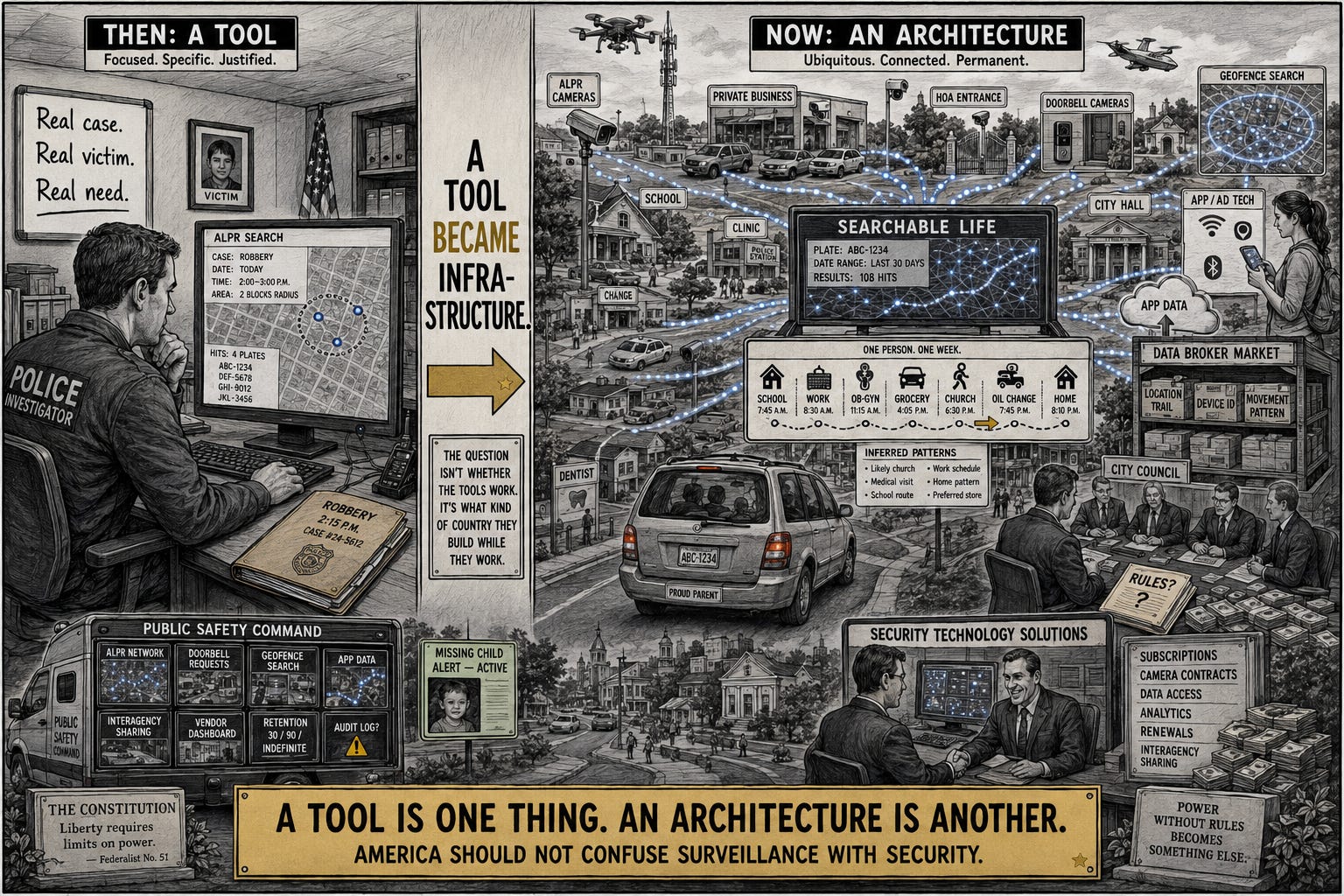
As a Detective, when I first encountered automated license plate reader technology in law enforcement, I understood the appeal.
If a crime happened in a specific place at a specific time, the tool could help investigators identify vehicles that passed nearby. It could help locate a stolen car. It could help narrow leads when there was a real case, a real victim and a real investigative need.
Used that way, the tool made sense.
But a tool is one thing.
An architecture is another.
That is the concern I cannot shake after this series.
The official series, “When Everything Becomes Searchable,” examined geofence warrants, commercial location data, private apps, ad-tech systems, data brokers, automated license plate readers and the larger constitutional question raised when ordinary life can be stored, searched, shared and reconstructed later.
This final commentary is different.
This one is personal.
I am not writing as someone who never worked cases. I am not writing as someone who thinks public safety is imaginary. I am not writing as someone who believes police should be denied lawful tools that help solve serious crimes.
I have seen why the tools are attractive.
That is part of why I am concerned about what they have become.
At the beginning, a license plate reader could feel like a focused investigative aid. A robbery happens. A shooting happens. A stolen vehicle moves through an area. A child is missing. Investigators need to know what vehicles were nearby during a specific time window.
That is not the same thing as building a searchable map of ordinary life.
What has changed is not only the camera.
It is the network around the camera.
License plate readers are no longer only a few law enforcement tools used by a few trained investigators for a few serious cases. They can sit on public roads, private businesses, neighborhood entrances, homeowners association streets and commercial properties. Private camera systems can become part of public-safety networks. Doorbell cameras can place porches, sidewalks and neighborhoods into systems where footage may be shared with law enforcement. Apps and advertising systems can collect location signals long before government ever appears. Geofence warrants can begin with a place and time, then ask which phones were nearby. Vendor platforms can package searchable information for public agencies.
Some of those uses may be lawful.
Some may be useful.
Some may help solve real crimes.
But taken together, they raise a larger question:
When did public safety tools become a domestic surveillance architecture?
That is the word that matters.
Architecture.
A camera by itself is one thing. A camera connected to a searchable database is another. A searchable database connected across agencies is another. A public system connected with private cameras, app data, vendor dashboards, location signals and long retention periods is something larger still.
At some point, the question is no longer whether a tool can help in a case.
The question is whether the country has quietly built the capacity to catalog ordinary life.
Think about the ordinary mother in a minivan.
Not a suspect.
Not a target.
Not a threat.
Just a citizen living her week.
A searchable movement system may be able to infer what church she attends, whether she changed dentists, when she last visited an OB-GYN, which grocery store she prefers, what route she takes to work, which days she works, when she is usually home, where her children go to school and when she stopped for an oil change.
Some of that information may come from public roads. Some may come from apps. Some may come from cameras. Some may come from private systems that later become available to government.
The question is not whether each individual data point looks small.
The question is what happens when all the small points become a life pattern.
That is where the old public/private distinction begins to break down. A person may drive on public roads. A person may carry a private phone. A private company may collect data. A public agency may buy access. A neighborhood may install cameras. A vendor may maintain the platform. Another agency may request access. A search may happen later.
Nobody kicks in a door.
Nobody stops the minivan.
Nobody knocks on the window.
A query is run.
A map appears.
A pattern emerges.
That does not make the power harmless.
It may make it easier to ignore.
The argument for these systems is almost always safety. Sometimes that argument is legitimate. A missing child matters. A stolen vehicle matters. A homicide investigation matters. A violent offender matters. A credible threat matters.
But surveillance is not the same thing as security.
A nation can collect enormous amounts of information about ordinary citizens and still fail to protect them wisely. It can build systems capable of reconstructing a mother’s weekly routine and still struggle with basic threat prioritization, border security, human intelligence, institutional judgment and the ordinary work of deciding where danger actually is.
More data is not the same thing as more wisdom.
More visibility is not the same thing as more safety.
More surveillance is not the same thing as freedom.
That is the uncomfortable part.
The United States has built a growing domestic surveillance ecosystem while still arguing, every year, about whether it can perform the basic duties of national security and border control. That does not mean every person crossing a border is a threat. It does not mean border security is simple. It does not mean technology has no role in national defense.
It means priorities matter.
A country should not be better at tracking ordinary citizens going to church, work, school, the doctor and the grocery store than it is at identifying and stopping actual threats.
That should trouble us.
If the purpose is safety, then the power should be focused on real danger. If the purpose is constitutional government, then the rules should be visible before the network becomes normal. If the purpose is freedom, then ordinary Americans should not have to live as searchable subjects just because technology makes it possible.
That is not anti-police.
It is not anti-security.
It is not anti-technology.
It is a warning from someone who understands why these tools were attractive in the first place.
Good police work is not supposed to be a data free-for-all. It is supposed to be focused, lawful, documented and tied to real investigative need. The best cases are not built on curiosity. They are built on facts, legal process, training, discipline and accountability.
That is why older surveillance tools came with serious rules. Intercepting communications under Title III was not treated casually. Wiretaps required legal process because listening to private communications is powerful. The law recognized that power and tried to govern it.
The same seriousness is needed now.
Location trails, searchable vehicle histories, geofence searches, app data, data-broker tools, camera networks and vendor dashboards may not feel like a wiretap. But they can reveal intimate facts about a person’s life. They can show routines, associations, habits, visits and private decisions.
A country should not require strong rules for one kind of surveillance while letting newer systems grow through contracts, default settings, private partnerships and quiet platform permissions.
That is how architecture grows.
Not through one dramatic announcement.
Not through one national vote.
Not through one law that says, “America is now searchable.”
It grows camera by camera.
Contract by contract.
App by app.
Permission by permission.
Agency by agency.
Database by database.
Then one day the public realizes the system is already built.
By then, the question becomes harder.
Not whether one tool helps.
Whether the whole architecture still fits a free country.
The United States is not China.
That is exactly why Americans should be willing to draw the line before the architecture begins to rhyme.
A free country should not wait until every street, phone, vehicle, camera and database can be searched before asking whether freedom has been reduced to permission.
The answer is not to blind law enforcement. The answer is not to ban every camera, disable every tool or pretend digital evidence has no place in modern investigations.
The answer is to govern power before power governs us.
That means real limits.
Warrants for searches that reveal patterns of life.
Court orders when the sensitivity of the data demands it.
Short retention periods.
Clear rules for outside agency access.
Public reporting.
Audit logs that are actually reviewed.
Restrictions on sensitive locations.
Disclosure when surveillance tools are used in criminal cases.
Consequences for misuse.
Local control over local data.
No private vendor terms substituting for public law.
No “trust us” where constitutional limits should be.
No quiet transformation of ordinary movement into a searchable file.
The land of the free should not require ordinary people to live as data points waiting for the right query.
That is not freedom.
It may be efficient.
It may be profitable.
It may even solve some cases.
But efficiency is not liberty. Profit is not security. And a solved case does not answer whether the system built to solve it is one a free people should accept without limits.
This is the line I come back to as a former law enforcement officer:
The question is not whether these tools can work.
The question is what kind of country they are building while they work.
If technology helps police find a missing child, recover a stolen vehicle or identify a violent offender under clear rules, good. That is a public safety use worth defending.
But if the same technology quietly builds a permanent, searchable record of ordinary citizens’ lives, then the country has not simply improved policing.
It has changed the relationship between the citizen and the state.
That should not happen by default.
It should not happen through vendor contracts.
It should not happen because the public was too busy, too confused or too tired to understand the system until it was already everywhere.
America should not confuse surveillance with security.
Security can protect freedom when it is focused, lawful, accountable and limited.
Security can crowd out freedom when it becomes invisible, permanent and searchable by default.
That is the warning.
A nation can watch its citizens closely and still fail to protect them wisely.
A free country can use powerful tools.
It cannot afford invisible power.
I am a retired detective and criminal justice / government educator based in Tennessee. I am a commentary write for Tennessee Lookout and a weekly columnist with Knox TN Today. My work examines public policy, public safety systems and civic responsibility. My reporting and commentary have also appeared in Governing, The Arizona Capitol Times, South Florida Sun Sentinel, Police1, among other state and regional outlets.


