

A Tennessee candidate disclosed China-linked investments. Here is what voters should know.


By The Redemption Project Newsroom
Civic / Government Desk
A congressional candidate’s financial disclosure has raised questions about foreign-linked investments, national-security designations and what voters should understand before evaluating a candidate’s financial interests.
The disclosure belongs to Brent Louis Taylor, a Republican state senator from Shelby County who is running for Congress in Tennessee’s 9th District. This is not Brent Taylor from East Tennessee who is running for Congress.
The filing reported three investment holdings connected to companies with China-related exposure:
Alibaba Group Holding Ltd. sponsored ADR.
Tencent Holdings Ltd. ADR.
Prosus N.V. sponsored ADR.
Each holding was reported in the value range of $1,001 to $15,000 as of the reporting period ending June 30, 2026.
The exact value cannot be determined because congressional financial disclosure forms report ranges rather than exact holdings.
The filing also does not identify whether the assets belonged specifically to Taylor, his spouse or a dependent child because ownership categories are reported under federal disclosure rules.
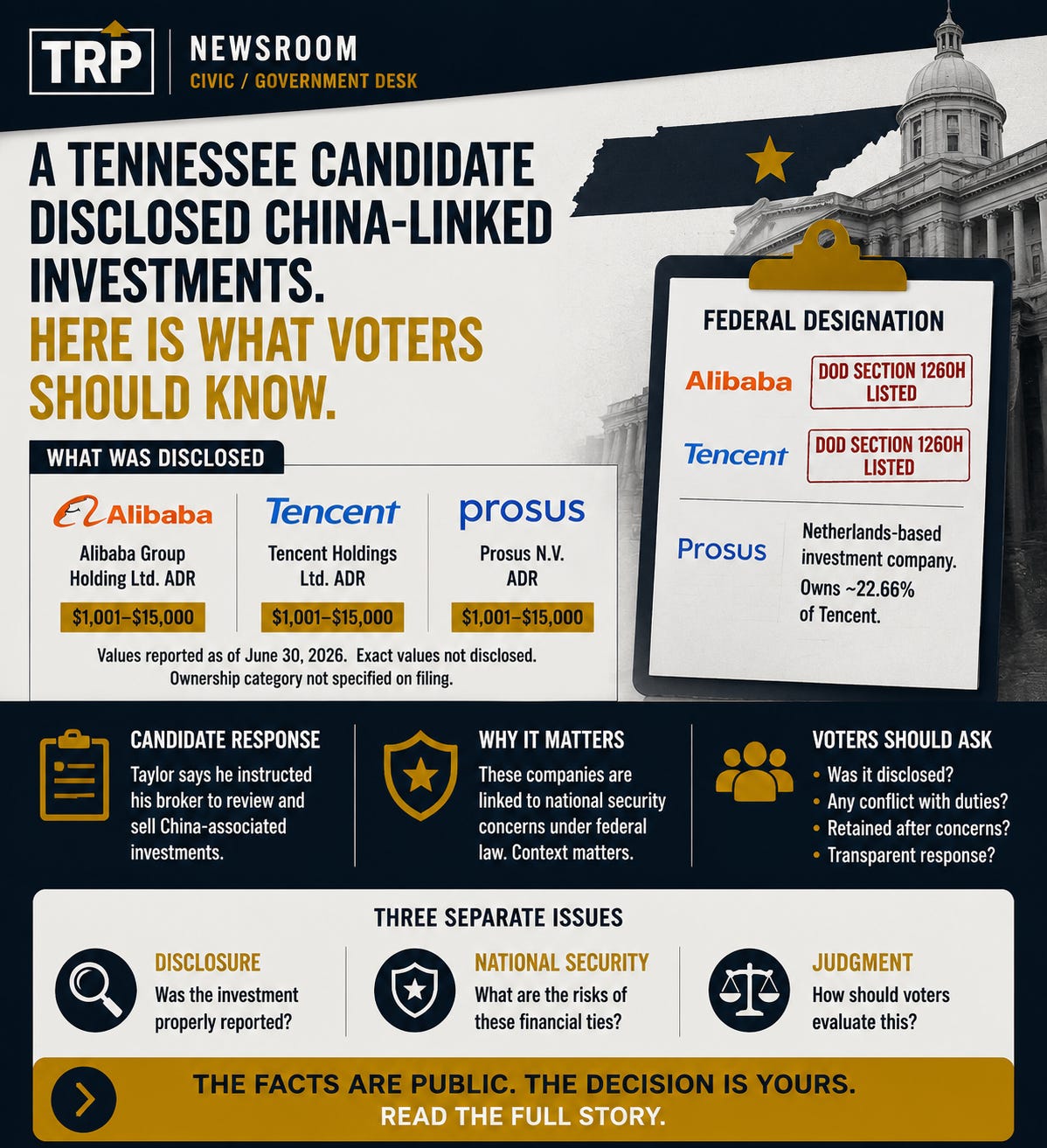
A financial disclosure shows what reportable assets exist within the household reporting structure.
It does not automatically reveal every purchase date, share count, investment decision or account detail.
The public question is not simply:
“Did this candidate own a China-linked investment?”
The better question is:
“What does that investment mean, and what should voters understand about it?”
Systems Explained: What is an ADR?
An American depositary receipt, or ADR, is a financial product that allows U.S. investors to gain exposure to a foreign company through a U.S.-traded security.
It does not necessarily mean the investor directly owns shares registered in the company’s home country.
Instead, a depositary bank manages a structure representing the investor’s economic interest.
For voters, the important question is not only:
“Is this a Chinese company?”
The better question is:
“What type of financial exposure exists, and what does it mean?”
Why the companies matter
Alibaba and Tencent are among China’s most recognizable technology companies.
Both were included on the Department of Defense’s June 2026 Section 1260H list of companies identified as Chinese military companies operating in the United States.
The designation reflects the Pentagon’s assessment under federal law that certain companies meet criteria connected to China’s military-civil fusion strategy or related national-security concerns.
It is not the same thing as a criminal finding against an investor.
It is not the same thing as a sanctions order.
It does not automatically mean every investment in the company is illegal.
Those distinctions matter.
A company designation and an individual investor’s intent are separate questions.
A person can own a publicly traded security without supporting every policy of the company, its leadership or the government of the country where the company operates.
The Prosus distinction
The third disclosed investment requires additional explanation.
Prosus N.V. is not Alibaba or Tencent.
It is a Netherlands-based investment holding company with a broad portfolio.
Prosus has reported owning approximately 22.66% of Tencent.
That means the Taylor disclosure shows direct investment exposure to Prosus, which creates indirect exposure to Tencent.
Calling it “Tencent stock” would not be precise.
Calling it completely unrelated to China would also not be accurate.
The difference matters because voters deserve the complete picture.
Taylor’s response
After questions about the holdings, Taylor said he instructed his broker to review and sell China-associated investments.
That statement establishes an instruction.
The public record reviewed for this article does not independently verify whether the transactions were completed, when they occurred or whether updated disclosure documents have been filed.
Those are separate questions.
A candidate stating an action was requested is different from a public record showing the action occurred.
Why this matters in a congressional race
Financial disclosures exist because voters have a legitimate interest in understanding potential conflicts, financial relationships and outside interests involving public officials.
At the same time, owning a publicly traded investment does not automatically establish wrongdoing.
Millions of Americans own mutual funds, retirement accounts, exchange-traded funds and other investments that may include international companies.
The public-interest questions are more specific:
Was the investment properly disclosed?
Does the investment create a conflict with official duties?
Did the candidate make decisions that benefited the investment?
Was the investment retained after concerns were raised?
Did the candidate respond transparently?
Those are accountability questions.
What voters should understand
This story involves three separate issues that should not be blended together.
First, there is the disclosure question.
Did the candidate accurately report required financial interests?
Second, there is the national-security question.
How should elected officials think about investments involving companies that the federal government has identified as security concerns?
Third, there is the judgment question.
How should voters evaluate a candidate’s financial choices when deciding whether that person represents their interests?
Different voters may answer those questions differently.
That is part of the democratic process.
The role of journalism is not to decide the conclusion.
It is to provide enough context for voters to understand the facts.
In this case, the documented fact is straightforward:
A Tennessee congressional candidate disclosed investments connected to companies with China-related exposure.
The remaining questions — about judgment, policy, conflicts and public trust — are questions voters will decide for themselves.
I am a retired detective and criminal justice / government educator based in Tennessee. I am a commentary write for Tennessee Lookout and a weekly columnist with Knox TN Today. My work examines public policy, public safety systems and civic responsibility. My reporting and commentary have also appeared in Governing, The Arizona Capitol Times, South Florida Sun Sentinel, Police1, among other state and regional outlets.

 | A guest post by
|