



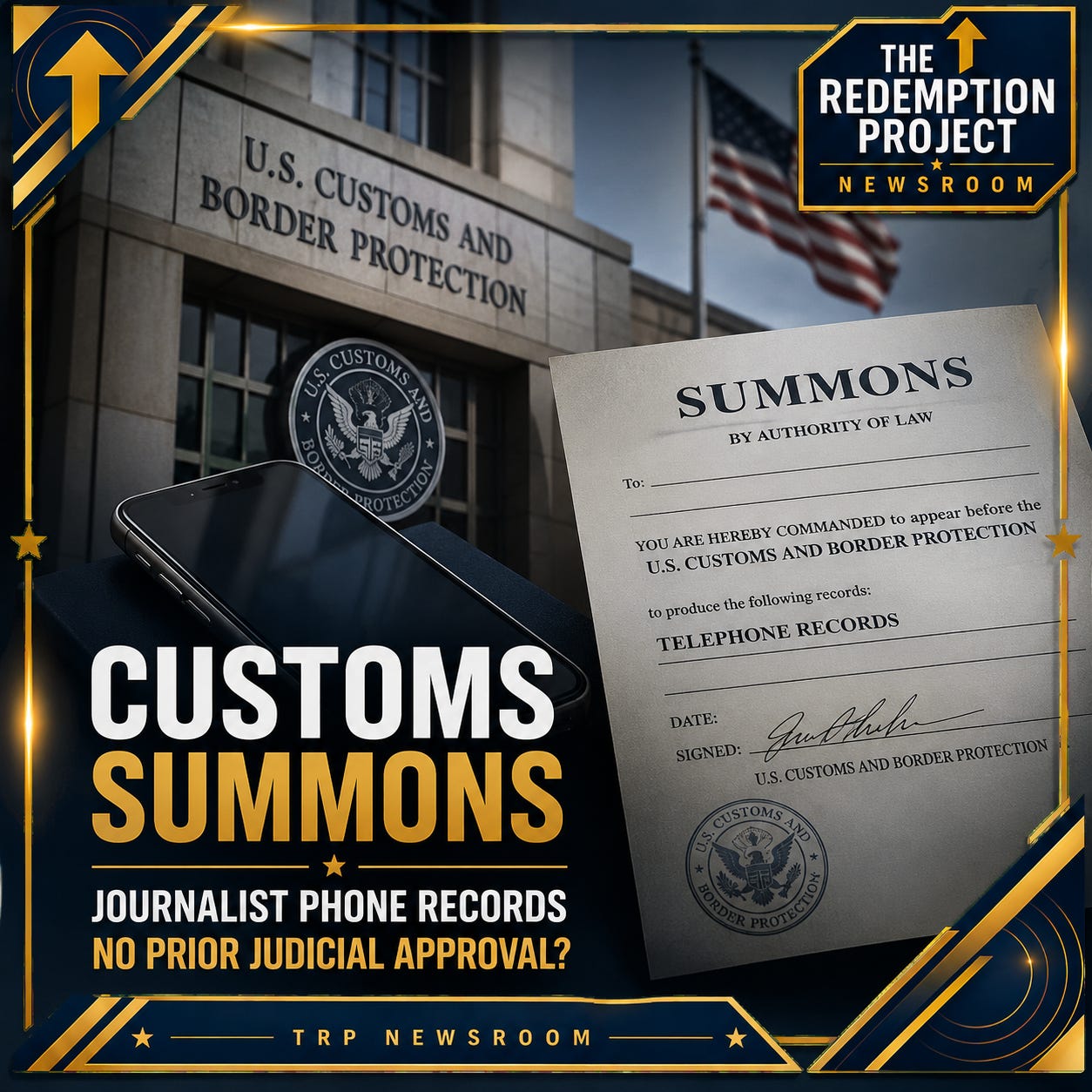
Section 1509 lets senior customs officials issue administrative summonses without first going to a judge. A recipient can refuse, forcing the government to seek enforcement in federal court. But telecom customers do not receive the statute’s special notice-and-challenge rights reserved for certain records held by customs brokers, lawyers and accountants.
By The Redemption Project Newsroom
WASHINGTON — A federal law written around customs records is drawing new scrutiny after The Guardian reported that the Department of Homeland Security used it to seek information associated with journalists, activists, labor unions and nonprofit organizations documenting or connected to immigration-enforcement activity.
The authority is 19 U.S.C. § 1509.
It is powerful in part because of what does not happen at the beginning.
No judge has to approve the summons before it is issued.
That does not mean there is no path to judicial review. If a company refuses to comply and the government wants to force production, §1510 requires the government to apply to a federal district court. After notice and a hearing, a judge can order compliance, and contempt sanctions attach if that judicial order is then disobeyed.
That distinction is essential.
A §1509 summons can begin without a judge. It does not become a court order merely because DHS issued it.
What happens before a judge ever enters the picture can depend heavily on the company receiving the demand.
T-Mobile complied. Google did not.
The Guardian reported that DHS obtained approximately six months of telephone records associated with Minneapolis journalist Georgia Fort from T-Mobile.
According to court papers reviewed by the outlet, the production included records involving more than 10,000 calls and text messages. Fort was not notified when DHS sought the records; she learned of them later when government lawyers produced the material to her attorneys.
That does not mean DHS obtained the contents of 10,000 conversations or text messages.
The reporting describes logs and communications metadata — records capable of showing connections among people, numbers, dates and communication activity. That distinction matters legally and editorially, but metadata can still be highly revealing for a journalist whose communications may expose confidential-source relationships.
The same investigation produced a different outcome when DHS went to Google.
Federal prosecutors previously sought warrants for account information associated with Fort and journalist Don Lemon’s YouTube activity. According to The Guardian’s review of the proceedings, a judge twice declined to approve the requests, finding the government had not established the required probable cause and expressing concern that the journalists should have an opportunity to challenge the demand.
DHS later served Google with a §1509 administrative summons seeking YouTube account information.
Google did not comply.
The company told DHS that the government had not shown how the requested records were connected to a customs investigation, according to documents reviewed by The Guardian.
One statute.
Two providers.
Two very different results.
The summons is not as limitless as “any other person” sounds
Section 1509 contains language that initially appears broad.
It allows the government to summon importers, exporters, employees, custodians of records and “any other person” the authorized official considers appropriate.
But that phrase does not stand alone.
The summons authority in §1509(a)(2) specifically refers to production of records “as defined in subsection (d)(1)(A).” That definition covers records required to be kept under federal customs recordkeeping law or records for which there is probable cause to believe they pertain to merchandise whose importation into the United States is prohibited.
The statute’s broader opening language also places the authority inside investigations involving entries, customs duties, fees and taxes, fines and penalties, or compliance with laws administered by the former U.S. Customs Service.
That creates the central legal dispute.
How far does the final category — laws administered by the old Customs Service — reach after the Customs Service’s investigative functions were transferred into the modern Department of Homeland Security?
The federal government and its critics do not read that question the same way.
Federal prosecutors say the authority reaches farther
The current controversy should not be presented as though DHS has no legal argument for what it is doing.
It does.
In a recent filing in federal court in Minnesota, prosecutors defended Homeland Security Investigations’ use of §1509 administrative summonses in an investigation arising from the Minnesota church protest.
The government argued that when Congress created DHS, it transferred functions of the former Customs Service into the new department and that DHS inherited investigative authority extending beyond traditional tariff and import cases. Prosecutors cited federal district-court decisions that have allowed §1509 summonses in investigations involving cybercrime and child pornography.
The filing says the summonses in that case were used for subscriber information from mobile-phone and email providers and other information defendants had conveyed to third parties. Prosecutors argued that the records did not involve communications content in which defendants had a reasonable expectation of privacy.
That is the government’s position.
It is not the only interpretation in the federal record.
DHS’s own inspector general previously warned about broader use
The Department of Homeland Security’s inspector general confronted a similar dispute in 2017.
CBP had served Twitter with a §1509 summons seeking identifying information about the anonymous @ALT_USCIS account, which criticized the government. Twitter sued, arguing that the summons exceeded CBP’s statutory authority, and CBP withdrew it before the court decided the question.
The inspector general subsequently concluded that CBP’s lack of clear guidance had produced “inconsistent — and, in some cases, improper” use of the authority.
OIG interpreted the third-party summons provisions as tied to customs records and prohibited merchandise and said the Twitter summons, which was intended to investigate possible misconduct by CBP personnel rather than merchandise or customs duties, may have exceeded the statute’s scope.
The review found something broader than a single Twitter dispute.
Between January 2015 and May 2017, CBP’s Office of Professional Responsibility had used the summons in at least 43 drug-smuggling cases, approximately 20% of all §1509 summonses the office issued during that period, even though its own operating policy expressly prohibited using the form in drug-smuggling investigations.
OIG said the data indicated CBP appeared to violate its own policy at least one out of every five times.
CBP agreed to reforms, including updated guidance, legal review and training.
The existence of those reforms does not decide whether DHS’s 2026 summonses are lawful.
It shows that the scope of this exact authority has been disputed inside DHS before.

The company can force the government into court
A §1509 summons is not self-enforcing in the way a court order is.
Section 1510 says that if the summoned person does not comply, the government may apply to a federal district court where that person resides, is found or does business. The court then provides notice and a hearing and can issue an order requiring compliance.
Only after violation of that court order does contempt become available.
That creates a significant practical checkpoint.
A company receiving a questionable summons can comply.
It can negotiate or narrow the production.
Or it can refuse to produce the records and require the government to defend the summons before a judge if the government wants compulsory enforcement.
The Guardian reported that Google took the resistant route in the Fort matter. T-Mobile produced records. The outlet also said it could not identify a case in which the government had successfully pursued §1510 judicial enforcement of a §1509 summons outside the traditional customs context.
That last point is particularly worth monitoring.
A legal authority can become enormously consequential without producing much appellate case law if companies usually comply before courts are asked to rule.
Customers do not all receive the same notice rights
Section 1509 does contain an unusually explicit customer-protection mechanism.
But Congress limited it.
For purposes of the statute’s special third-party summons procedures, a “third-party recordkeeper” is defined as a customs broker, attorney or accountant.
When the statutory conditions are satisfied, the person whose qualifying records are sought receives notice and can instruct the recordkeeper not to comply, effectively forcing the government into judicial enforcement.
A telecommunications company is not on that list.
Neither is a social-media company, bank or payment application.
That does not mean those companies are always forbidden from notifying their customers. Providers may have their own notice policies, and another statute or court order can affect what notice may be given.
It means something narrower and important:
Section 1509 itself does not give an ordinary telecom customer the same statutory notice-and-stay right it provides in qualifying summonses involving lawyers, accountants and customs brokers.
A customer therefore may not know the demand exists before the provider responds.
The reported demands reached beyond one journalist
The Guardian reported that DHS also sought YouTube-account information associated with Lemon, Democracy Now, conservative commentator Megyn Kelly, the Milwaukee Journal Sentinel and independent journalist Brendan Gutenschwager. The requested information included account-level data such as IP-address and login information rather than merely the public videos themselves.
The same investigation reportedly involved §1509 demands for financial records associated with the Sunrise Movement, the Service Employees International Union, Communications Workers of America and Venmo records connected to Voices for Racial Justice.
The Guardian reported that those organizations had not themselves been criminally charged.
TRP has not independently obtained every underlying summons described in that reporting.
Those examples therefore remain attributed to The Guardian and the court records it reviewed.
That distinction should remain visible as this story develops.
DOJ has special rules for journalists. They do not automatically answer the DHS question.
The Justice Department maintains a separate set of protections for obtaining information from journalists.
The current version of 28 C.F.R. §50.10 was revised in 2025. DOJ says compulsory legal process aimed at newsgathering is an extraordinary investigative measure and imposes enhanced authorization, necessity, narrowness and notice requirements in covered circumstances.
The regulation expressly covers DOJ use of subpoenas and specified court orders to obtain a journalist’s communications or business records from third parties, as well as warrants targeting a journalist’s property or communications records. Attorney General authorization is generally required for covered demands connected to lawful newsgathering, subject to defined exceptions.
But §50.10 is a Justice Department policy and regulation governing members of DOJ.
A summons issued administratively by DHS is not automatically converted into DOJ process merely because the person whose records are sought is a journalist.
That creates a more precise accountability question than the first draft posed.
Did DOJ personnel participate in, approve or advise on a particular §1509 demand? If DHS later asks DOJ attorneys to enforce the summons under §1510, what news-media review occurs then? Were prosecutors aware that journalists’ records were implicated? And if other DOJ process was used in the same investigation, which §50.10 approvals or notice provisions applied?
The current federal regulation also says its protections do not create a privately enforceable legal right against the government.
That does not make the policy meaningless.
It makes the approval trail a reporting target.
Phone metadata can expose more than a phone number
A records summons is not a warrant to enter a journalist’s home, search a laptop or seize a telephone.
The distinction should remain clear.
So should another one.
Communications content and communications metadata are not the same thing.
A call log does not reveal what two people said. But six months of records showing which numbers communicated, when, how frequently and in what sequence can expose relationships that a journalist or confidential source never intended to reveal.
DOJ’s own news-media regulation recognizes that telephone connection records and similar source-and-destination information can be communications records relevant to newsgathering.
For a newsroom, that makes notice especially important.
By the time a journalist discovers records have already been produced, the source network may already be visible to investigators.
Tennessee providers and newsrooms have questions to answer
The immediate Tennessee story is not that DHS has been proved to use §1509 against a Tennessee journalist.
TRP has not established that.
The Tennessee relevance is preventative and measurable.
Major telecommunications, technology and financial providers serving Tennesseans can be asked whether their transparency reports separately identify §1509 demands, whether they treat them as administrative summonses or subpoenas, how frequently they challenge them, whether they require a demonstrated statutory nexus and under what circumstances customers receive notice.
News organizations also should know what happens if one of those notices arrives.
A reporter or newsroom should preserve the demand, provider correspondence and any accompanying nondisclosure language; identify which accounts and time periods are involved; evaluate source exposure; involve counsel quickly; and determine whether a provider has already produced records or is waiting for a response.
That is not advice to obstruct a lawful investigation.
It is ordinary institutional preparation for a legal tool whose first stage may occur without a judge and without the journalist knowing about it.
The most consequential decision may be made before a courthouse ever becomes involved.
T-Mobile produced Fort’s records.
Google demanded a better legal explanation and did not.
The power of §1509 therefore depends not only on what the government believes the statute permits, but on what the company holding the records is willing to make the government prove.
Behind the Reporting: What Section 1509 Actually Says — and Where the Legal Fight Begins
Paid subscribers get the statutory audit, competing federal interpretations, journalist-notice analysis, 2017 inspector-general history, records plan and provider questions behind this report.
The first correction: “any other person” does not mean “any record”
The broadest phrase in §1509 is easy to quote.
